By Jeff Daum, Ph.D., PPA
Product & Technology Analyst
Those of you who follow my blog might recall that I ended my initial article on Aptera Motors Corp.1 saying “This is hopefully Part 1 of a multipart Aptera review. Stay tuned for Part 2: a factory visit and first drive…” I just returned from Aptera’s production facility and while I did not get the opportunity to drive the Aptera, I did enjoy a ride in a preproduction unit.

My focus here will be on what I’ve learned and not to go over the points discussed in my initial article (link in footnote) other than to reiterate my full transparency statement: I was so impressed with the Aptera, its cutting-edge technology and dual CEO team direction and commitment, that I have placed and received confirmation of a pre order future variant all-wheel drive Aptera.
Our tour- my wife accompanied me being highly curious about the Aptera and why I was excited about it- was facilitated by Will Jarrett from Aptera’s Marketing department. Aptera Motors intended production facility in Carlsbad California is a bright open space building of approximately 77,000 square feet.


While the formal visitor tour set up is still being developed, parts of it are currently in place including:
- A preproduction version with the same body shape as the production version, but with a clear glass rear hatch instead of solar panels
- The front-end light unit from the supplier with its classic smile look
- A complete body shell
- A full frame
- An AGV robot of the type that will be used to automatically move the assembly components around the production line
- Various solar panels for different sections of the Aptera, all designed and made in-house
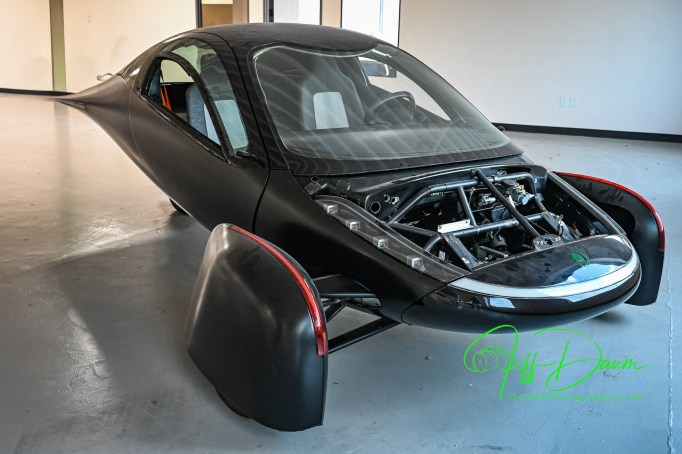
- An earlier version Aptera in striking matt black
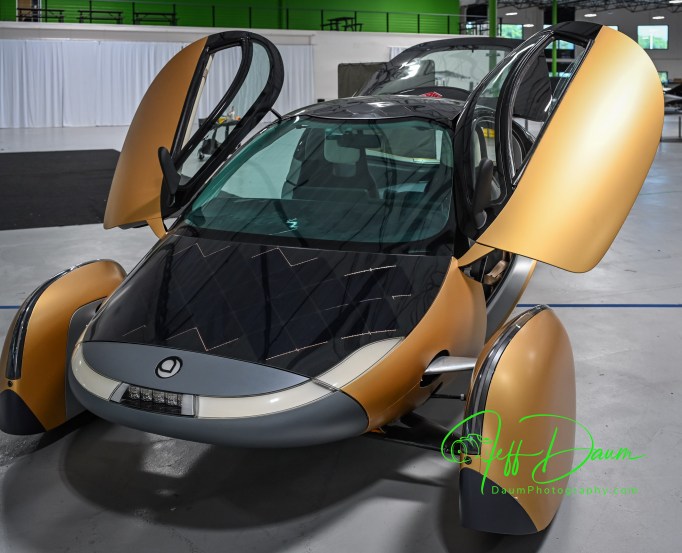
- Gold colored Gamma version
- More solar panels including those being sold to other companies for non-Aptera applications
- A pneumatic ‘gun’ for firing pellets at the solar panels for testing durability
- Aptera bodies with nearly complete interior components
- A video simulation showing the 14 or so stations that the assembly line will progress through on the AGVs
Not included in the tour were areas of the facility that housed testing rooms, subassembly rooms, etc.
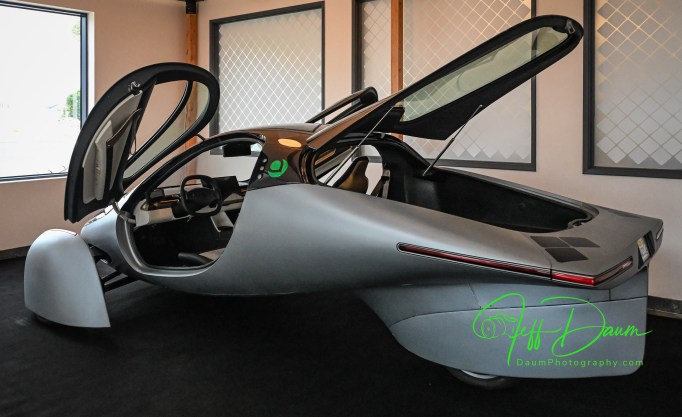
As we walked through the facility, Will explained what we were looking at and responded to my questions. Here is a summary of our discussions. The extremely low coefficient of drag body is manufactured in Modena Italy by the C.P.C. Group and is a combination of Carbon Fiber Sheet Molding Compound and Glass Sheet Molding Compound and shipped over as a unit. Amongst its advantages are the significant strength to low weight ratio and that it has only six structural pieces compared to the hundreds that are used in most cars. The Aptera safety cage is modeled after Formula 1 cars!

It sits on a custom metallic chassis that is also made in Italy by the Costamp Group, located right next to C.P.C.
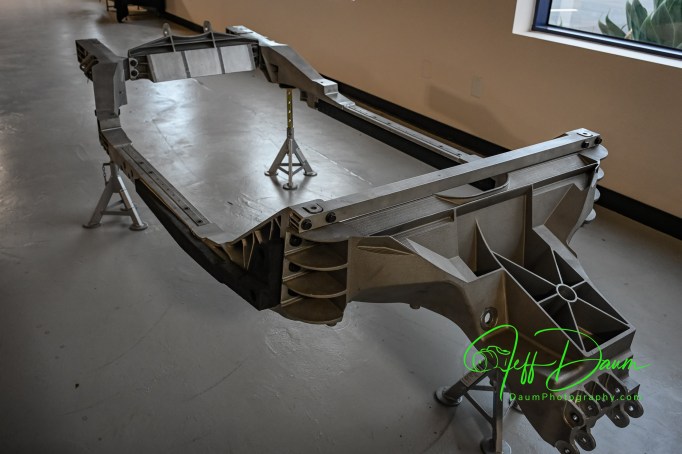

The components and Apteras as they are being assembled will be moved around the 14 stations of the production line on AGVs that follow the blue line that can be seen on the facility floor. The advantage of this AGV technology is flexibility over fixed production lines. If something happens with one of the AGVs it can be pushed aside and the line will continue to operate.

The cars will be primarily assembled by people, assisted by automation where practical. After the low-volume production phase, the objective is to produce 20,000 Apteras in this facility per year.

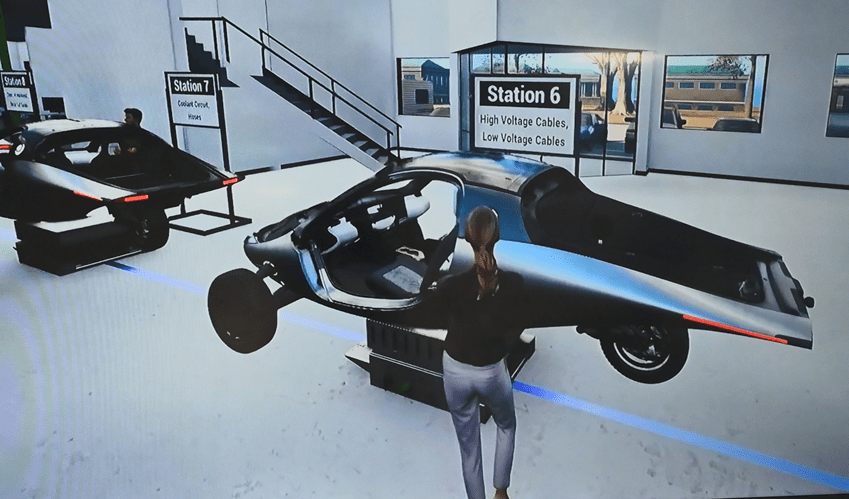

[above three images are screen shots from Aptera’s Media Simulated Production Line video]
The battery assembly will be done in house. 40 KWh unit will provide a 400-mile range. They will be using LG batteries.
The solar panels are designed and patented by Aptera’s team. They have also started licensing the technology to others for alternative applications. Amazingly they are bendable and have a glass surface similar to Gorilla Glass (as used in smartphones). They can withstand direct hits without breaking. The design allows for the panels to be replaced if necessary postproduction. For example, if a section gets damaged, or down the road the efficiency of the solar panels improves so much that it might make sense to swap the older ones out.

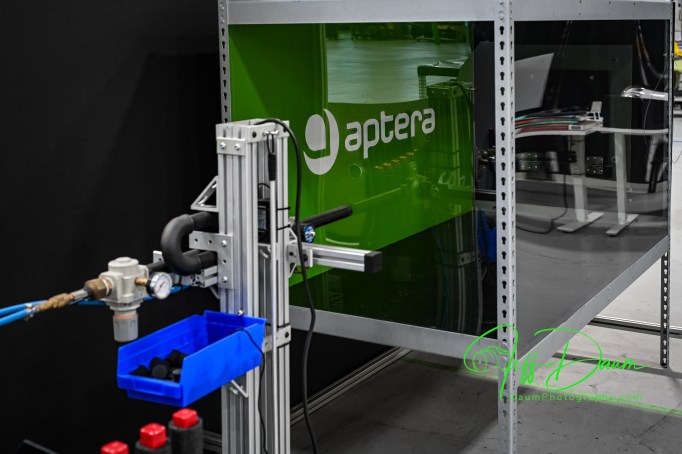
The production versions will have a solid trunk lid without glass and be covered with solar panels and use a camera for an unobstructed comprehensive rear view in a center mounted electronic rear view mirror (similar to the one used in the new Corvette for example). The side mirrors are combination of mirrors and cameras. The mirrors are required to follow existing US NHTSA law. The cameras show clear views of both sides of the Aptera on two screens directly behind the steering wheel.
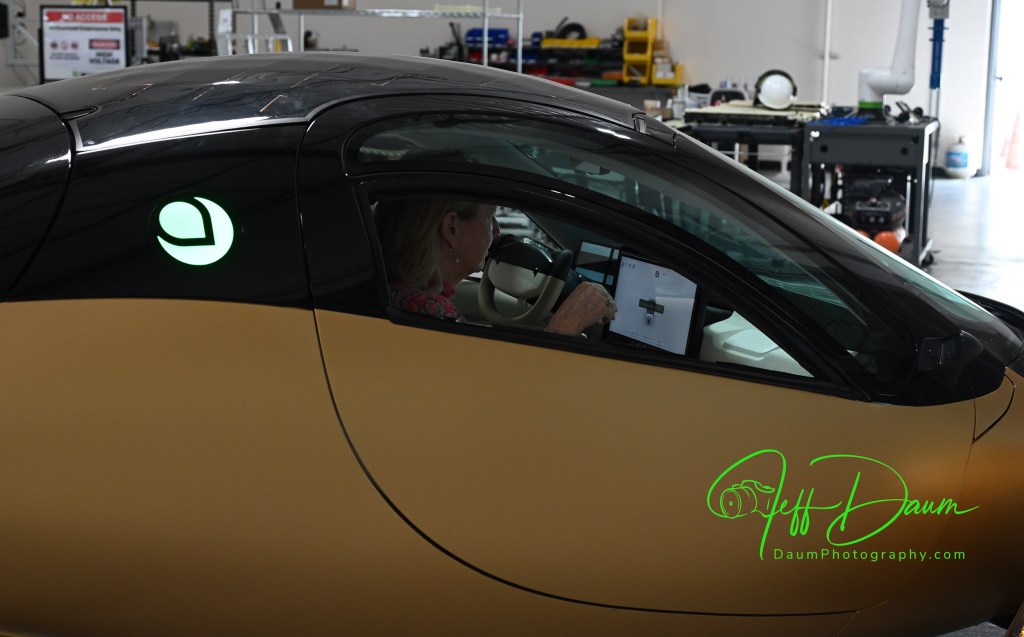
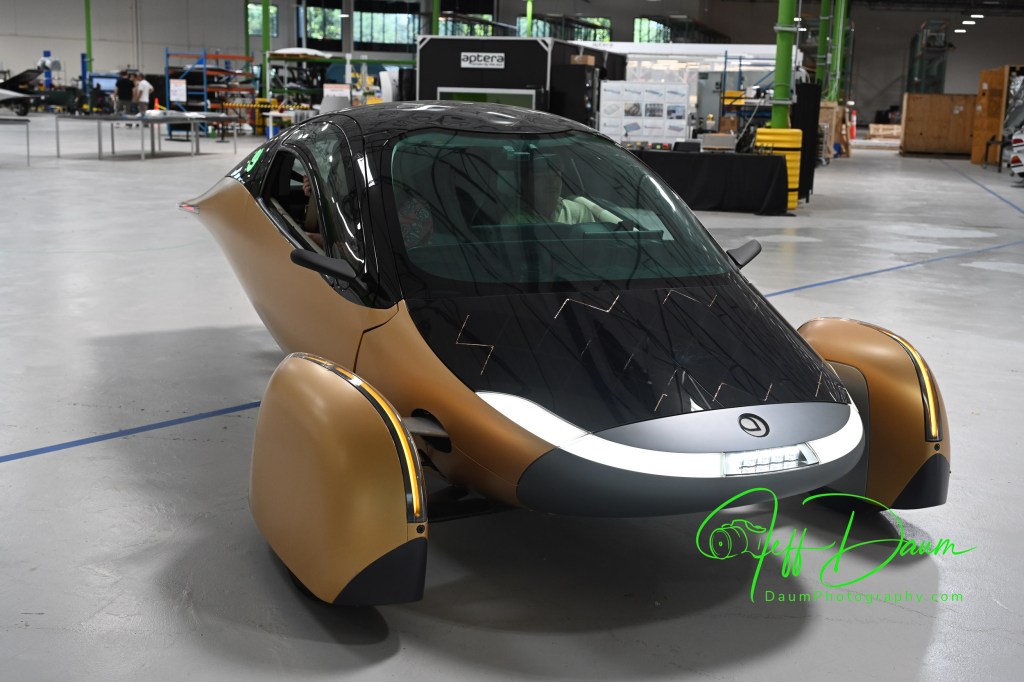
The gold unit “Gamma” in the following image is the most recent prototype, though they now have Production Validation versions. This is the one we rode in.


The silver unit is a current Production Validation Aptera called Artemis and is the one that they did the extended Route 66 trip.

There are a few additional things that Will pointed out. They have built-in fail-safe backups like having buttons behind the large central screen that will allow you to continue to drive the Aptera if the screen fails.
The trunk lid is designed to open part way without flying up so that if you have a low ceiling you don’t have to worry about it hitting it. You manually open the lid the rest of the way.
There are plans to have several options for the battery pack beyond the standard 400-mile range, including a 250-mile range, 600-mile range and 1000-mile range. Also having a Level 2 Autonomous driving option.
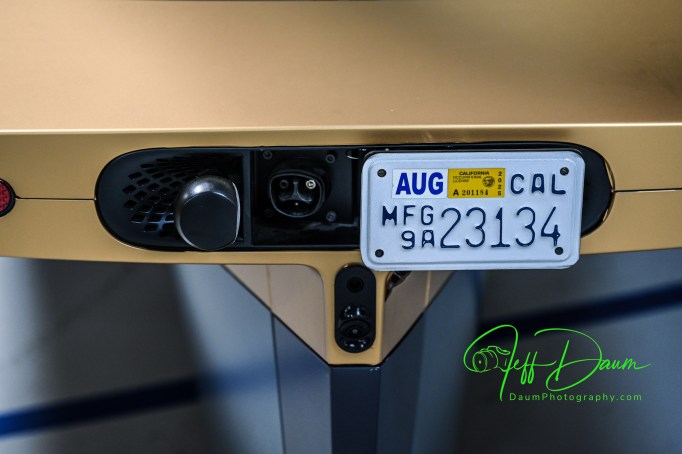
In the image above, you can see the North American Charging Standard (NACS) port located behind the license plate which slides to the side providing access
While Will is not permitted to discuss the status of funding he said once sufficient capital is obtained it will be about nine months until the first production vehicles are finished and out the door.

My thoughts following the tour and ride
Having driven several all-electric vehicles from different OEMs and currently owning one, I’ve come to expect lots of torque and rapid acceleration from an EV and Aptera doesn’t disappoint. What I did not expect was that Aptera, a three-wheeler, would feel so rock solid through turns at speed.
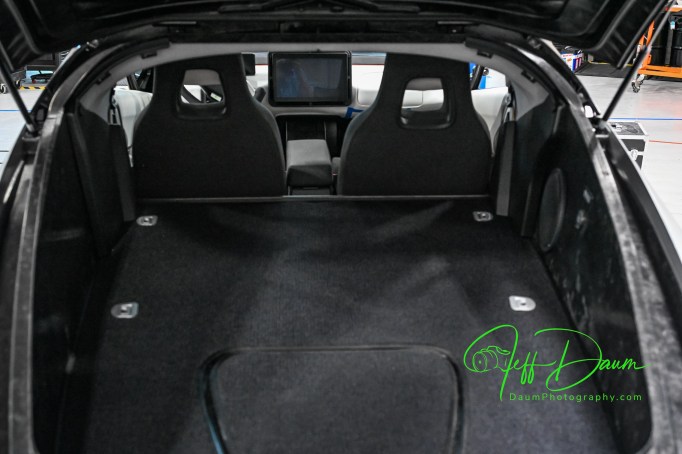
The interior is roomy and comfortable, feeling for example very comparable to my Corvette Stingray Coupe (but Aptera has more headroom) with a surprising amount of usable space behind the seats.
Visibility looking out is very good and supplemented by an electronic rearview central mirror as well as electronic side views on two screens directly in the driver line of sight.
Aptera has lots of ‘coolness factors’ including its slipstream shape, knock on the body to open doors and trunk (no outside handles) and the solar recharging.
I am left with two concerns at this point: One is a driving practicality issue and the other is whether Aptera will achieve financial fluidity to realize their objectives.
What I mean by driving practicality comes down to how the two “outrigger” front wheel units will survive in real world situations. They are quite wide at approximately 88” across when the wheels are straight and wider when turned off center. This width is further compounded by the fact that the tops of the wheel units are low with respect to the Aptera body. That wheel unit to wheel unit width is greater than many cars and even small trucks on the road today.
Here is why I think this may be a concern: If you backed your Aptera in the center of a typical parking spot in a parking garage, the slot often is only 9 feet or less wide, which leaves about 10 inches or less between the edge of your wheel unit and the edge of the next parking slot. If a car, or worse a truck, then goes to back in next to you and turns in rather than pulling straight in, what are the odds that they will only glance at the body of your Aptera and not see the outrigger front wheels? Since the Aptera front wheels contain also the driving motors if they get brushed or hit the damage could be considerable. Will the wheel units need some sort of pop-up flag or indicator to ensure they are seen and avoided when parked?
This width will also require drivers to maintain better vigilance regarding staying in the center of their lane and not straying on the road compared to driving other vehicles.
Regarding Aptera Motors Corp. viability I did some research on their current financial Issues. Based on Aptera’s August 27, 2025, Form S-1 filing for listing on NASDAQ here is their estimate of funding still needed for production: “Our production plan for our Carlsbad facility is phased and each phase is contingent upon a specific level of funding. The initial “low-volume” production phase is estimated to require approximately $65 million in capital to fund remaining necessary tooling and validation programs. Following the initiation of low-volume production, a second phase to ramp to high-volume production would require an estimated additional $140-$160 million. This high-volume rate, which we project to be approximately 20,000 vehicles per year at our current facility’s maximum capacity, was a figure determined in consultation with Munro & Associates, a firm specializing in lean manufacturing principles for the automotive industry.”
“Specifically, securing the capital estimated for both initial low-volume and subsequent high-volume production phases is critical. Until this funding is secured, the Company will be unable to predict if and when production will commence.”
Hopefully the listing on NASDAQ and subsequent offers will go well (and rapidly) for Aptera- I am so looking forward to having one in my garage!
P.S., My wife really enjoyed her ride and was impressed with the Aptera 😊.
Marques Brownlee has just posted an informative video based on his driving a preproduction Aptera. You can view it at https://www.youtube.com/watch?v=2OvyyVxQjuI He raises some excellent points.
Stay tuned for my next Aptera update! Thanks for visiting and reading. If you have a question or comment, please feel free to enter it below!







 Insight - Daum Photography