By Jeff Daum, Ph.D., PPA and IP (Itinerant Photojournalist)

As an itinerant photojournalist I believe Annie Leibovitz said it best “I wish that all of nature’s magnificence, the emotion of the land, the living energy of place could be photographed.”
Some of you know my wife and I are enthusiastic globe-trotters and have had the good fortune to visit more than one hundred countries. Part of our motivation to travel has always been to see new flora, and wildlife, and to experience cultures that are different from our own. Unfortunately, some might not be around in the future for a variety of reasons.
We just returned from a trip to observe the Polar Bears[1] just outside of Churchill Manitoba along the Hudson Bay in the southern part of the Arctic Circle. It was truly an amazing experience seeing these Ursus maritimus (literally ‘Maritime Bears’ because they spend so much time in the sea or sea ice), which are the largest land carnivores, in their milieu. The males are generally between 550 to 1700 pounds and are eight to ten feet while the females are between 200 and 700 pounds at six to eight feet.
Though they are carnivores eating primarily the Ringed seals they catch in the sea ice, they also eat grasses and berries. But I am getting ahead of myself- how did we get here?
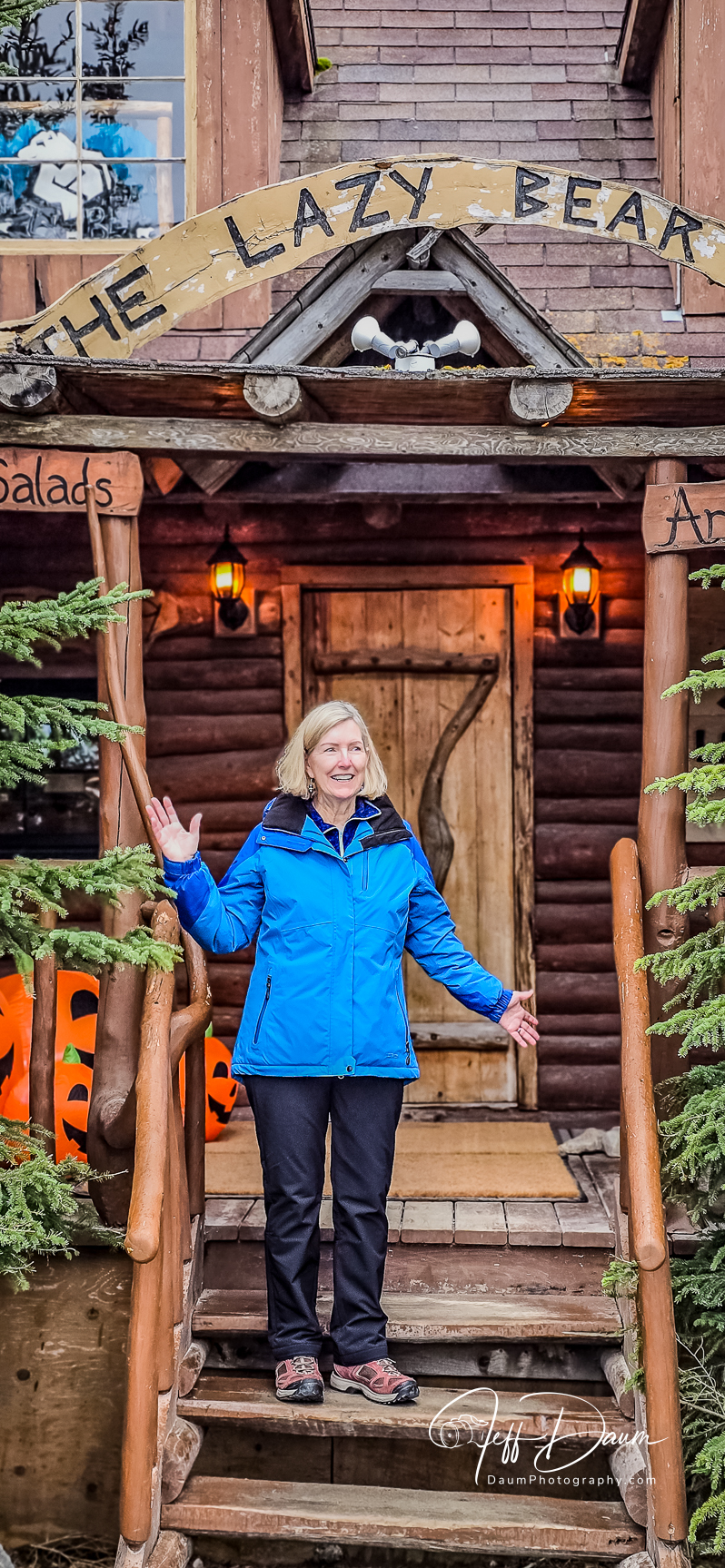
This adventure was part of a small group Tauck Tour, who made all the arrangements including flying us from Winnipeg to Churchill Manitoba, staying at the Lazy Bear Lodge, engaging a local naturalist guide and providing excursions on Lazy Bear’s custom Arctic Crawler™ Tundra vehicles.
The exploration began with checking into the Lazy Bear Lodge. The real log cabin Lodge was built by owner Wally Daudrich from reclaimed trees, taking him over a decade to complete. Wally’s son Deacon served as our highly knowledgeable and most congenial naturalist guide and Arctic Crawler™ Tundra vehicle driver.

[1] Commonly called Arctic Polar Bears, but since they only occur in the Arctic, they are properly called Polar Bears. Their scientific name is Ursus maritimus.
Following check-in, we headed out of Churchill to board the custom-built Lazy Bear Arctic Crawler™ Tundra vehicle. It is enormous: about forty-seven feet long, eleven- and one-half feet wide, over thirteen feet tall with nearly six feet high tires and wheels, tipping the scales at twenty-one tons! The large tires help distribute the weight to minimize damage to the tundra. We ‘crawled’ at maybe four or five miles per hour out to Hudson Bay. At this time of year, Polar Bears typically amble about until the bay freezes and they can go out onto the ice to hunt and feed. The Bears congregate at this point around the Bay because it is the first area to freeze and the Ringed seals have a pupping nursery area not far offshore. Unfortunately, because of climate change, the bay is freezing later each year. It used to freeze in September, but now it was not cold enough even at the beginning of November.

We searched for quite a while before seeing a Polar Bear, and when we did it was in the distance near the shoreline. Since darkness was setting in, we headed back to the lodge. I was a bit disappointed but clearly understood these Bears operate on their own schedule and there is no guarantee.
The next morning, we headed off again in the Arctic Crawler™ Tundra vehicle accompanied by a beautiful sunrise.

Shortly thereafter we spotted a Polar Bear again near the shore. Apparently we were more interesting than his search for seaweed or grass to eat and he started to amble over toward our vehicle. Because of their size, they don’t appear to be moving very fast, but in fact with his large stride he covered about a quarter of a mile (ok, since he was in Canada, he covered about 0.40 kilometers 😊) in just a few minutes.


He appeared to be curious about our vehicle, and particularly the corner red marker flags. After carefully studying it, he stood up and swiped one of the flags. He examined it and decided to leave it on the ground. Once the Polar Bear walked away, Deacon carefully climbed down and retrieved the flag, so as not to leave it in the protected area.


As the day progressed, more Polar Bears appeared. Most were by themselves, but several ended up joining one another. In those cases, there were displays of jostling and sparing. This included pushing, cuffing and some biting. But in no case did one Bear hurt the other or drew blood. These interactions could last ten to fifteen minutes, and a couple of times forty-five or more minutes. The longer sessions typically had ‘breaks’ where one Bear would walk a short distance away, or both would lay down next to each other, before resuming the tousling.


Based on what I observed, along with talking to our local guide, and to renown polar bear expert Matthias Breiter, they are highly curious, basically gentle giants. They do not roar even when jostling. Polar Bears don’t normally attack people but do go after opportunistic food caches and because of these present problems around towns.
Females will aggressively defend their cubs who tend to stay very close to the mother for two to three years. However, they will not interfere with the cubs if they are fighting one another.
Polar Bears are frequently misunderstood, often the result of being portrayed as growling ferocious bears in movies, and they are needlessly shot and killed.

This Polar Bear is looking across the bay hoping for ice as the sun is rising.
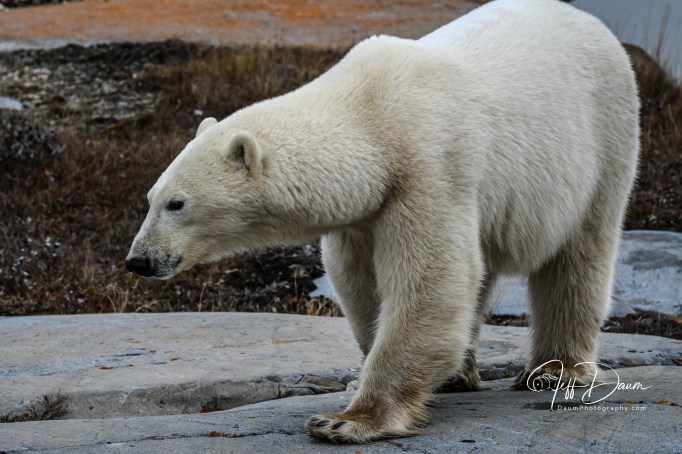
Just ambling along, possibly drooling thinking about seals.

Making sure his nails look good.

Jostling to assess one’s skills.
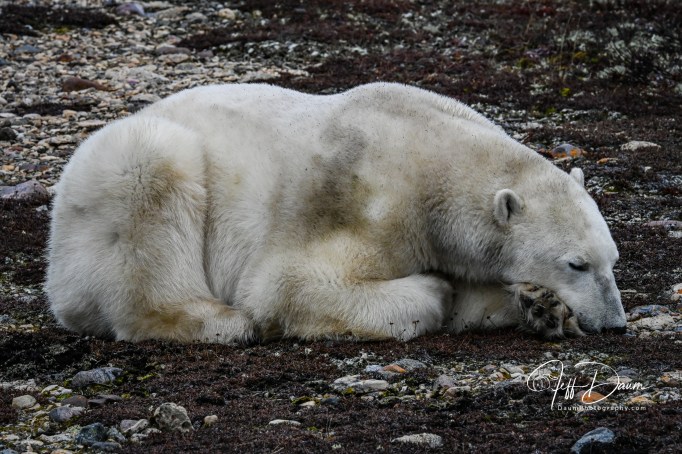
Just resting.

Not all Arctic Polar Bears are white.

Coming to get a closer look at me.
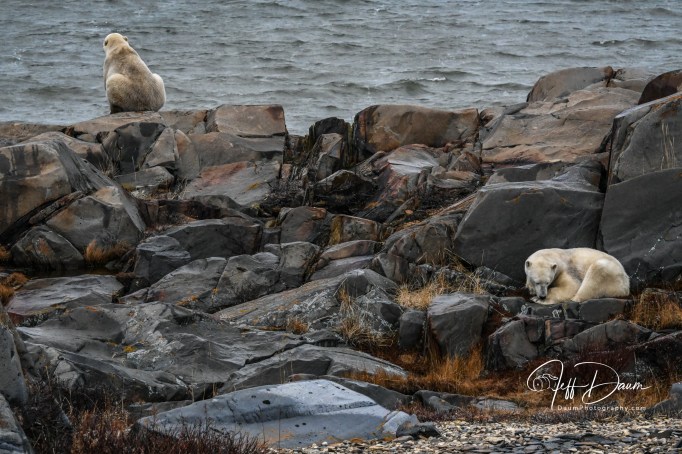
At the end of day, once again checking for ice.
The following day our Deacon took us to different part in the Churchill Wildlife Management area[2] of Hudson Bay and we were fortunate to see a number of Polar Bears. Additionally, we were treated to hawks, Willow Ptarmigans, ducks, Grouse and other birds. While we did not see any Arctic Foxes (theorized to be disappearing because of the impact of global warming here) we did see one Red or Cross Fox, and several Arctic Hares.

[2] This is a limited access permit only area designed to protect and preserve the Polar Bears natural habitat.
We did not come upon mothers and their cubs any day until the third day, when the sun was setting and we were heading back on a road near the forest. At that point a female with one cub pretty much hidden by the trees, were spotted heading back into the woods.
Our last day in Churchill we were treated to a visit with renowned dog musher, “Big Dog” David Daley. He shared an overview of dog sledding, care, treatment and training of the dogs. Then we were off for an invigorating sled ride for the IDIDAMILE (not to be confused with the Iditarod). But that story is for another time…

For a teaser of the dog sled ride see https://youtu.be/uTvFXeF5PEA
Additional Bare Facts about (Polar) Bears 😊 primarily from Matthias Breiter[3]
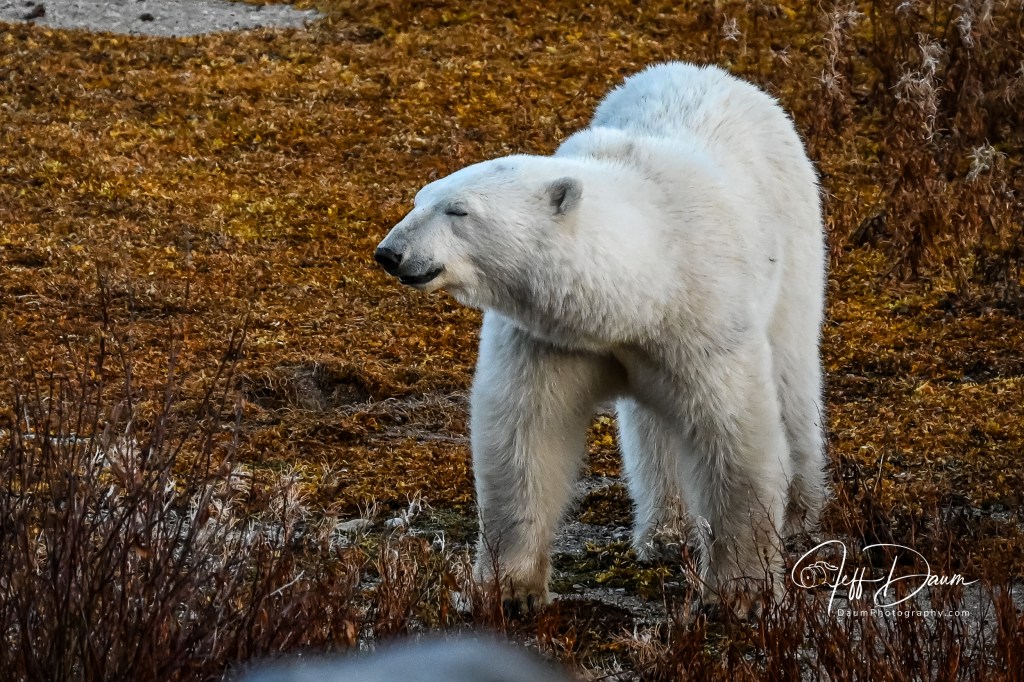
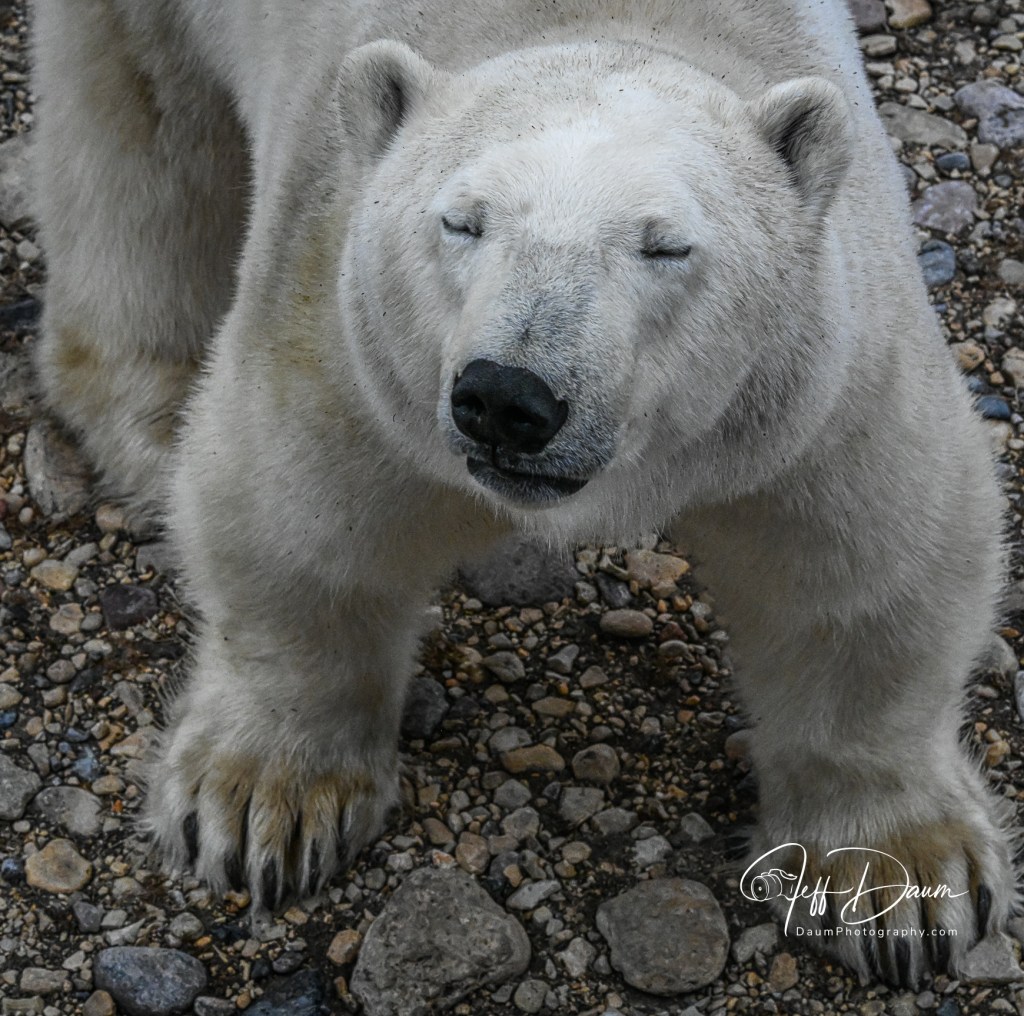
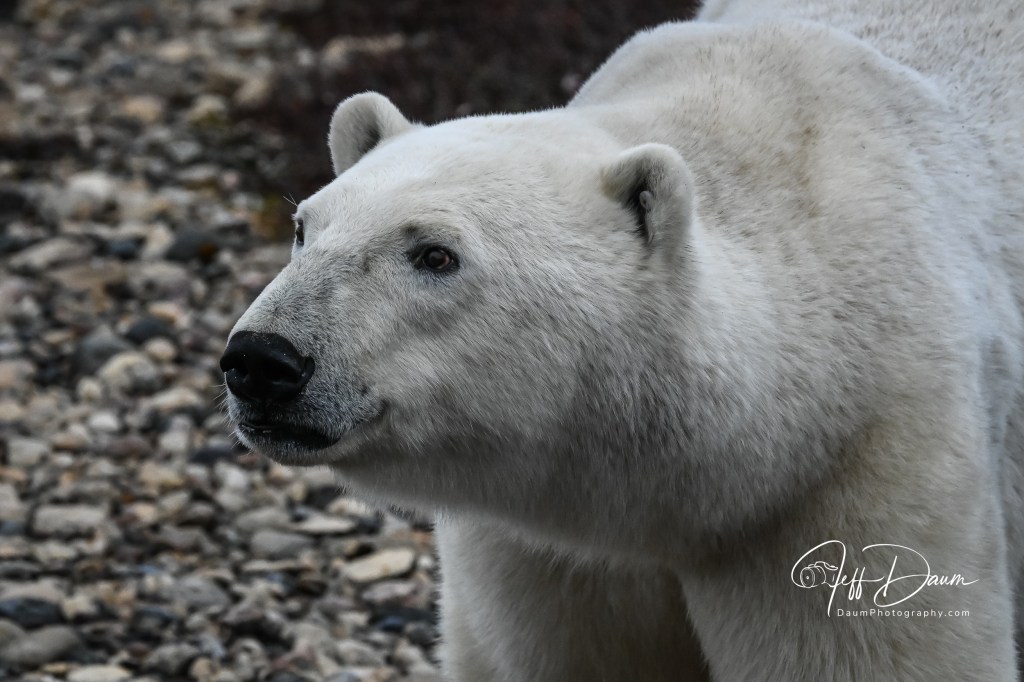
- Polar bears often close their eyes when walking. They are not sleeping, however. Rather, they are focusing on their most advanced ability, their sense of smell. They have an articulated nose. The enlarged nasal cavity is a heat exchange chamber. It helps heat cold air on inhale and cool down on exhale. You won’t see a plume of moisture when they exhale even in below zero temperature and this helps prevent dehydration resulting from breathing.
[3] From a talk and discussion Matthias Breiter had with our Tauck group
- They don’t have to pee to get rid of amino acids like we do, because they are able to recycle amino acids.
- Tag or tags in ears means the bear has been caught around town and detained in bear “jail.”
- Life span is fifteen to eighteen years, though some have lived over thirty years.
- World population is estimated at 25,000 living in the circumpolar arctic region.
- Mid-November to end of July they are out on the sea ice hunting seals.
- Polar bears typically mate from March to May.
- Pregnant females go to the dens in the forest in early October and typically give birth to cubs in late November or December, returning with the cub(s) to the sea ice in February or March. The average litter size is 2.1 cubs. If they have three, one is a runt and typically won’t make it to be a Yearling. They don’t go into the dens until there is snow on the ground. There are about 600 dens under the tree roots and they are very stable. They are reused. About 300 of the dens are active.
- While males do wander the females stay close to and return to the area where they were born.
- Healthy females can live off their fat for nine months without eating. They only lose about five percent of their muscle mass in hibernation. In bears, muscle mass and the rebuilding of the mass is separate from the actual use of the muscles. During hibernation they drop their metabolic rate by half.
- Their big paws help distribute their weight and enable them to be exceeding good and very fast swimmers.
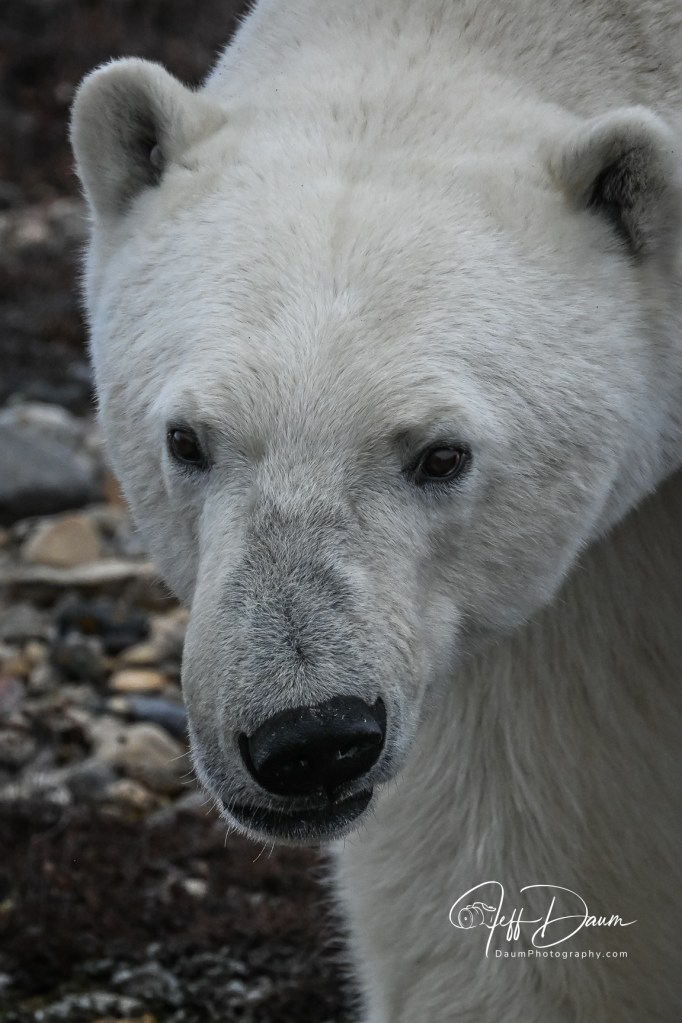
- While appearing for the most part as white, the Polar Bears actually have black skin. However, their fur is composed of hollow transparent hairs that bounce the sunlight around scattering the full spectrum resulting in luminescence and reflecting back as white.
- The big problem they have is thermal regulation and overheating. If you scanned them with an infrared camera you would hardly see any indication of heat because of their subcutaneous fat layer and insulating fur. The only places that they can dissipate heat are their arm and leg pits. They will prostrate themselves on the snow or ice to cool down after a sprint or chase.
- Polar bears are social, typically by gender. Aggression is rare, except as noted with females protecting their cubs.
- The biggest problem is that polar bears get shot needlessly in defense of property around the town by people who don’t understand how to control bears. If you run from them, they may chase after you. Movement toward the bear will normally cause them to back up.
- Polar bears basically gain all the weight they need in six weeks to two-month period. They then maintain that weight or lose a little for the rest of the year.
- However, without the sea ice and the seal pups there would not be any polar bears surviving. Now unfortunately the ice isn’t forming as early as it used to. Sometimes you don’t have sufficient ice until December. In the past, the ice formed in September.
- When he Matthias started working in Hudson Bay there were around 1600 polar bears, now there are 612.
For the camera enthusiasts: All images were taken with either a Nikon Z7ii using a Nikkor Z Zoom S 100-400 mm lens handheld or a Nikon Z7 with a Nikkor Z Zoom S 24-124 mm lens. The Nikons were carried using a Blackrapid double or single straps system. To ensure I always had enough power, I started each day with five fully charged batteries. I did not run into any issues with the cold affecting my equipment. The real challenge was holding the camera and lens steady while out on the observation deck due to high the crosswinds.
A few parting shots (pun intended):
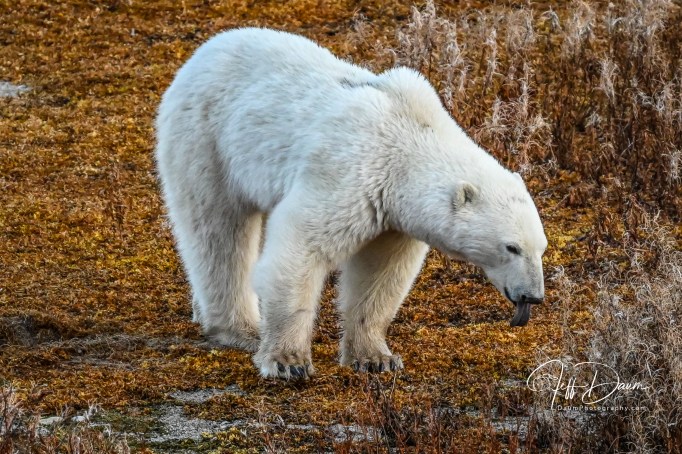


In sum, we would say this Polar Bear experience was right up there with our Gorilla Trek (in the Bwindi Impenetrable Forrest) in terms of unique encounters with the awe-inspiring magnificence of Mother Nature.
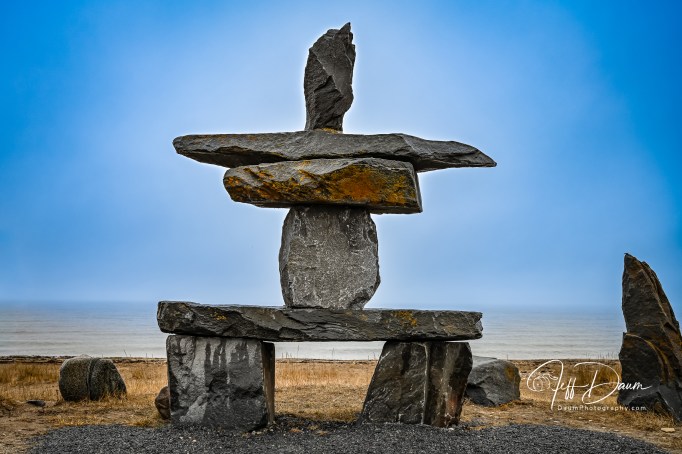
If you would like to see my full gallery of Polar Bears click on https://www.daumphotography.com/Nature-Images/Arctic-Polar-Bears
Thanks for joining me on this adventure! Please feel free to leave comments and/or questions below.














 Insight - Daum Photography