By Jeff Daum, Ph.D., PPA
This is an initial look at the Aptera all electric solar vehicle presented at the 2025 CES (Consumer Electronics Show) in Las Vegas, Nevada.
Let me begin with a full transparency statement: I was so impressed with the Aptera, its cutting-edge technology and dual CEO team direction and commitment, that I have placed and received confirmation of a pre-order future variant all-wheel drive Aptera.
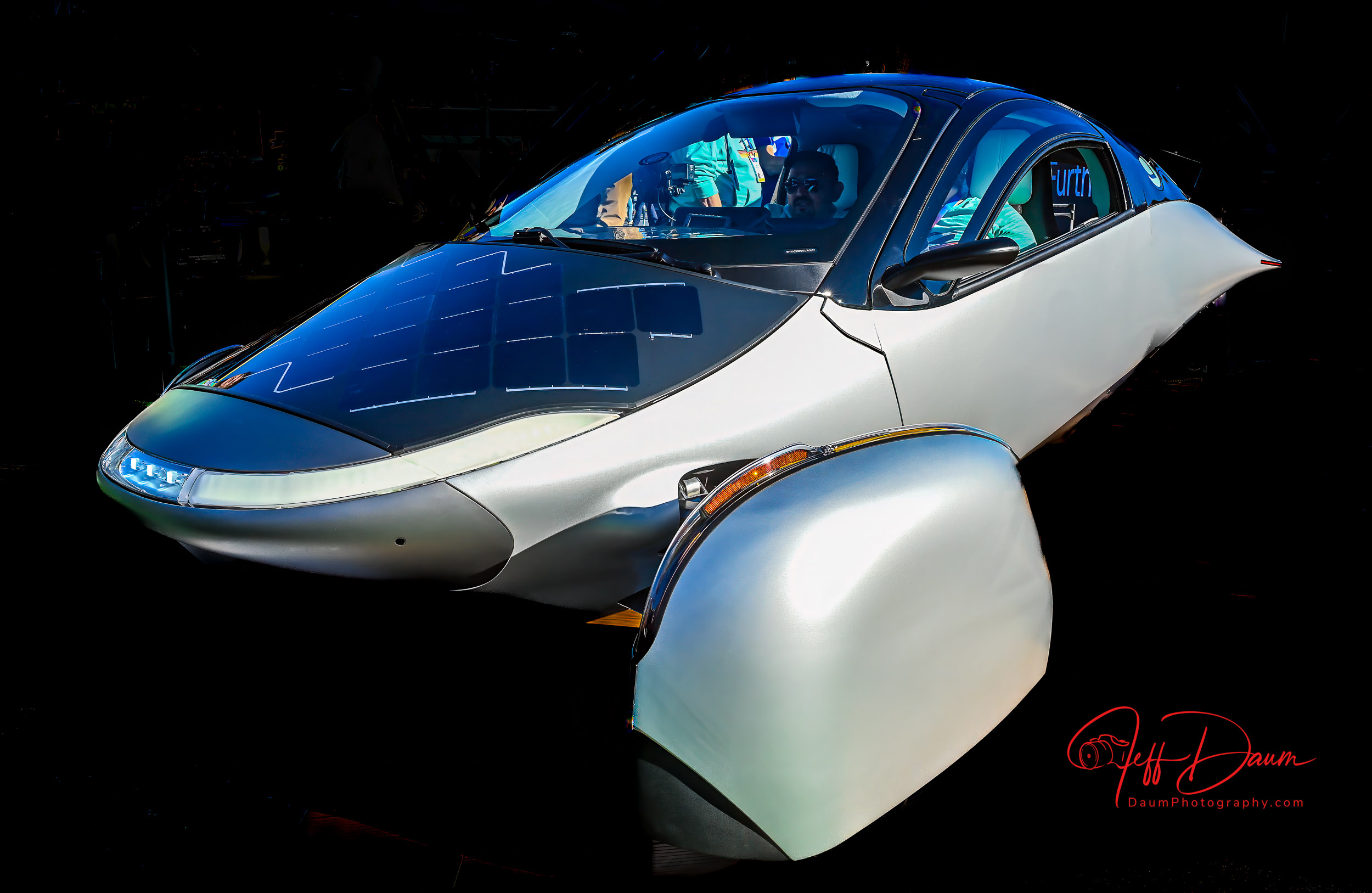
The first thing that you notice is its unique aerodynamic shape. In fact, because of this shape it has the lowest coefficient of drag of any road vehicle at approximately 0.15! The body was designed in concert with Pininfarina and is out of carbon fiber. It is manufactured in Italy and shipped to Aptera Motors facilities in Carlsbad, California.
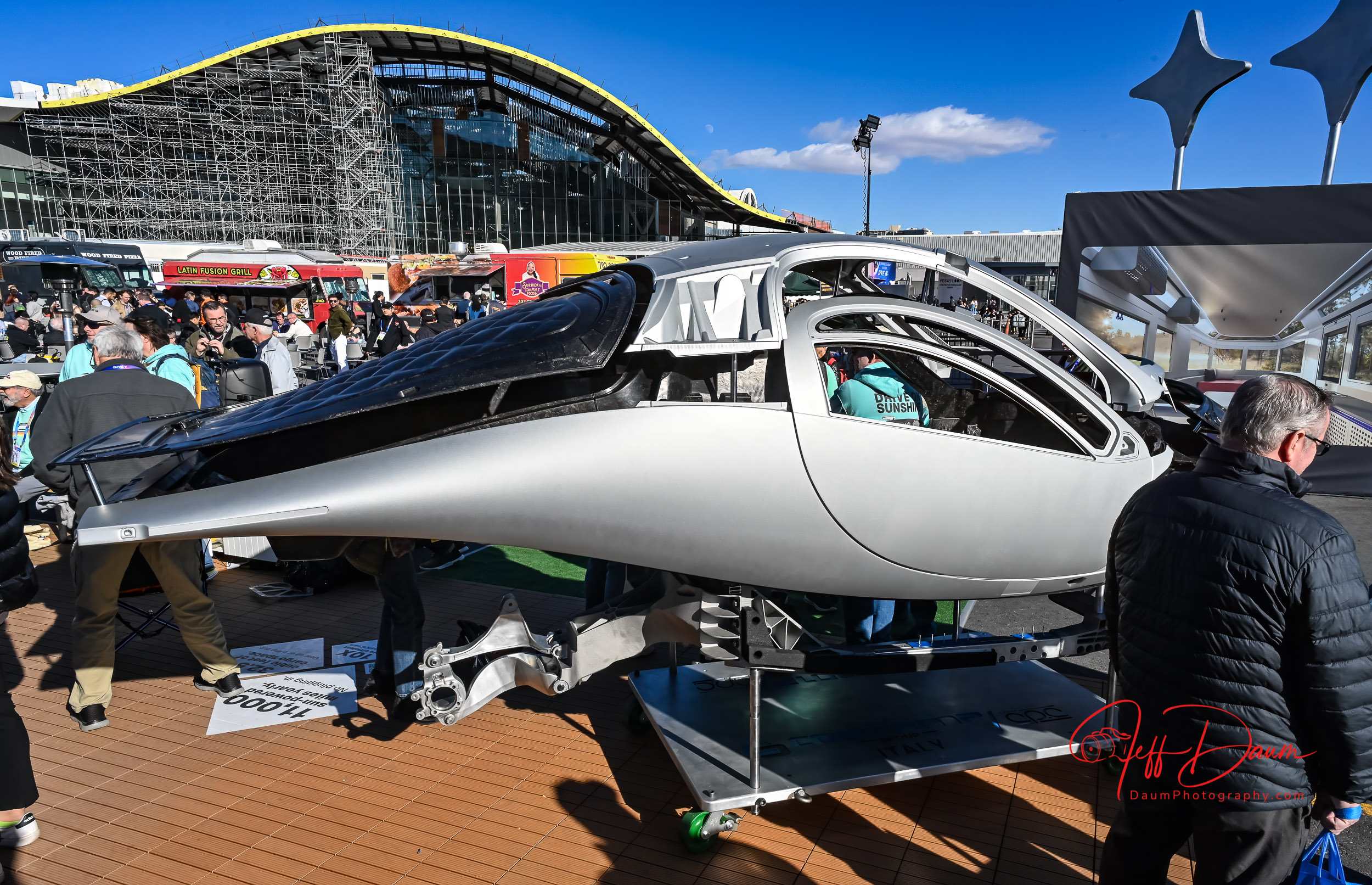
Probably the next thing you will notice is that Aptera has two front wheels and one rear wheel- an autocycle. It is classified by the DMV as a motorcycle, specifically a Trike with full enclosure. This means that it is registered as a motorcycle but you will not need a motorcycle driver’s license nor need a helmet.


Like most sports cars, the interior includes side-by-side two passenger seating. It has all the normal accouterments: safety belts, frontal driver and passenger air bags, a steering wheel, accelerator and brake pedals, ac and heat, etc. In front of the steering wheel is a horizontal screen that continually shows full views of the right and left side of the Aptera virtually eliminating any blind spots. To the right of the steering wheel is the infotainment and information display. The electronic rearview mirror shows the unobstructed view behind the Aptera (from a camera on the roof). There is also a backup camera located adjacent to the license plate. The plate holder slides to the side, revealing the NACS charging receptor.

Aptera has bespoke solar cells on the hood, dash and roof capable of generating 700 watts of electricity. Each cell is incredibly thin, lightweight and glass covered yet capable of being bent to conform to the respective body shape. According to their website details, an individual cell could be cracked yet continue to generate power because of its unique wiring.
While I was at CES, one of the two Production Intent Vehicles was driven for 25 miles on the streets around Las Vegas. The solar cells generated and put back into the batteries the equivalent of 29 miles of electricity! Wait, what? Yes, it generated more power than it used. Of course it can be plugged in to recharge its batteries. Plugging into a regular 110-volt outlet will put approximately 150 miles of energy into the batteries overnight. It can also use Level 2 chargers which will put approximately 60 miles of energy into the batteries per hour or a DC fast charger can put approximately 500 miles of energy into the batteries in an hour. The Aptera recharges in about one fourth of the time of other EVs.
According to Aptera’s website, “the Launch Edition uses 21700 NMC 811 cylindrical lithium-ion cells, known for their high energy density and long life. The 44 kWh battery pack contains 2,304 cells, delivering 400 miles of range.” [ https://aptera.us/article/what-batteries-are-inside-aptera/ ]
I had the pleasure of talking with Chris Anthony, Founder and CEO Aptera Motors.

Chris’ partner, Steve Fabro, also carries the title of Founder and CEO.

I started off asking Chris about Aptera’s design elements to ensure safety, Here are highlights from this interview:
- Regarding Aptera’s safety: Able to do things with carbon fiber that steel and aluminum vehicles can’t do. Able to add protection such as great frontal impact strategies, offset frontal, side impact. Crash energy is diverted from the passenger area downwards to the well protected battery and frame. Aptera has front and rear crumple zones. Aptera has front and rear crumple zones and a carbon fiber roll bar.

- Suspension dynamics: even though it is a three-wheel vehicle, because the heavy battery is mounted so low, it has almost the exact same suspension dynamics as a VW Golf.
- Done lots of track testing and skid pad stuff, curb strike angles at forty-five miles per hour, pothole tests every which way you can think of with the vehicle, and because the battery weight is so low it is extremely stable.
- We will be running Crash Tests shortly.
- It has better ground clearance than a Honda Civic with six inches to the belly and five and one-quarter inches to the wheel pans, and ingress and egress a couple of degrees better than the Honda Civic.
- Regarding stability, especially with the large area by the rear wheel, it has a low-profile mid-section. We have simulated cross winds up to 115 mph and it performs better than other vehicles because flat sided vehicles are much more susceptible to the winds. There is no float created because it is basically a downforce vehicle that creates a bit of downforce, though we attempted to keep it as neutral as possible.
- The tires are 195-55 R16 low rolling resistance, specially formulated for them by Hankook Tires.
- The ABS and airbags (passenger and driver frontal airbags) are currently undergoing calibration.
- It has DC Fast Charge, Level 2 and regular 110 outlet capability. The 110-volt outlet will provide 150 miles charge overnight. The Aptera uses one quarter the energy of the average EV, meaning we charge four times faster. A DC Fast Charger will put 500 miles an hour into it, a Level 2 will put 60 miles per hour and a regular outlet will put 13 miles an hour into it.
- Currently we have more than 50,000 preorders from across 115 countries, had the largest Crowd Funding in the industry with 20,000 individual investors, and now working on an IPO and hope to have production vehicles in people’s hands by the end of the year.
- No dealerships, but have distribution centers around the world, and working with some Tribal communities in states that don’t like the lack of dealerships similar to what Tesla does.
- In sum, the Aptiva is much more akin to a formula one car than anything else on the road. It is the penultimate in aerodynamic efficiency and has a carbon fiber chassis through and through. It is an interesting mix to try an be the most efficient vehicle in the world but also have really extreme performance, when you look at the how the vehicle is constructed and how we achieve 100-watt hours per mile and still keep safety paramount, and get all the solar power out of it we need. The Aptera is the most efficient vehicle in the world but still sporty and very nimble.
Some addition information from the Aptera website https://aptera.us/ :
- the core of our design is a safety cell crafted from Carbon Fiber Sheet Molding Compound (CF-SMC), which is both ultra-lightweight and stronger than steel, paired with metallic subframes that absorb impact energy.

- Aptera’s body features a specialized composite structure known as Body in Carbon (BinC), primarily constructed from Carbon Fiber Sheet Molding Compound (CF-SMC) and Glass Sheet Molding Compound (SMC). CF-SMC is a lightweight material that utilizes a random arrangement of short fibers, allowing for the creation of intricately shaped parts with significantly higher stiffness and strength compared to standard SMC.
- Aptera features an unequal-length dual wishbone suspension in the front and a double trailing link suspension in the rear. This advanced suspension system provides a balanced combination of stability, control, and ride comfort, allowing for smooth handling across diverse terrains.
- The largest single component is the carbon fiber tub.
- Use of SMC side panels on the body that won’t dent when hit.
- Front wheel covers rotate up to allow access to tire valve stem and rear tire has a small access hole for the same purpose.
- At Aptera, we’re redefining the repair experience by making it accessible, straightforward, and affordable. Whether you’re repairing your vehicle yourself or working with a local shop, Aptera will provide detailed documentation and make spare parts easy to order. Unlike typical processes where maintenance information and parts access can be limited, we believe in empowering owners with everything they need to keep their vehicles in top condition.
- The Launch Edition’s dimensions are optimized for aerodynamics and stability. The vehicle measures 15 feet (4.56 m) in length, 7.3 feet (2.22 meters) in width, and stands 4.6 feet (1.4 meters) high, with a wheelbase of 9.2 feet (2.82 meters).
- Aptera has integrated the Vitesco Technologies’ EMR3 drivetrain—a high-voltage axle drive that combines a permanent-magnet synchronous e-motor, inverter, and reducer in one compact unit.
Final thoughts:
I had a chance to sit in the Production Intent Aptera and found the seats very comfortable. The interior is airy with great outward visibility. The ‘double knock’ to open the door or trunk is a fun twist- there are no outside door handles. The trunk is quite spacious, easily carrying two regular golf bags or even, apparently, with the seats folded forward, room to lie down if you take the Aptera camping. There is also a small compartment under the regular rear floor that can be used to store charging cables or other supplies.


I am particularly impressed with Chris and Steve’s vision and approach. They are continually striving to use their own and their team’s knowledge, seek and use outstanding third party input and resources, and harness AI to refine the Aptera to be highly efficient, practical and fun. The use of Open-Source Software and Right To Repair sets the Aptera apart.
Of course, the ‘elephant in the room’ question, unanswered at this point is whether Aptera will make it where many others have failed. Their concept appears sound, the technology is there, Production Intent Vehicles validated, but the financial green light is still pending. According to Scooter Doll writing for electrek on Nov 5, 2024: “Last we heard, Aptera had raised over $135 million from over 17,000 investors, which the startup touted as the most successful crowdfunding raise in history. However, the company shared that it would need another $60 million in additional funding to begin low-volume SEV production, now slotted for late 2025.”
This is hopefully Part 1 of a multipart Aptera review. Stay tuned for Part 2: a factory visit and first drive…
Thanks for visiting and reading. What are your thoughts on the Aptera? If you have a question or comment, please feel free to enter it below!
 Insight - Daum Photography