Sometimes we don’t need to look any further than outside one’s back door to experience the wonders of nature. This series- High Drama– capture the amazing natural blaze of colors in the Nevada sky.




Probably the best way to start is to use CES’ clever one word campaign that defines CES 2017: Whoa!
Having spent 5+ days trying to take it all in, and by all I mean over 3,800 exhibiting companies, across several Las Vegas resort locations and the LV Convention Center, and is the largest event of its kind, I have to agree Whoa! best describes it.
If you are not familiar with CES, it used to be known as the Consumer Electronics Show, and now is called CES: the global consumer electronics and consumer technology trade show. While the new official name isn’t as ‘catchy’ as the original one, it is more accurate. Exhibitors and buyers from 150 plus countries attend, network, and place orders for this year’s hottest tech.
Additionally, it serves as a platform for the top experts in related fields and industries to come to share ideas and learn from one another. While it is not open to the public, it has a massive attendance- over 175,000 this year, along with a large media presence to get the word out.
CES 2017 covered a broad range of technology and its impact on:
The focus of this blog is one slice of CES 2017 which, in my opinion, will ultimately impact virtually everyone- that of Autonomous Vehicles. From my perspective, it truly reflects the synthesis and status of the technology found across most of the areas in the bullet list above.
Is it a car that can drive down the road by itself like a Tesla, or one that can park itself like a Toyota, or brake itself to avoid collision like a Cadillac, or is it reserved for something more like depicted in the 1960s series the Jetsons?

At CES 2017 there were numerous autonomous vehicles in all shapes and sizes.


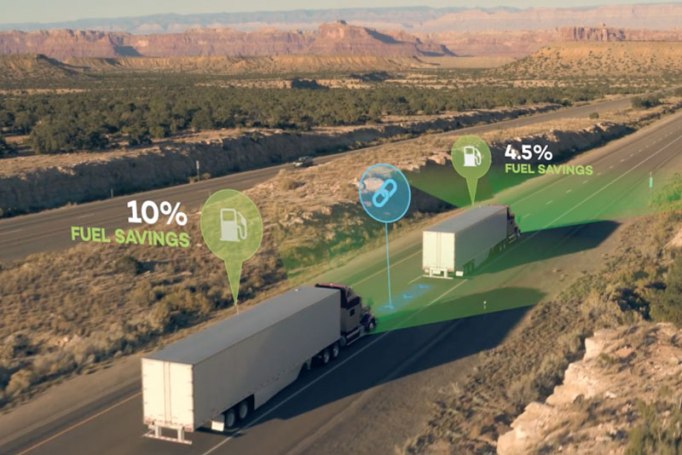
And there were even semi-autonomous trucks demonstrating platooning technology, where they are able to travel in a caravan fashion saving fuel and driver effort.
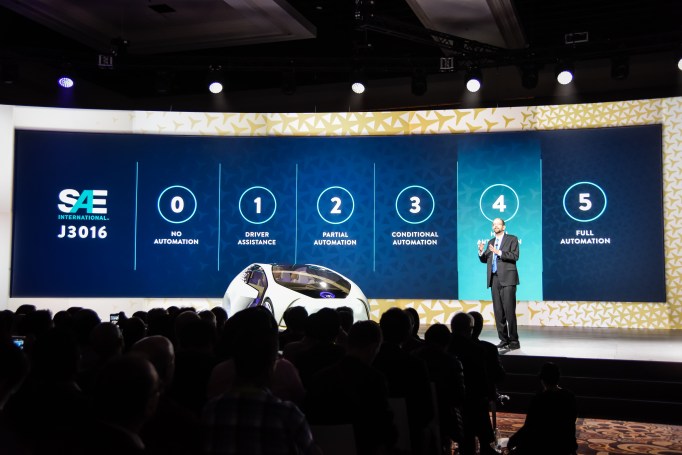
SAE has developed the most broadly accepted definition of the levels of driving automation. As seen on the accompanying chart, they have described five levels ranging from ‘no automation’ through ‘full automation.’ Most important is the transition role (responsibilities) between the human and the ‘system.’ The biggest shift is between levels 2 and 3, where the responsibility for monitoring the driving environment shifts from the person to the system. The role of the human becomes one of back-up to the automated driving system. Of course, this shift in responsibility is one of the thorniest and most complex components of the process.
Among the top reasons to move towards automation level 3, 4 or ultimately 5, include anticipated significant reductions in vehicular deaths; reduction in congestion; reduction in pollution; facilitated transport of individuals unable to or who should not be driving (too old, infirm, disabled, too young, under medically induced or other impairment).
For example, there are approximately 32,000 automotive related deaths per year. NHTSA has estimated that between 90 and 94% of those are due to human error. Further, the economic cost is c. $242 billion and societal harm c $836 billion. Automated drive systems, whether as low as SAE level 2 on upwards to 5, is expected to significantly reduce deaths due to human error. Most agree it is reasonable to expect automation to quickly reduce the automotive related deaths easily by half or more.
Damien Riehl (a technology lawyer with a background in legal software design) summed up the critical advantages of the ‘hand-off’ from human to machine: “Computers do not share human drivers’ foibles: They cannot be inebriated, they don’t text, and they don’t fall asleep. Automated-driving systems can also have super-human qualities: 360–degree vision; 100 percent alert time; constant communication with the road, traffic lights, and other cars; “sight” through fog and darkness; and universal, system-wide routing for traffic-flow optimization. Computers react faster: Humans’ reaction time is approximately 1.5 seconds, while computers’ reaction times are measured in milliseconds (and, per Moore’s Law, improving exponentially). [ from the Bench & Bar of Minnesota, the official publication of the Minnesota State Bar Association; Riehl Oct. 4, 2016]
Another significant advantage of moving towards autonomous vehicles comes from the necessary connectivity in each vehicle. Autonomous vehicles will need to be able to ‘communicate’ with other vehicles on the same road, the environmental variables such as traffic lights, weather, flow, etc. This critical inter-connectivity will enable aggregated, and most cases, instantaneous learning by the vehicle’s system. Much like we see today in applications such as WAZE and LIVE, where we as drivers hear of traffic issues, police actions, etc. in near real time, and they can choose to act upon such information, that is learn from it, or ignore it. But of course, the difference is that autonomous vehicles will be programmed with algorithms to instantaneously incorporate the new information and take appropriate corrective actions. For example, if an autonomous vehicle is driving along a road where there is a traffic accident or construction, it would send the information to other autonomous vehicles further back on the same route, resulting in a seamless rerouting. This built in collective and incremental learning will mean that the more the autonomous vehicles drive, the more of them on the road with vehicle-to-vehicle and vehicle-to-environs instant and continuous connections, the more efficient and expeditious each will become.
Potential applications abound (many you probably have heard about) including driverless pick up via Uber/Lyft; calling your own car to pick you up and drop you off; driverless public transportation like Olli; platooning of freight hauling trucks, etc. Autonomous vehicles also open up new modes of transportation, such as the hyperloop. For example, Hyperloop One is being built north of Las Vegas, Nevada as a proof of concept. Here in their own words is an explanation: “The Hyperloop is a new way to move people or things anywhere in the world quickly, safely, efficiently, on-demand and with minimal impact to the environment. The system accelerates a passenger or cargo vehicle through a steel tube in a near-vacuum using that linear electric motor. The autonomous vehicles glide comfortably at faster-than-airline speeds over long distances due to the extremely low aerodynamic drag and non-contact levitation. There’s no direct emissions, noise, delay, weather concerns nor pilot error. “[By Bruce Upbin, VP Strategic Communications, Hyperloop One]. Ultimately the vision for hyperloop is to have direct connections (non-stop) between cities, with hubs where either you could drive your car or take an autonomous car to the hub. At the hub you would drive onto an autonomous platform, be in a small grouping of platforms going to the same location, and be sent out within minutes of your driving onto the platform to your destination, non-stop, at speeds of up to 700+ miles per hour. At your destination, you would leave the hub and drive or be driven to your objective.
Autonomous vehicles logically could also result in lack of need for personal car (or multiple car) ownership, personal automobile insurance, significant reduction in the need for parking garages in cities, decreased pollution, and increased personal time.
For a sample of my photographs from CES 2017 please see http://www.daumphotography.com/Events/2017-CES/




Sunsets tend to have a transformational power.
Not only do they bring a fleeting, but dramatic change to the natural beauty of the land, sea and air, but they have the ability to provide an image to the mind’s eye that often takes your breath away.
Whether the less frequently seen ‘green flash’ as in these images


Or the spectacular sunsets seen around the world. [Slideshow below might take a few seconds to load]
Always worth watching and appreciating- much like stopping to enjoy the fragrance of a rose. Unique, temporary and often uplifting.

With a bit of luck (and imagination) you get to soar

Observe a Mother teaching her son the art of hunting

a Father and son playing

A rare black rhino foraging

An odd ‘couple’ out for a stroll
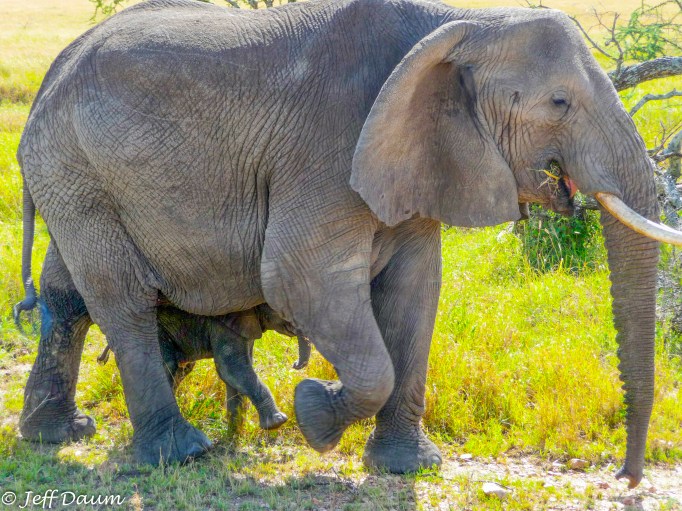
Mother and child (look under her) enjoying the day

Sharing an intimate moment

Capturing lunch on the go

Providing lunch on the go

The pause that refreshes
Here is a comparison of my first professional camera in the center, with my first digital with a Leica lens on the right, and my latest digital Nikon on the left.
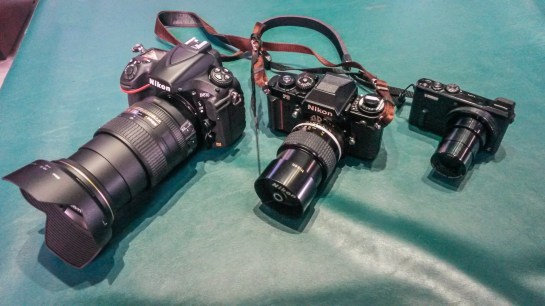
Evolution (or Nikon on steroids).
I tend to add new equipment when I feel the technology offers a significant improvement. For example, the small Leica was my initial move into the world of digital. It was considerably smaller than my film cameras, and offered the ability to immediately confirm I captured what I wanted. It also allowed me to learn how to shoot in digital since, in my experience, it required somewhat different skills than film cameras. Framing and composition were still the same, but how digital captured light has subtle but important differences to my eye as compared to film. [ Much like digital audio equipment sounds different when compared to tube based equipment. ]
While I still occasionally shoot with negative professional film using my older Nikon equipment, nearly all of my images today are shot with my full frame Nikon digital cameras.
Initially all of my work was done on black and white professional negative film, that I developed in my lab. Developing of film was done by the ‘book’ without enhancing the image. Slowly I experimented with color negative film but my concern was that it was too easy to get an interesting picture simply because of the colors as compared to black and white. For example, this shot of spices from India is really only interesting to me because of the colors as compared to shooting it in black and white.


This approach still reflects my technique today, except I normally only shoot with an eye to the colors and how they interact with the composition.


And certainly, many images rely totally on color for dramatic impact:


I trust my ability to see and capture what I want without coming back and spending time using readily available software (today’s equivalent of chemicals in the lab and development times when I started) to modify the image. I don’t think there is anything wrong enhancing images using post shooting software, but believe it reflects more of a philosophical difference. I consider myself a ‘naturalist’ photographer verses an artist/photographer producing a final photograph with software.

Reflections are often fleeting, but almost always cause us to stop and try to take in the moment. They tend to add a visual complexity to something that otherwise might have escaped our notice.


While at Barrett-Jackson’s 2016 Car Collector Auction in Las Vegas, Nevada, I had the great pleasure of spending some time with Mike Brewer, who car enthusiasts worldwide know from his and Edd China’s highly entertaining, Wheeler Dealers fame.

The following is a transcript of my recorded interview as Mike and I were walking across the vast Mandalay Bay convention center, filled with every imaginable type of transportation. Having just walked past an older Corvette, I took it as an opportunity to segue into Mike’s impressions of the new Corvette Stingray.
JD: You haven’t gone into any detail [on your show] on the C7, the new one. I know you prefer old cars.
Mike: Yeah, actually I like the C7. I like the new one. I had a little ride and drive in one of those C7s, when they first came out, and I think it’s the, well undoubtedly, it’s the best Corvette they’ve ever made.
JD: Certainly agree with you.
Mike: … And it’s the closest I think for the first time, American engineers got anywhere close to a European engineer in terms of mainly it’s styling, but in terms of the feel, because the car does feel very European on the road. You know like the Ferrari does feel, say a C6 Corvette feels very different from a Ferrari 355-
JD: Right.
Mike: …Which feels much more connected, and that was half of the problem, you didn’t feel connected to the car, but with the C7, it feels like you’re putting on a leather glove. It really does feel like you are connected to the car.
JD: It is the total package.
Mike: Yeah.
JD: Thinking of all the cars that you’ve had a chance to acquire, I’m sure there’s still a list of ones that you haven’t yet…
Mike: There’s many.
JD: What are the couple that are next on your list, the one’s reflecting your highest desires?
Mike: That’s a good question. On my highest desirable list. Actually, I’ve actually almost achieved most of my dreams of in terms of inside the Corvette world. I’ve got a, I’ve just got a wonderful C3 Corvette, it’s a ’67 Mako Shark, it was the, it’s not the Stingray, it was the ’68 in red. Beautiful car, convertible. I bought that car in, I do believe in Texas, and we did a lovely restoration job on it and we took it to the lake bed and drove it. Phenomenal. That was a great car, but in terms of my dreams, and what I’d like to do, the list is endless honestly I’ve got so many. Yeah, the list is endless, I’ve got so many cars that I haven’t got to yet.
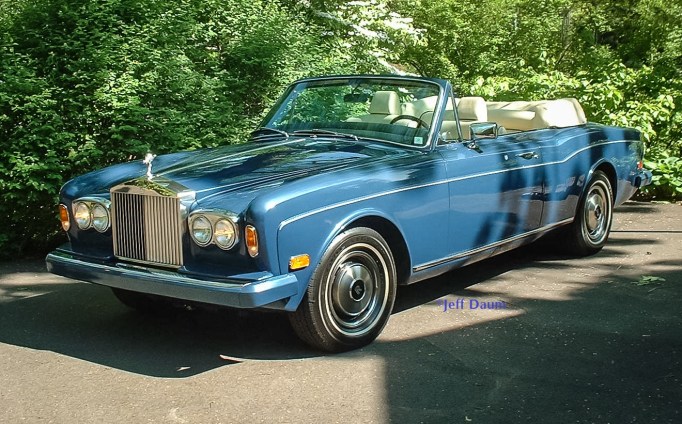
One of the cars that we still haven’t done and I can’t believe it for a Brit, is a Rolls Royce Corniche convertible.
JD: I was fortunate enough to own a 1975 RR Corniche drop head coupe Mediterranean Blue with Blue top and Magnolia hides.
Mike: You’ve had a better car collection than me!
JD: I was the second owner. It was probably the prettiest car line-wise, classic lines that I’ve ever owned. Incredible build, I loved the car. Drove it 11 years.
Mike: Wonderful. Yeah, I mean, you know there’s so many cars I haven’t gotten to yet, and walking around here at Barrett-Jackson, you know I get that feeling that I can see so many cars that sometimes cars pass me by, I don’t notice them, until I see them again, and you know, all of a sudden the world has gone mad for these pickup trucks, you know, C10 pickup trucks, and we haven’t done one of those yet on Wheeler Dealers and that’s a nice thing I’d like to venture into, but also older cars you know. If you was to ask me what is my most desirable dream car that I’d ever like to get my hands on is undoubtedly going to be a late ’20s Bentley blower. That would be it as my dream, but that in a realistic world, you know, one of those today is half a million dollars, and that’d be for just a shed.
JD: Right.
Mike: … So it’s going to be difficult to ever achieve that dream. It’s out there, you know, one day.
JD: When you source the parts.
Mike: Yes.
JD: In the US versus the UK.
Mike: Yeah.
JD: Do you rely more on your networking here or you still use the Internet a lot like we see you doing on the show?
Mike: I spend my life on the internet. You will see that during the course of the day when I get a break here, we’re making 8 hours of live television here today at Barrett-Jackson and then when I get a break in between filming, from these people around, and when I get a break in between filming, I am sitting on the Internet, and you’ll be surprised what I’m looking for. You know I could be looking for hubcaps for a Messerschmitt or I could be looking at the, you know, the gear shifter for a Citroen Maserati. You know, I could be looking for all kinds of stuff that’s currently going on in my world out there.
Now I’m just immersed in what’s going on and in terms of car restoration, and where I need to find those parts, but the Internet is my most valuable resource, just like everybody else in the world, really.
JD: Okay. You’re over here about 6 months out of the year.
Mike: It’s about 9 months now.
JD: 9 months now?
Mike: Yeah, 9 months of the year. Yeah, we’re based down in California.
JD: Right, that I knew. I guess it was 2 years ago when you were on the Velocity Live show over at SEMA, where you were talking that you just purchased that location.
JD: From the whole process, from the acquisition to the restoring to the selling, which part excites you the most?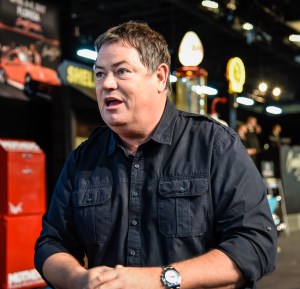
Mike: It’s most definitely the test drive at the end. It’s the achievement that you know, that sense of achievement that you’ve done what you set out to do, because you know, cars can be tricky. Some cars come into the workshop with me and they offer themselves up, they say, “Restore me, I want to be restored, here I am”, you know, and they undo easy, the nuts and bolts come off, the fenders, the hood, the bonnet, the engine pulls apart easy.
Yet other cars, they come into the workshop and they put boxing gloves on. They’re a little bit like Mike Tyson, and they want to go 10 rounds with you, and they’re not easy. They don’t want to be restored, they want to die. When we beat those cars into submission, and we give them a new coat of paint, some new lipstick, and we put them out there on the road and we test drive them. That sense of achievement brings a tear to my eye, and that’s why I do this show, I love it.
JD: That’s the enthusiasm that we see as viewers when you and Edd are out afterwards, before you actually sell it.
Mike: Yeah, I mean I just love, you know, we just love restoring cars and a lot of people don’t know this, but when the cameras are cut, not so much for Edd, but for me, when the cameras are cut, what do I do in my spare time? Restore cars. My own cars.
JD: [We walk past a Mark 2 Jaguar]
Mike: Mark 2 Jaguar? Love to talk about that.
JD: Isn’t that a beauty?
Mike: It’s a beauty, but it’s not a good color. It’s not a good original color combination. Nobody ever done that, but it would work, it’d be a nice car, it’s a Jaguar.
JD: You had that in Rolls and Bentley, those color combinations.
Mike: Yeah, but not in Jaguar.
JD: Right.
Mike: They never did that two-tone Jaguar. That’s somebody’s interpretation of what a British car should look like, and these chrome accents here that they put on the hood.
JD: Right.
Mike: They’re not correct either, you know, they just put those on because it’s had it’s Hollywood face lift hasn’t it? It’s a British car that’s been to Hollywood.
JD: Right. Do I have a couple more minutes?
Mike: Yeah, yeah you can go for it.
JD: Thanks. You did a great job in Afghanistan.
Mike: Thank you, much appreciated. It’s my proudest achievement I think.
JD: It was very well recognized.
Mike: Thank you.
JD: Is there something similar you have planned down the line?
Mike: I’d really like to not go back into military programming. Having the two documentaries and nearly died several times. You know, I’ve got a wonderful wife, an amazing daughter and it was something that I wanted to do as a passion inside me and I wrote and produced that series, but I’ve done it, and I’m proud of what I’ve done. I have put a spotlight for a moment on what goes on in the real theater of war, and I felt it and you know, it’s my biggest achievement I’ve ever done in my life and long may it just stay there. You know, I can look back at it and show my grandkids and say “This is what I did”, but yeah, I don’t want to go back there again, it’s a scary place, and you know, the service men and women all across the world, British, American, whoever they are, you know, I salute them. I can’t tell you just what they go through because it’s horrible.
JD: I appreciate that, thank you very much.
Time for one more question?
Mike: Yeah, yeah.
JD: Okay. Autonomous cars.
Mike: Yeah.
JD: Thoughts.
Mike: My thoughts on autonomous cars, okay. You know, I think, I’ve worked harder than anybody else I know, and the thought of getting in a car at the end of the day, pressing a button then it taking me home, fills me with joy. Fills me with joy, but the thought of actually doing it sends shivers down my spine. I’m never going to do that. I want to hold that steering wheel. I want to feel the pedals under my feet. I want to feel the road surface. I’m not going to trust a computer to get me home. You know, I can’t trust myself to get me home, let alone a computer, and I live in a world where you know, well we all do, you know, you’re in, if you’re on your cellphone, and we’ve got computers at home and cellphones. I’m forever rebooting mine and trying to get the thing to work, and so I don’t know if I want to be cruising down the freeways at 70 miles an hour with a computer that needs rebooting at some point.
JD: Exactly.
Mike: No, I think I’ll be, I think I’ll let it go for a few years and see how people get on with it, and see what happens before I ever decide to go and do such a thing, but no. I think there is a future for it. I think there is a market for it, and I can understand why you’ve got the likes of Google and Amazon and other companies chasing after this Utopian world that we’re all going to be driving around in these wonderful self-driving cars, but I think it’s a long way off. I do believe there’s been accidents already with cars that have been automated. No for me, I want to hold the steering wheel.
JD: Thank you Mike, I tremendously appreciate your time.
Mike: It’s an absolute pleasure sir, it’s always, I’m honored to talk to people.
JD: Nicky would you take one picture of us with my camera?
Nicky: Absolutely!
 JD: Thank you so much.
Mike: Well, Jeff it’s been a real pleasure to meet you sir. You have a great day here today at Barrett-Jackson, I’m sure-
JD: I will.
Mike: … You’ll get lots of content. There’s tons of cars and it’s going to be exciting.
And off Mike went, continuing on his hectic pace surrounded by a Velocity camera crew to his next filming event. The impression of the man lingered in spite of the ‘energizer bunny’ style- so genuinely interested in and knowledgeable about all things automotive, so easy to interact with and personable. A real pleasure indeed!
 Insight - Daum Photography