Autonomous Vehicles: Part 3*

The following is a guest perspective that presents some excellent points on the current status of autonomous vehicles. It was written by Srikanth Thirumalai of Waymo, published August 26, 2026 on Waypoint: The official Waymo blog, and is presented here in its entirety:
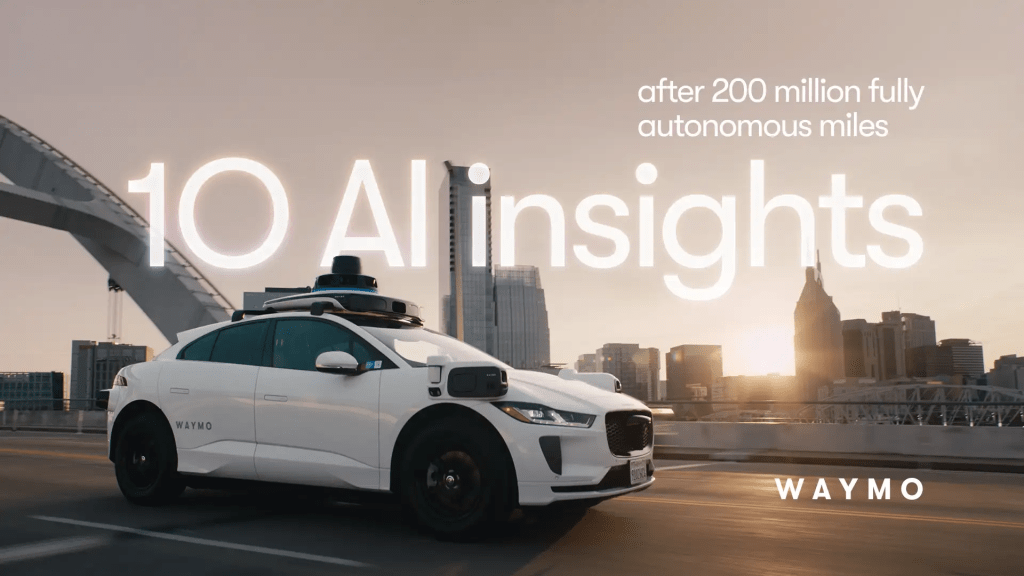
10 AI Lessons from Driving 200+ Million Fully Autonomous Miles

Srikanth Thirumalai

Much of the autonomous vehicle (AV) space is uncharted territory. However, at Waymo, with more than 200 million miles driven fully autonomously, we’re one of very few companies that can look to our past to illuminate our future. Our experience has led us to ten fundamental truths that shape how we build AI.

These truths are validated by our safety data, which shows the Waymo Driver is already making roads safer in the cities where we serve. More than safety being the output, safety is the reason for each insight.

Let’s dive into what we’ve learned, starting with the two most heavily debated topics in AV history.

1. Multimodal sensors are indispensable

Cameras are incredible, but they aren’t enough. For years, there’s been a debate over whether cameras alone could solve full autonomy. Now, after more than 200 million real-world miles, the data is clear: safe, fully autonomous operations at scale require more. By combining inputs from cameras, lidar, and radar, the Waymo Driver creates a rich, redundant world view that no single sensor can replicate.

In addition to redundancy, each sensor brings complementary sensing strengths that bolster safety.

  • Lidar provides the wireframe, capturing 3D geometry with millimeter precision.
  • Cameras provide the semantic overlay with their ability to read street signs and detect colors of traffic lights.
  • Radar serves as a dynamic sentinel, tracking velocity and “seeing” through what obscures cameras, like heavy rain, fog, or dust.

2. HD maps are a powerful “prior”

This brings us to the second great AV debate—to map or not to map. At Waymo, we use high-definition (HD) maps to jump-start our validation process, so we can provide a fully autonomous service to riders from our first trip. As we drive, we treat our maps as another input—like our sensors, but acting as a mental memory. It is there as an additional source of information, proving incredibly helpful in poor visibility and complex thoroughfares. This allows the onboard computer to dedicate its real-time processing power to what is dynamic or new, such as a sudden detour or a temporary stop sign. Our AI-driven mapping system ensures these maps are continuously updated, providing the vehicle with a reliable, high-fidelity reference to lean on during complex maneuvers.

3. Fewer, larger models are better

In the early days of AV development, the industry relied on specialized modules. For example, one for pedestrian detection, another for car tracking, another to tell when a light turns green. While agile, this modular spaghetti becomes unmaintainable at scale.

By consolidating to fewer, high-capacity, specialized foundation models, we are better able to leverage the power of vast datasets and large-scale computation. This strategy lets the data, rather than brittle human priors, determine what is relevant, allowing models with sufficient capacity to develop complex reasoning capabilities.

This less-is-more approach allows us to benefit from the same scaling laws that have propelled breakthroughs in large language models, using efficient teacher-student models to optimize onboard compute. However, while fewer models are better, that does not mean we’re consolidating our processing into a single, black box.

4. You can’t build trust with a black box

AI is powerful, but it isn’t magic. Pure end-to-end (E2E) neural architectures, where a model takes in raw pixels and directly outputs steering commands, run the risk of black box failures. That means, it’s hard to understand how decision making happens in full E2E systems. While Waymo’s system transforms sensors into driving decisions in real time, we’ve added an independent onboard validation layer. This architectural choice is non-negotiable for safely scaling at L4.

This is a separate, AI-based safety system that monitors every trajectory proposed by the Waymo Driver. It checks these plans against hard physics-based constraints and traffic laws by incorporating techniques like Reinforcement Learning and reasoning inspired by Generative AI. If the AI proposes a path that violates a limit or risks a collision, the validation layer acts as a hard backstop.

5. Closed-loop simulation reveals more edge cases

If you want to train an AI to safely handle highly dynamic, rare scenarios — like a vehicle suddenly cutting three lanes of traffic on a freeway — it’s really difficult to test in the real world. Simulation allows us to test, validate, and improve our performance for the everyday and the one in a million events we navigate on a weekly basis. However, we’ve learned that simply replaying recorded data, known as open-loop simulation, is insufficient because it’s like stepping into a video replay – the surrounding traffic moves, but it’s completely indifferent to your actions.

Large-scale, closed-loop simulation is critical. It provides the most realistic assessment by mimicking real-world cause and effect. In a closed loop, if the Waymo Driver swerves or brakes to avoid that aggressive lane change, the surrounding traffic will react naturally to its actions. This creates a feedback loop, which is essential for understanding complex interactions and for unlocking powerful techniques like Reinforcement Learning.

It’s impossible to find every edge case on the road, so a closed-loop simulation allows us to discover and test some of the rarest events before we encounter them on the road.

6. Every great driver needs a great Critic

We all dislike back seat drivers, but what if we engineered a helpful one? At Waymo, we built an AI critic to analyze, understand, and detect undesirable driving behaviors both in simulation and on the road. The Waymo Critic allows for a continuous, automated feedback loop that examines the millions of road miles traveled each week (and tens of billions in simulation), allowing our human engineering talent to focus on the most complex edge cases. Without a robust and discerning Critic, the Driver risks “grading its own homework.”

The Critic is tuned to catch a range of driving behaviors, from safety and traffic law compliance to how smoothly the car progresses through a turn or how comfortable the braking feels. By combining this powerful Critic with our calibrated driving data, we can precisely measure the Driver’s quality in any scenario.

7. Vision Language Models improve scene reasoning

Driving requires complex, chain-of-thought reasoning. When a car encounters a police officer using hand signals at the site of a collision, the Driver must understand the intent of those signals within the context of the surrounding scene. This is where Vision-Language Models (in our case, trained with Gemini) become crucial reasoning partners. They provide high-level semantic “hints” to the Driver, helping it navigate situations that are far outside its standard training data.

Our experience shows that while Vision-Language Models (VLMs) excel at high-level reasoning, they are too slow for real-time control and lack sufficient spatial awareness on their own. To bridge this gap, our system adopts a “thinking fast and slow” architecture. It relies on rapid, intuitive processing and sensor fusion for instantaneous, real-time control (thinking fast), while leveraging VLMs for deep, deliberative reasoning (thinking slow). This dual approach allows the Waymo Foundation Model to perceive the world with high fidelity across diverse sensor inputs while simultaneously navigating complex, long-tail scenarios and anticipating future developments.

8. Our holistic approach shows AI is only as effective as the governance that evaluates it

Most people think that when you’ve built an autonomous Driver, your work is done. Simply “develop and go” misses the bigger picture. True scalability is only possible if driving, simulation, and evaluation are created with a safety governance to determine their readiness. Our entire strategy is built on this holistic premise.

At the heart of our readiness framework is a rigorous, quantitative data engine composed of multiple complementary evaluation methodologies. We augment this empirical core with expert human judgment and proper safety governance — ensuring every deployment decision is grounded in proven metrics.

9. A data flywheel enables continuous improvement

A core pillar of our Waymo Values is to always be learning. The Waymo Driver is constantly getting better over time thanks to our automated data flywheel—a virtuous cycle of continuous improvement that accelerates our ability to scale.

Driving millions of miles a week, we leverage our automated systems, including our Critic and feedback from riders and communities, to highlight opportunities for refinement. We extract and examine the relevant data, use advanced auto-labelers to categorize it, retrain our models, and validate it through simulation, and then our safety framework. Operationalizing this cycle across exabytes of data is what allows an L4 system to systematically address the long tail of driving scenarios.

10. There is no substitute for fully autonomous experience

The final lesson is that there is no substitute for actual fully autonomous miles. Simply improving a driver-assist system (L2) for full autonomy is a false summit. True L4 maturity can only be safely achieved by a purpose-built system, validated on closed courses and hardened by the uncompromising experience of driving without a human in the car.

You can run billions of miles in simulation or with human supervision, but an AV system only truly matures when it is solely responsible for the driving task. Full autonomy exposes the system to the true gravity of its decisions and reveals novel situations that humans or simulations might unconsciously smooth over.

The Road Ahead

As we look toward the billions of miles ahead, these ten lessons remind us that safety is the direct result of rigorous, real-world experience. While these highlights only scratch the surface of what we’ve learned operating at scale, you can take a deeper look at our specific AI approach in this blog post.

© 2019-2026 Waymo LLC


* For Autonomous Vehicles Part 2 see https://insight.daumphotography.com/2017/01/25/autonomous-vehicles-part-2/

Thanks for visiting! If you have any questions or comments, please feel free to enter them below.
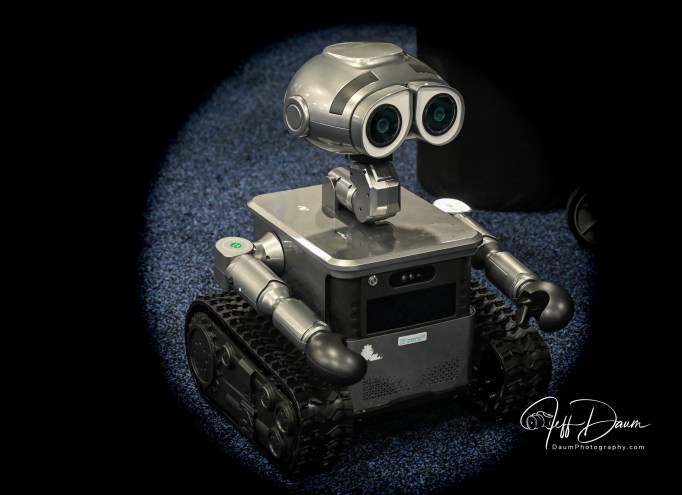

Highlights from CES 2026: A Dive into Tech Innovations

by Jeff Daum, Ph.D., PPA Technology & Product Analyst

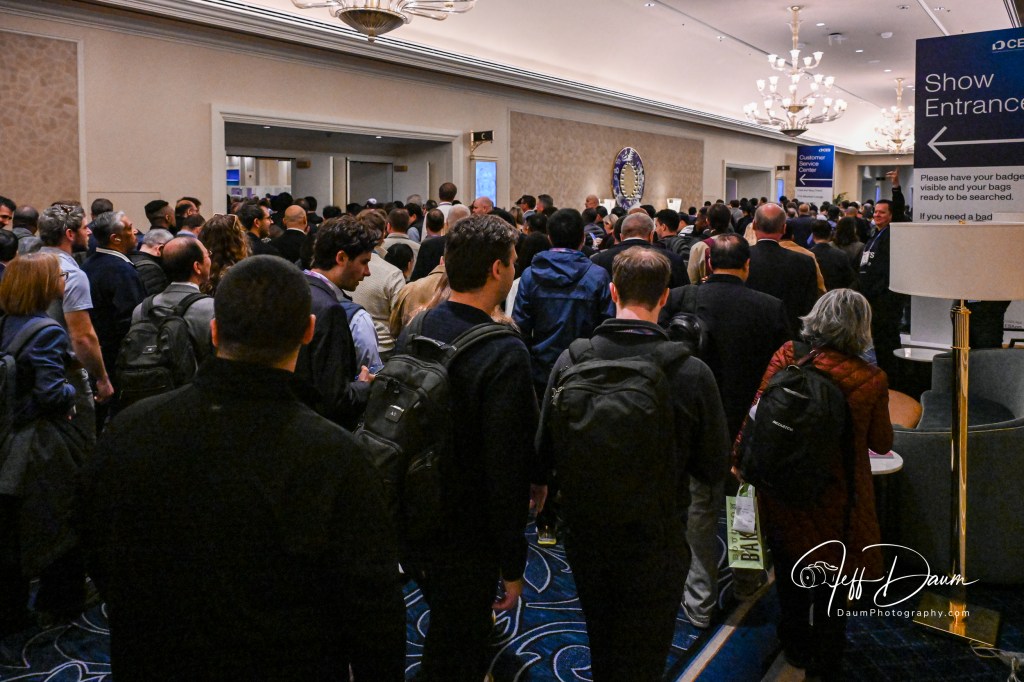
CES 2026 wrapped the end of last week. As the largest Consumer Electronics Show of its kind and the largest convention held in Las Vegas (at the LV Convention Center plus several of the Resorts), it tends to be both encompassing and overwhelming. [I averaged 12 to 13,000 steps each day with my equipment.] According to the Consumer Technology Association (who runs CES) there were 148K+ attendees, 4100+ exhibitors and 6900+ media and industry analysts this year.

Not surprisingly, AI was incorporated into just about every imaginable application (whether it was needed, added true value or not) from clothing, shoes, bracelets and rings that tracked multiple health indicators, to vehicle components (attention tracking, HVAC, accident avoidance, etc.), drone flight control, cleaning robots (house floors, windows, pools), kitchen and laundry appliances, surveillance systems, pet liter boxes, and the smart home.

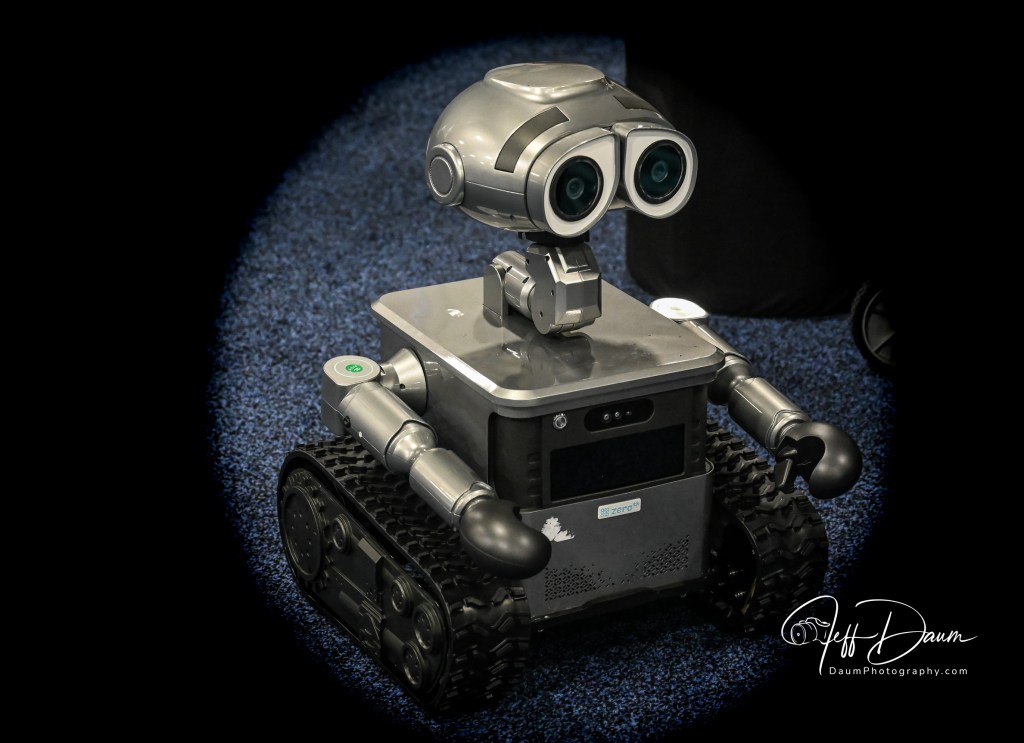
Everything that is electronic can be found at CES from supersized TVs, to cooking/food preparation appliances, to solar systems, power walls and generators, to vehicles of all sizes and shapes (giant John Deere harvester, fire trucks, regular cars, prototype cars, flying cars), powered wheel chairs, workout equipment, to cell phones and accessories, speakers to ear buds, toilets and faucets, and robots of every type and size.

CES is not open to the public, only manufacturers, buyers, sellers, investors, and the press. The first couple of days are restricted to the press and an opportunity to preview the ‘latest and greatest’ new technology of the show, along with many Keynote and PR presentations (like the impressive one by Nvidia’s CEO Jensen Huang). This is followed by four days of the exhibits being open across all the venues.

In addition to major players (LG, Samsung, Bosch, Nvidia, Amazon, etc.) there are many very small, often start-up companies there. It is usual to see, for example, an item by a known manufacturer like LG and BeatBot (pool robots) and then half a dozen or more unknown companies displaying very similar looking products with similar performance claims but sometimes of dubious quality.  Products displayed range from actual production units to beta versions or even mock-ups.

What I like about CES is not only the opportunity to see (and handle or interact with) the newest technology, but also the chance to talk directly with respective CEOs, innovators, and technical gurus.

It seemed like there were fewer vehicles this year compared to previous years, but more exhibitors displaying advances in specific vehicle components (like lidar, dash displays, audio, EV motors and batteries).

It is hard to pick THE one product or technology that truly impressed me, because of the scope of CES, but several standouts are:

  • All solid-state battery for vehicle applications by Donut Labs
  • Status Pro X ear buds with Knowles balanced armatures
  • SwipeVideo immersive video streaming technology that lets users seamlessly switch perspectives by swiping through unlimited camera angles
  • Qlay’s AI software that detects the use of AI to cheat on tests or in an interview
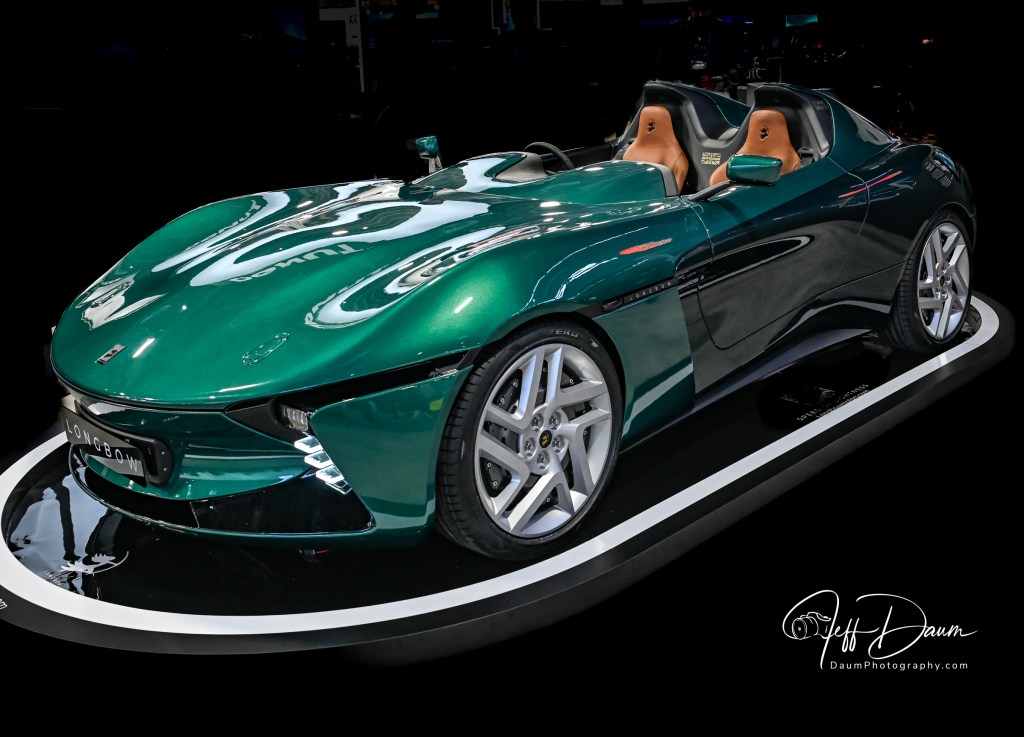
  • Longbow Speedster retro sports car built around cutting edge technology
  • Reolink’s use of AI to quickly sort through surveillance videos
  • Wheel M=ove powered wheelchairs

Here is a link to my gallery providing an overview of this year’s CES experience: https://www.daumphotography.com/Events/2026-CES

or you can scan this QR code:

BlackVue DR770X Dashcam Review: Security Redefined

By Jeff Daum, Ph.D., PPA

BlackVue represents some of the best dashcam systems on the market.  You can see my reviews of previous models at for the DR970X https://insight.daumphotography.com/2024/02/02/blackvue-dr970x-2ch-plus-and-dr970x-2ch-lte-plus-dash-cameras-field-test/ and https://insight.daumphotography.com/2020/07/11/product-review-blackvue-dr900s-2ch-field-test/ for the DR900S.  This review focuses on BlackVue’s new DR770X Box-3 channel Pro version.  It is primarily designed for the individual who wants up to three cameras- a front facing, rear facing and interior facing dashcams, and a system that is designed to provide protection from someone else getting to the recording memory card or attempting to physically remove the connections to each of the dashcams.  You might want this added security, for example, in a ride share or taxi vehicle.  Of course, the DR770X can be used in your own vehicle even if you don’t need the added security of a tamper proof set up.

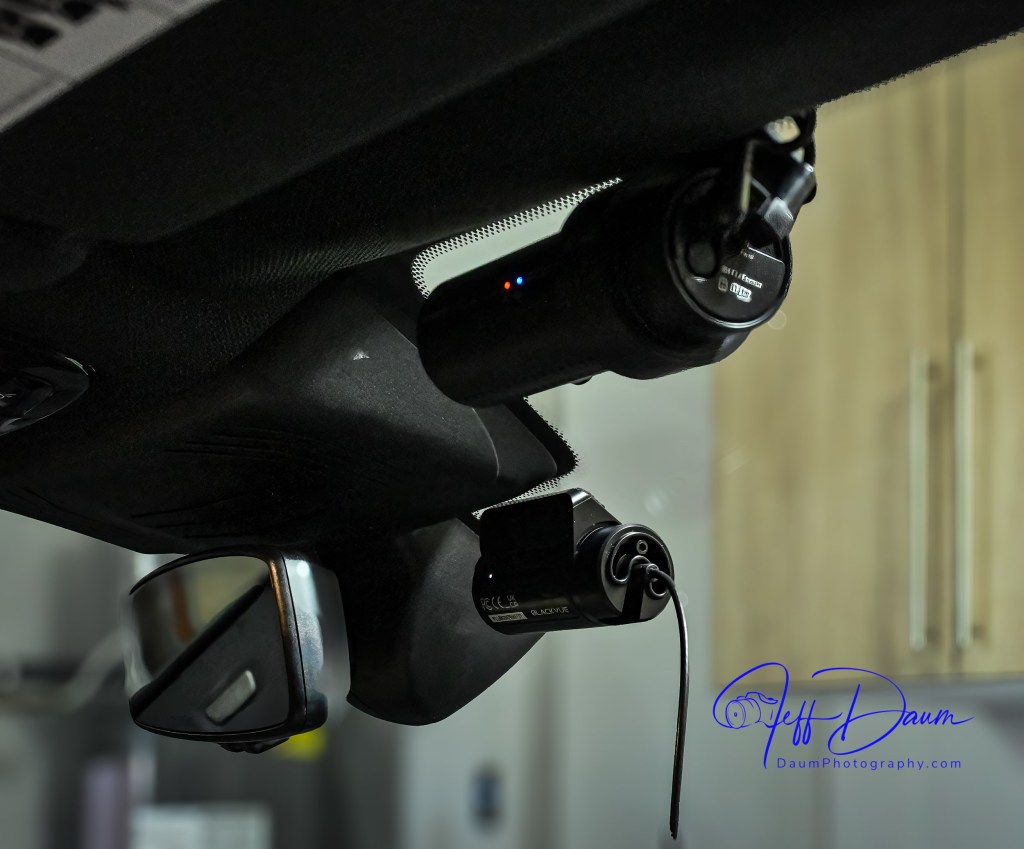
The first thing you’ll notice is that the front facing DR770X is physically a lot smaller than most other BlackVue dashcams.  Specifically, the DR770X is approximately 3 inches (76mm) long compared to their DR970X and DR900S at approximately 4.7 inches (118.5mm) long or the even longer DR970X-2CH LTE Plus at approximately 5.4 inches(137.6mm).

The lockable main box comes with a large Velcro pad on the back so that it can be positioned out of sight but convenient to remove to gain access to the microSD card.

While BlackVue’s marketing states the DR770X has a faster lens at f/1.7, it depends on what other dashcam they use in the comparison: The DR970X Plus also has a f/1.7, but the DR970X’s is f/2.8.

The DR770X has a narrower coverage area with Diagonal 139°, Horizontal 116°, Vertical 61° for the front camera and Diagonal 115°, Horizontal 95°, Vertical 49° for the rear facing camera.  The DR970X has front: Diagonal 155°, Horizontal 130°, Vertical 70° and rear: Diagonal 139°, Horizontal 116°, Vertical 61° while the DR900S had front: Diagonal 162°, Horizontal 136°, Vertical 77° and rear: Diagonal 139°, Horizontal 116°, Vertical 61°.

The DR770X is a 4K dashcam with Sony STARVIS, the DR970X and DR900S an 8-megapixel CMOS Sensor.

The DR770X Pro has an increase in the event buffer recording time to 10 seconds up from 5 seconds compared to prior models.  Events are when the system senses a bump, hard turn, crash, etc., and automatically mark the recording as such preventing it from being overwritten when the MircoSD card is full.

Note: prior to setting up your DR770X system in your vehicle, I suggest you jot down the unique password that is on the camera behind the tamper proof end cover.  You will need this if the auto-find in their app doesn’t locate and load your cameras on your initial set up.

All three models incorporate a built-in microphone in the front facing camera that can be set to always record interior sounds (voices, turn signals, music, etc.) or be turned off.  They also include a speaker that lets you know the system is functioning when it turns on.

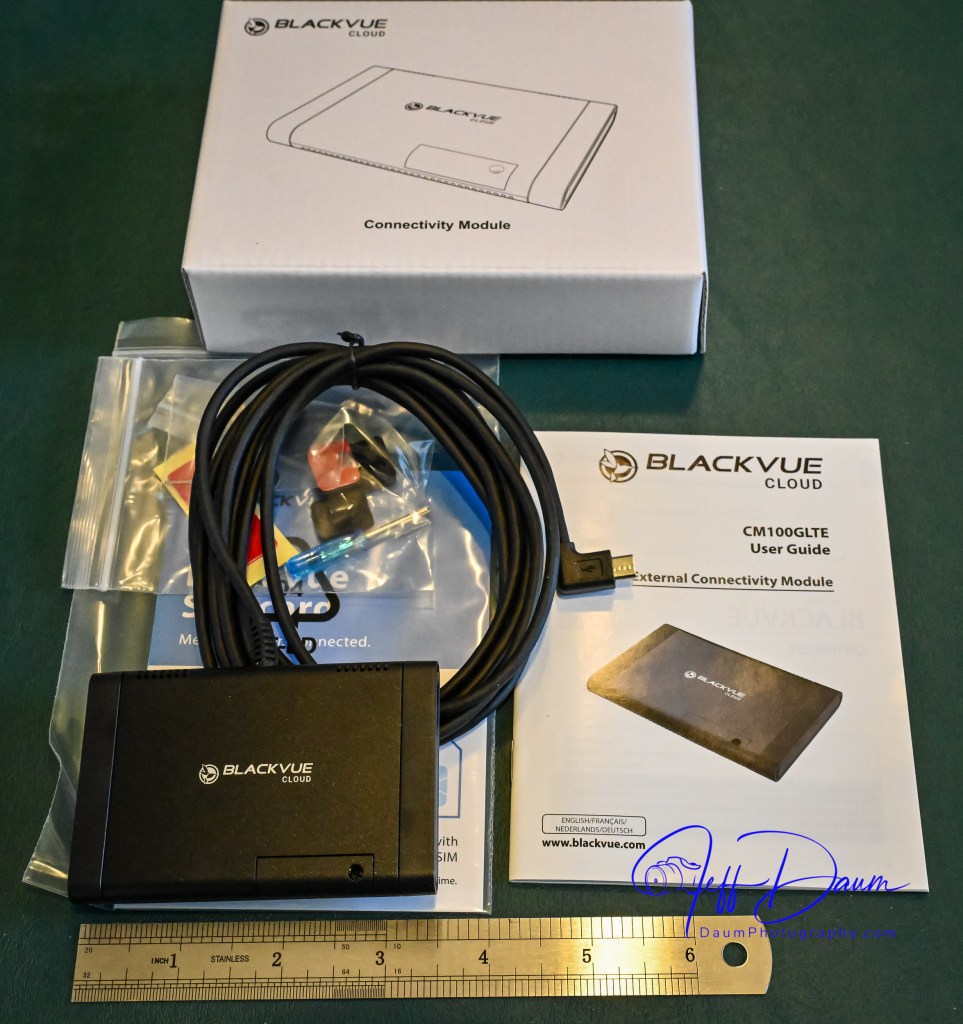
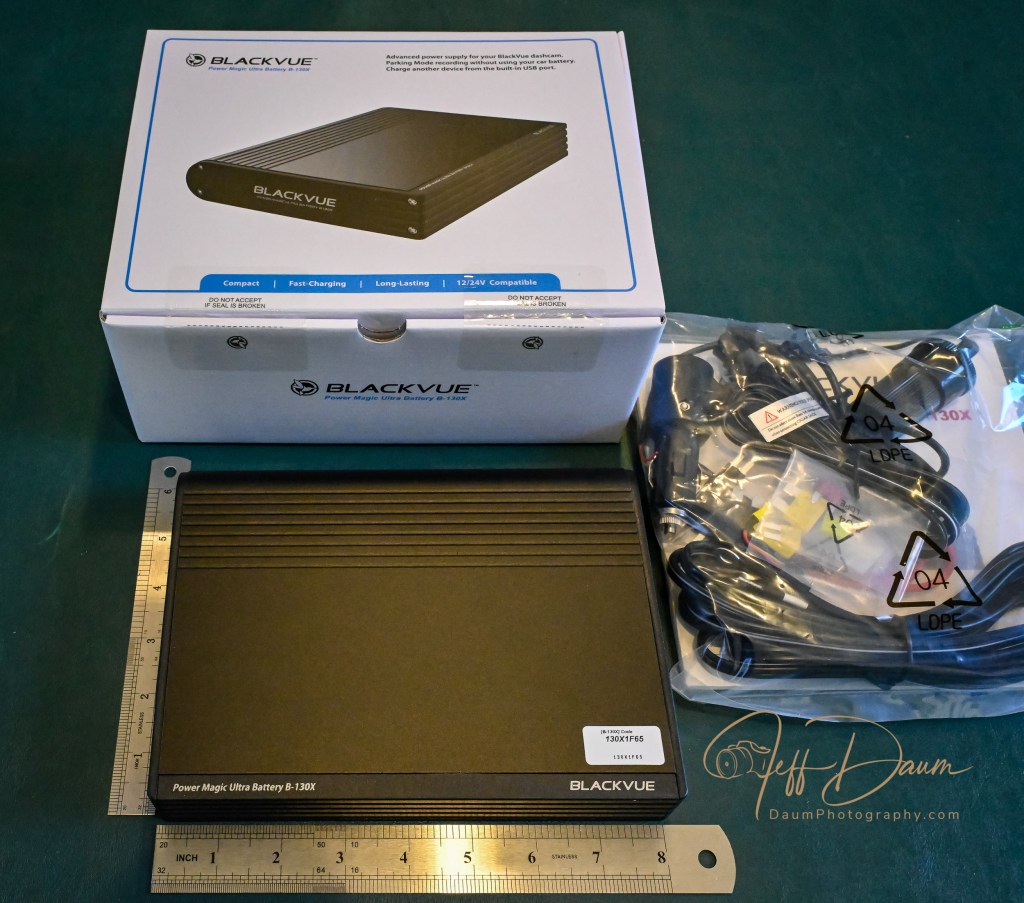
At the same time I tested the DR770X Box-3 channel Pro, I tested BlackVue’s LTE BlackVue cloud Connectivity Module and their B-130X Power Magic Ultra Battery system.

The DR770X dashcams were tested by mounting them in nearly the same perspective on the front and rear windshields as the DR900S, as can be seen in these images.

The main lockable box and B-130X Power Magic Ultra Battery were temporarily placed on the floor, with the GPS module or the LTE BlackVue cloud Connectivity Module antenna temporarily mounted near the top of the windshield.

Field Test

In this as well as all my tests, the images here are unmodified and based on the factory settings, which can be fine-tuned if one wants to.

Here is a look at the front facing cameras during the day.  In this comparison the DR900 images are slightly darker than the DR770.  The DR900 has a wider perspective, meaning you would see vehicles on either side earlier than with the DR770.  Both systems capture solid images along with documenting your position and speed (though you can turn that off in the set-up).  When I looked at enlarged images, the DR900 captures a bit more detail than the DR770.

[Note: a higher resolution video can be seen by clicking on “Watch on YouTube” in the lower left section of each video]

Here is a comparison of the rear facing cameras, with similar conclusions as the front facing cameras. Again, the DR770 has a smaller angle of coverage with its rear facing camera than the DR900S.

Turning to night captures, the front facing DR900 appears sharper with less flare around bright lights than the DR770. 

Looking at the night rear facing cameras, the DR900 has more flare around bright lights than the DR770, but still a bit more detail on examination.

The interior facing camera of the DR770 provides similar quality during the day to the front facing camera, but with a much wider range of 180 degrees.  It captures everything from the driver door to the passenger door and back seat.  This camera includes Infrared LEDs and sensors that automatically come on in low light, providing clear images in total darkness.

The free BlackVue app provides easy access to check on the B-130X remaining power.  If you have the optional LTE Connectivity module connected, the app also allows you to see what your dashcams are seeing, stored recordings, etc.  Even if you do not have the Connectivity module, the app will allow you via WiFi to see what your cameras are seeing and to modify their and the system’s settings.

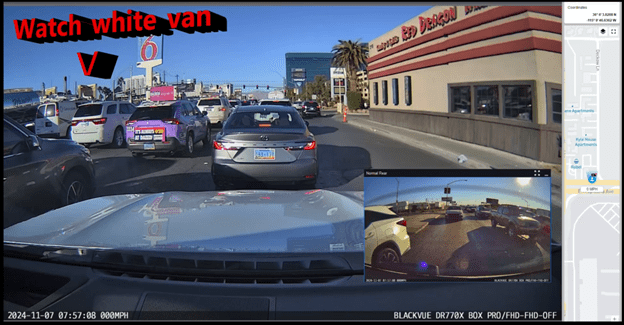
There is also a free BlackVue app for your computer that is very useful.  While you can remove the MicroSD card and view the recordings on your computer without the app, the app offers several real advantages.  When you use the app to view your recordings, it enables you to see all cameras (front, rear and interior) simultaneously as well as providing a sidebar with a dynamic map and GPS position.  Another nice function of the app is it will automatically join the individual recordings one after another, simplifying the viewing.

Here is a screen shot of what the BlackVue computer app looks like with the DR770X.  On the right side of the screen, you see a narrow column with a dynamic map showing my vehicle’s position with street names, my speed, and actual GPS coordinates. On the bottom of the screen, you will see a line with date, time, vehicle speed, and the BlackVue camera(s) on the recording.  In the main part of the screen, you see a picture in a picture that has the rear facing camera and the rest is the front facing camera.  You can adjust what is included in the screen.

When you look at the following example from the app, you can see how the map is dynamic, and somewhat amusing, the white van will attempt to cross three lanes nearly perpendicular to the flow of traffic!

Preliminary Field Test Conclusions

Set up of the DR770X was straight forward, especially since this system uses the included wireless button to pair the cameras with the BlackVue phone app.  Once you power up everything, you simply press the wireless button which pairs with the app, and then you use it to confirm the DR770X cameras you installed.  Once that is done, you are all set.  You can use the system immediately or use the app to modify software defaults.

As in prior comparisons, BlackVue continues to produce top line dashcams with the most important features built in.  Of course, quality does come at a price with the DR770X 3CH Pro including a 64GB microSD card retailing at US$474.99.

The Power Magic Ultra Battery B-130X retails at US$359.99. The LTE module retails at US$159.99.

BlackVue customer service has been excellent in responding to any set up questions and/or issues.

The BlackVue DR900S has been in my vehicle for nearly 5 years now and has performed flawlessly in all temperatures from freezing to extreme desert heat. I have no reason to think the new DR770X Box-3CH Pro series won’t perform equally well and it adds the ability to have the IR interior camera along with added security of the locking main box and tamperproof camera mountings.

BlackVue states that you should use their microSD cards for optimal performance. I experimented early on with several non-BlackVue microSD cards (all were name brand high-quality professional level cards, designed specifically for handling the frequent record events typical of security cameras designed for video recording), and while they would work for a period, inevitably they would stop working or have glitches.  Once I went back to BlackVue’s own card I never had it stop working or fail.

These cameras offer pricing plans for saving files to the cloud as well as in the case of the option LTE connectivity module, a built-in SIM card to simplify the recording directly to the cloud.  As noted, it is easy to either download the video files or temporarily remove the microSD card and transfer the files to your computer.

The fit and finish of the new DR770X is excellent and all the components included are high quality.

If you are highly concerned about your vehicle when it is parked and unattended, you should consider purchasing the optional Blackvue Power Magic Ultra Battery.  I was impressed with how it elegantly solves the OEM battery management software issue.  I am adding it to my cars.

A final thought worth repeating from my earlier reviews: Many of my readers have asked ‘Do you really need a dashcam, and if so which one?”  Hopefully this review is helpful in reaching a decision.  For me personally I always want to have documentation of what is going on around my vehicle when I am driving, so all my cars have dashcams and when I rent a car, I put in a portable dashcam before I leave the lot.  I also find it is nice to have videos of scenic drives and the ones from BlackVue are perfect for this.

Thanks for visiting and reading. If you have a question, please feel free to ask below!

Thoughts on Automobility LA

Day one of the 2019 Automobility LA show might be best summed up in one word “Karma.”  The first media day is basically a series of thirty minutes (or more) technology update panels.  I find it interesting on a number of levels, including what really is new and what is status of the field.

For the most part, especially if you have attended a number of these over the years, you take what is said with a grain of salt and consider it a lot of marketing hype designed to stimulate discussion, create awareness, and in more cases than not, investor interest.

My ‘take-aways’ from today include:

  • The new CEO of Faraday (he was the CEO of Byton last year) sees the real financial profitability coming from the interconnected digital experience, rather than through the sales of their FF91 (September 2021) at $150-200k, or of their FF81 after that at $60-80k.
  • The “living space” experience of future semi-autonomous and ultimately, fully autonomous (levels 4 and 5) vehicles is the ‘hot’ topic focus of many presenters here.
  • Critical is figuring out how to integrate all of the vehicle voice assistants, such as OEM versions and Alexa, along with the artificial intelligence (AI) dynamic data base so that it is a seamless experience for the end user.
  • Figuring out how to gain the trust in the general public of autonomous vehicles (AVs)

One split in thinking and focus that I feel isn’t being given enough effort is that there really are two very different AV ‘roads’ that need to be integrated for this future disruption to succeed.  That is, one faction sees AVs as ultimately the replacement for the personal car as simple a means to primarily get from A to B, while the other is attempting to create a whole new means of experience that people will just want to do because of the experience.  The later are focused on integrating lots of monitors (screens), high end audio, augmented reality, etc.  An overriding issue for both factions is what the respective impact will be on reducing congestion in urban environments.

Continuing issues include lack of standardized intra and inter vehicle communication (software), privacy of the ever-expanding data base on each end user (incrementally increasing under the 5G capabilities), and lack of interstate DMV regulation for AVs.

It still appears that the near future of AVs will be restricted to proprietary lanes on highways and in urban environments, where human driven vehicles are not allowed to drive.  Under this set-up, I believe we will see a significant reduction in accidents and deaths.

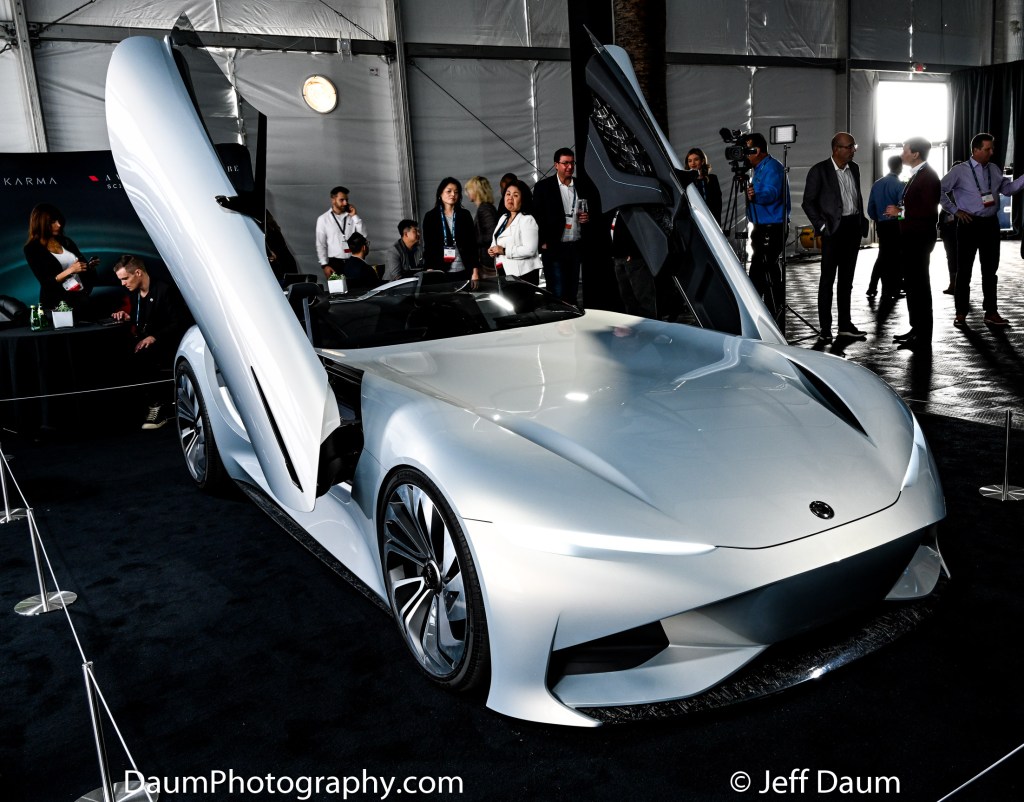
Oh, and why this first day is best summed up as Karma? The simple answer is that Karma had their FF91 there, as well as functioning protypes of their future vision cars the SC1 and SC2 (convertible and hardtop respectively, each with ‘scissor’ doors), and their Revero GTS model.  Alternatively, as a bit of tongue-in-cheek, perhaps the future of AVs is just karma personified…

More to come.  In the interim, what are your thoughts?