by Jeff Daum, Ph.D., PPA Technology & Product Analyst
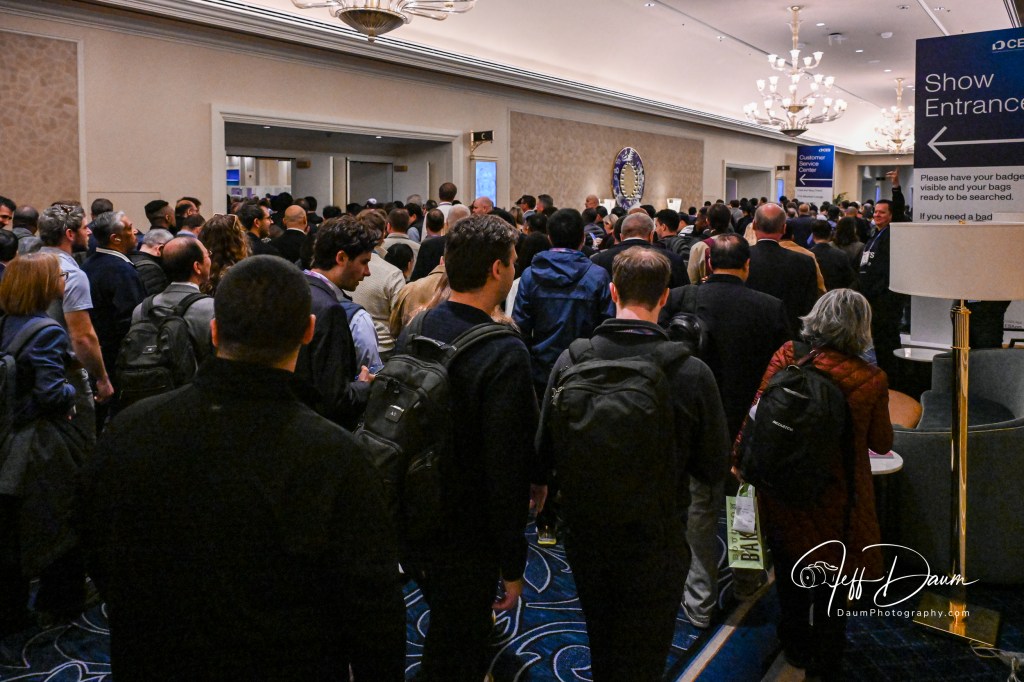
CES 2026 wrapped the end of last week. As the largest Consumer Electronics Show of its kind and the largest convention held in Las Vegas (at the LV Convention Center plus several of the Resorts), it tends to be both encompassing and overwhelming. [I averaged 12 to 13,000 steps each day with my equipment.] According to the Consumer Technology Association (who runs CES) there were 148K+ attendees, 4100+ exhibitors and 6900+ media and industry analysts this year.
Not surprisingly, AI was incorporated into just about every imaginable application (whether it was needed, added true value or not) from clothing, shoes, bracelets and rings that tracked multiple health indicators, to vehicle components (attention tracking, HVAC, accident avoidance, etc.), drone flight control, cleaning robots (house floors, windows, pools), kitchen and laundry appliances, surveillance systems, pet liter boxes, and the smart home.
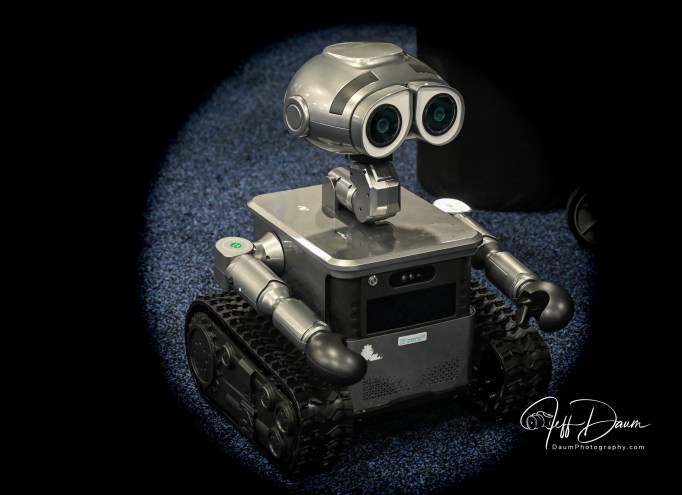
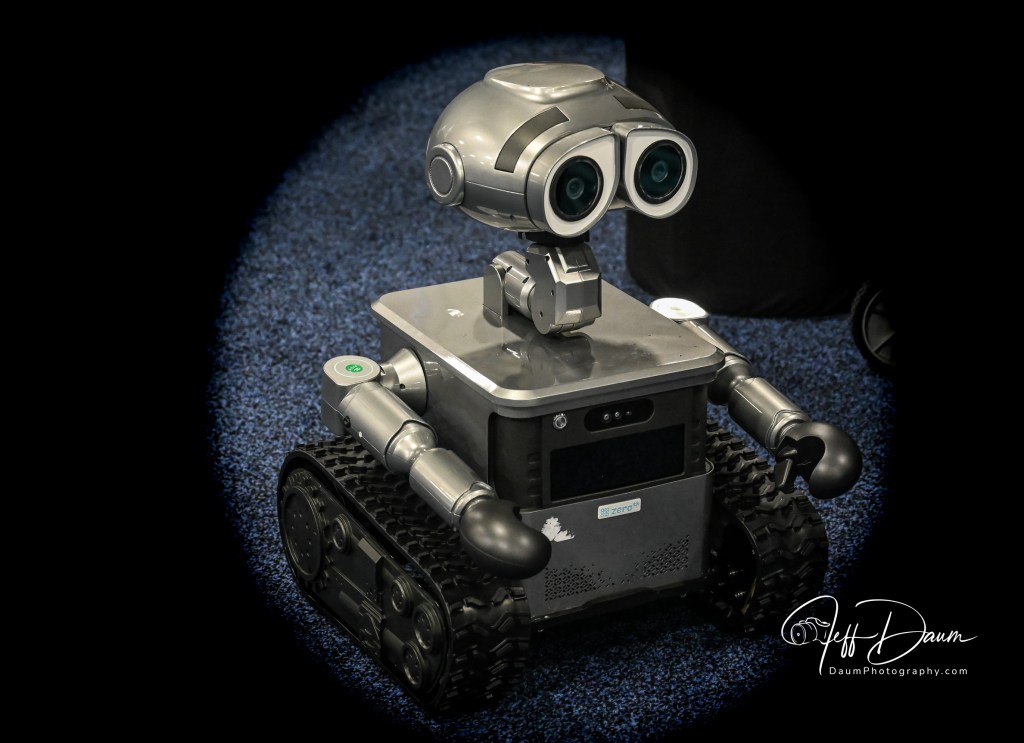
Everything that is electronic can be found at CES from supersized TVs, to cooking/food preparation appliances, to solar systems, power walls and generators, to vehicles of all sizes and shapes (giant John Deere harvester, fire trucks, regular cars, prototype cars, flying cars), powered wheel chairs, workout equipment, to cell phones and accessories, speakers to ear buds, toilets and faucets, and robots of every type and size.
CES is not open to the public, only manufacturers, buyers, sellers, investors, and the press. The first couple of days are restricted to the press and an opportunity to preview the ‘latest and greatest’ new technology of the show, along with many Keynote and PR presentations (like the impressive one by Nvidia’s CEO Jensen Huang). This is followed by four days of the exhibits being open across all the venues.
In addition to major players (LG, Samsung, Bosch, Nvidia, Amazon, etc.) there are many very small, often start-up companies there. It is usual to see, for example, an item by a known manufacturer like LG and BeatBot (pool robots) and then half a dozen or more unknown companies displaying very similar looking products with similar performance claims but sometimes of dubious quality. Products displayed range from actual production units to beta versions or even mock-ups.
What I like about CES is not only the opportunity to see (and handle or interact with) the newest technology, but also the chance to talk directly with respective CEOs, innovators, and technical gurus.
It seemed like there were fewer vehicles this year compared to previous years, but more exhibitors displaying advances in specific vehicle components (like lidar, dash displays, audio, EV motors and batteries).
It is hard to pick THE one product or technology that truly impressed me, because of the scope of CES, but several standouts are:
All solid-state battery for vehicle applications by Donut Labs
Status Pro X ear buds with Knowles balanced armatures
SwipeVideo immersive video streaming technology that lets users seamlessly switch perspectives by swiping through unlimited camera angles
Qlay’s AI software that detects the use of AI to cheat on tests or in an interview
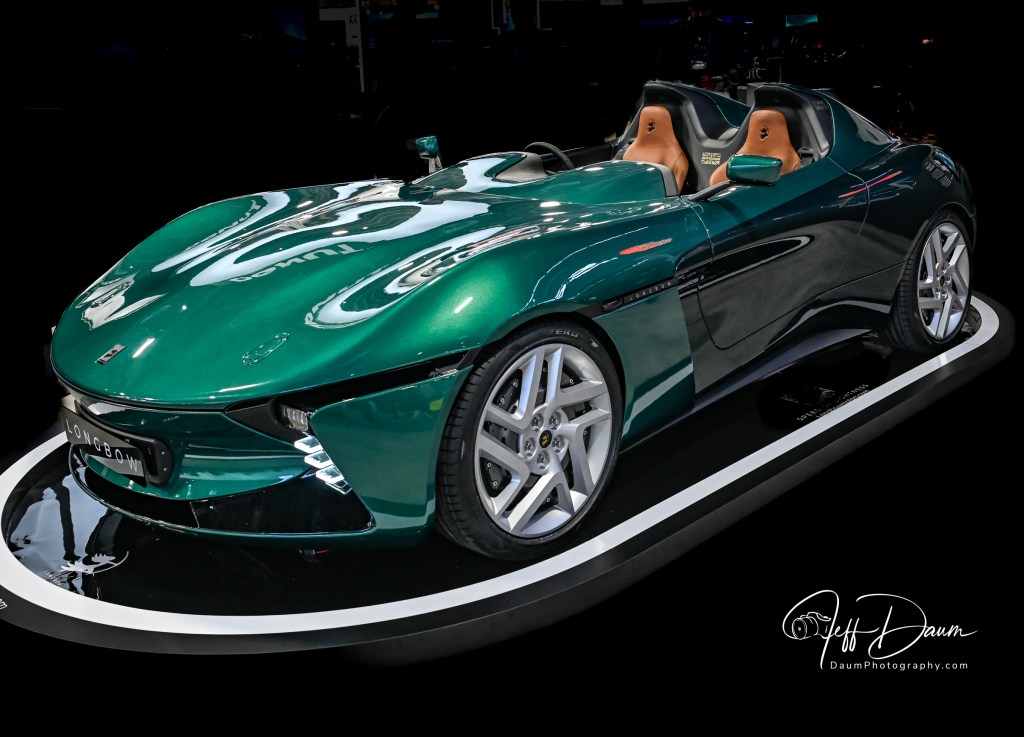
Longbow Speedster retro sports car built around cutting edge technology
Reolink’s use of AI to quickly sort through surveillance videos
Those of you who follow my blog might recall that I ended my initial article on Aptera Motors Corp.1 saying “This is hopefully Part 1 of a multipart Aptera review. Stay tuned for Part 2: a factory visit and first drive…” I just returned from Aptera’s production facility and while I did not get the opportunity to drive the Aptera, I did enjoy a ride in a preproduction unit.
My focus here will be on what I’ve learned and not to go over the points discussed in my initial article (link in footnote) other than to reiterate my full transparency statement: I was so impressed with the Aptera, its cutting-edge technology and dual CEO team direction and commitment, that I have placed and received confirmation of a pre order future variant all-wheel drive Aptera.
Our tour- my wife accompanied me being highly curious about the Aptera and why I was excited about it- was facilitated by Will Jarrett from Aptera’s Marketing department. Aptera Motors intended production facility in Carlsbad California is a bright open space building of approximately 77,000 square feet.
While the formal visitor tour set up is still being developed, parts of it are currently in place including:
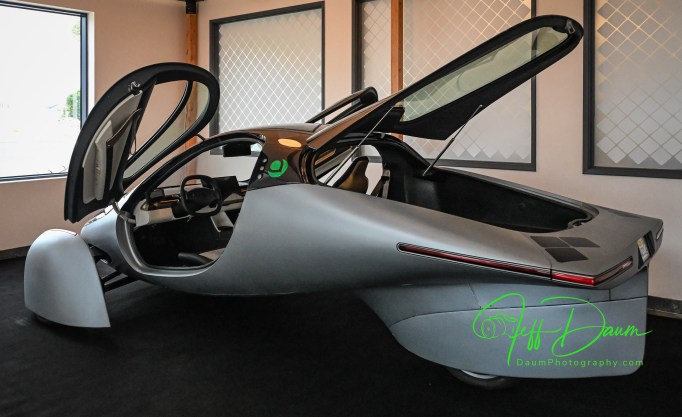
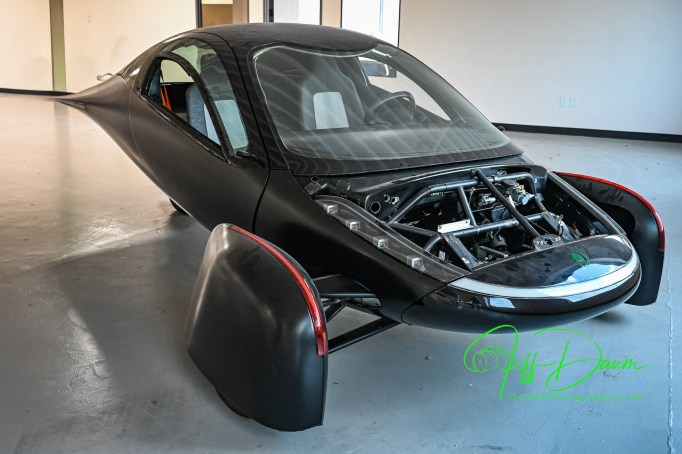
A preproduction version with the same body shape as the production version, but with a clear glass rear hatch instead of solar panels
The front-end light unit from the supplier with its classic smile look
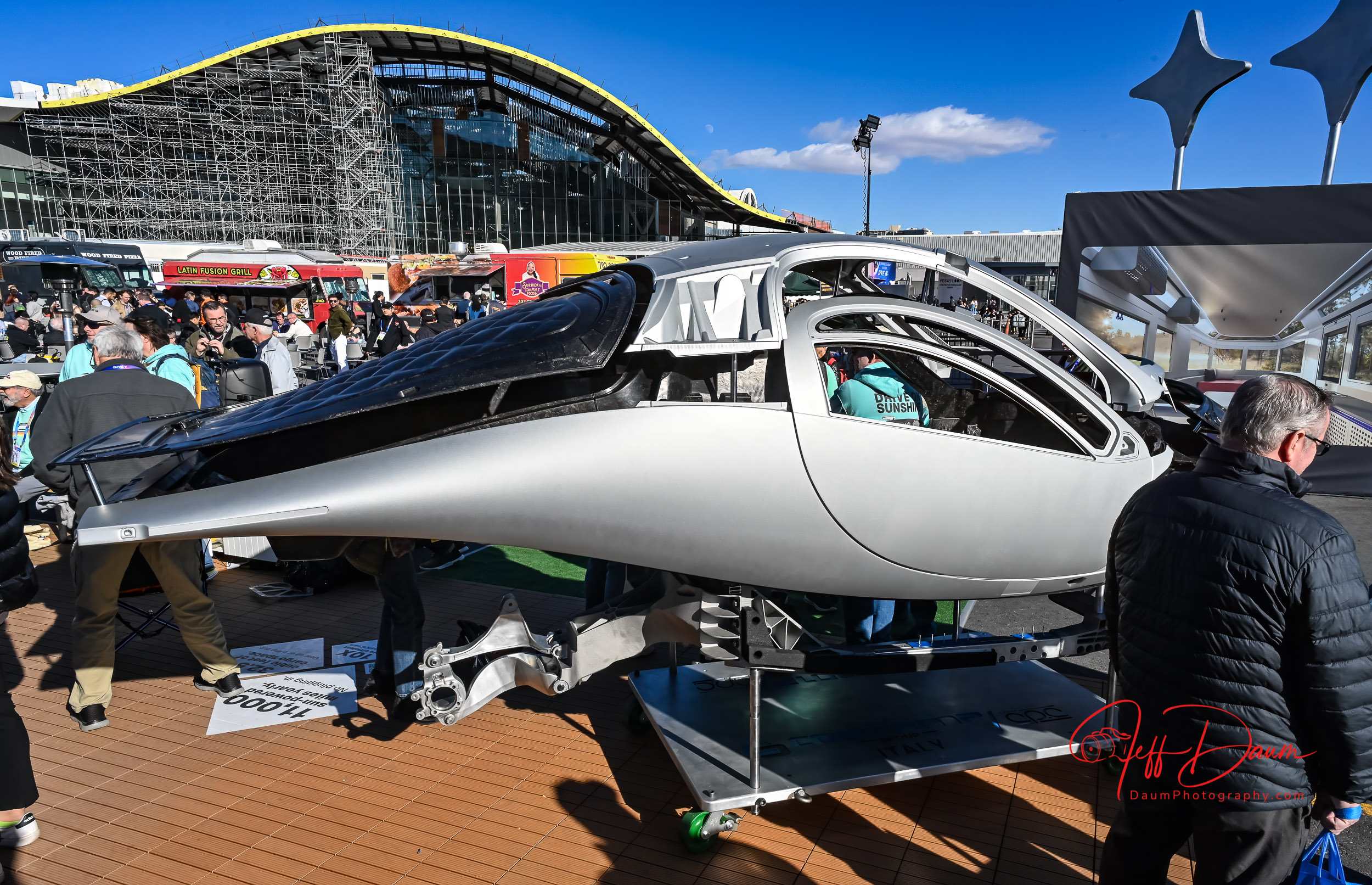
A complete body shell
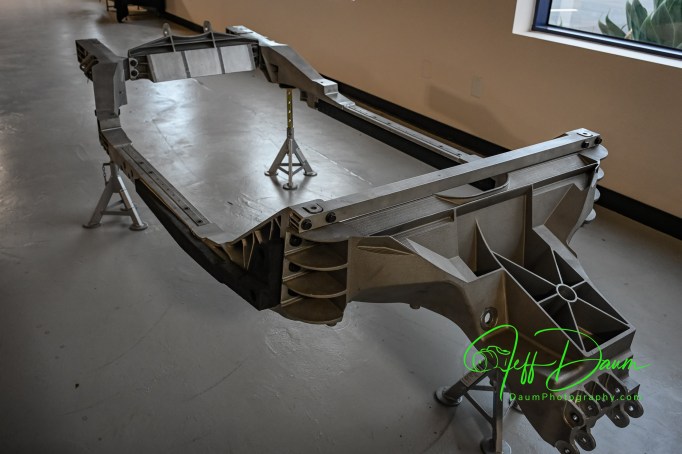
A full frame
An AGV robot of the type that will be used to automatically move the assembly components around the production line
Various solar panels for different sections of the Aptera, all designed and made in-house
An earlier version Aptera in striking matt black
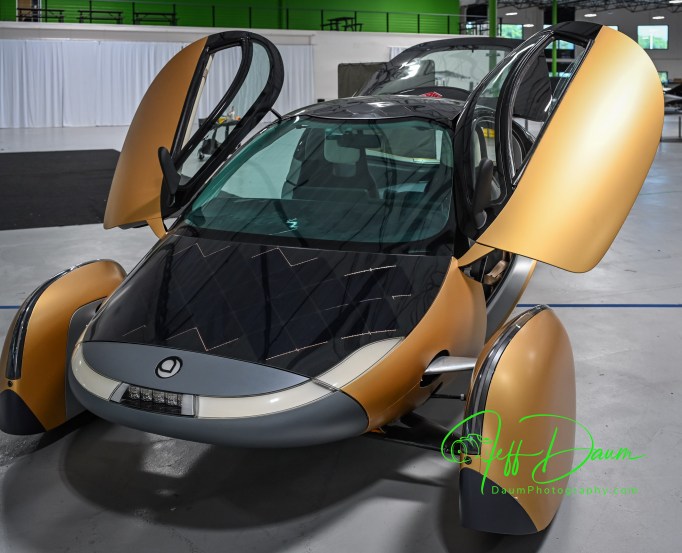
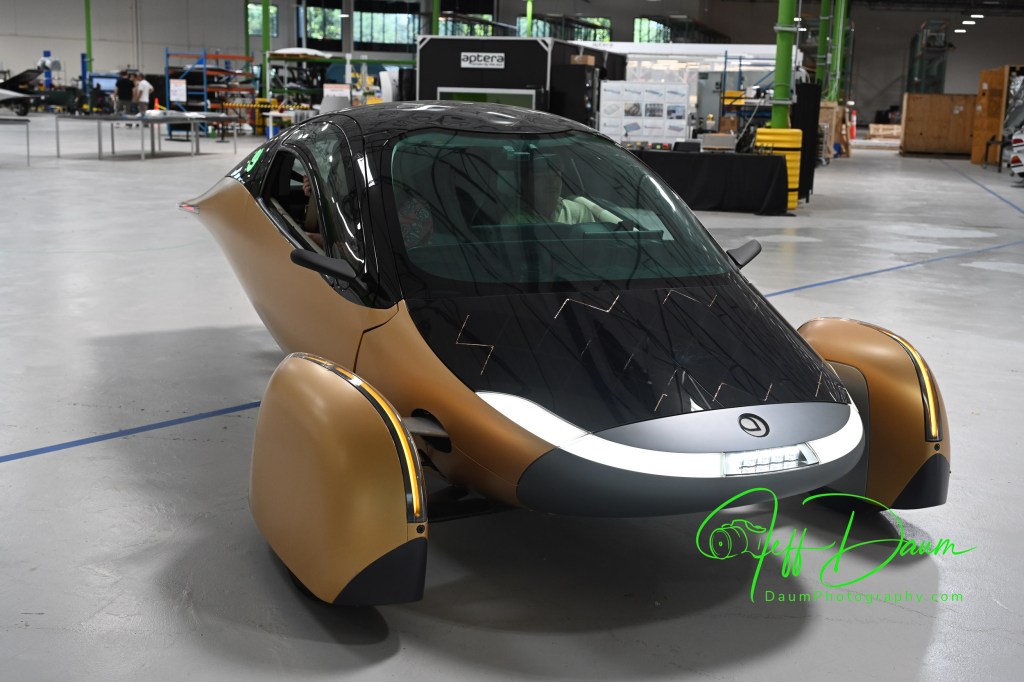
Gold colored Gamma version
More solar panels including those being sold to other companies for non-Aptera applications
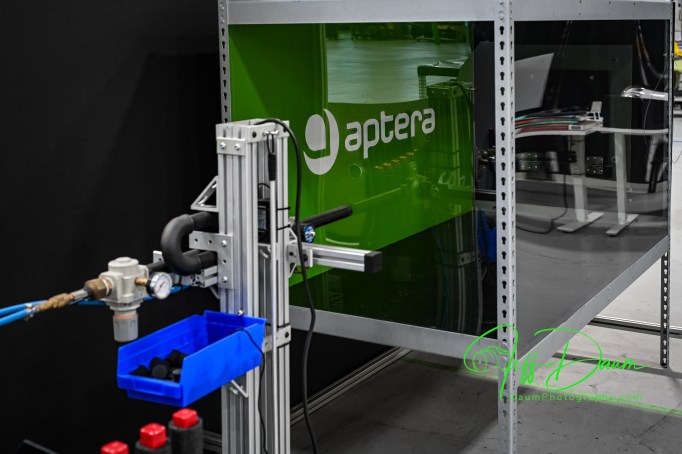
A pneumatic ‘gun’ for firing pellets at the solar panels for testing durability
Aptera bodies with nearly complete interior components
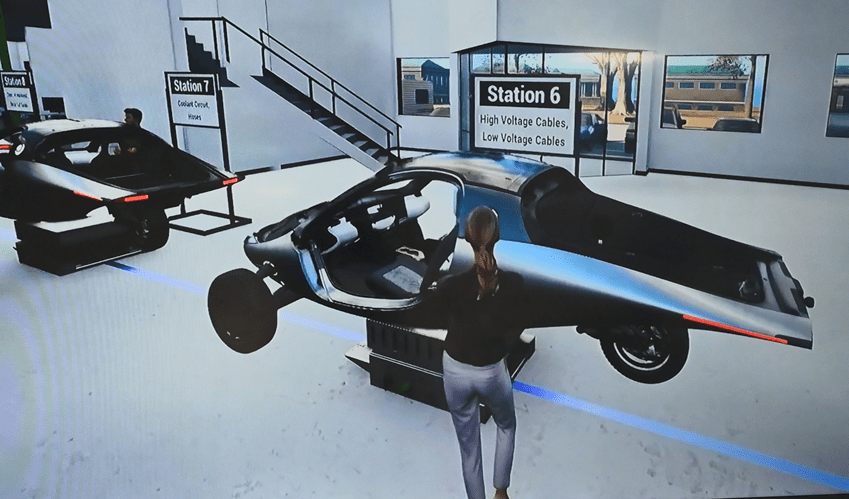
A video simulation showing the 14 or so stations that the assembly line will progress through on the AGVs
Not included in the tour were areas of the facility that housed testing rooms, subassembly rooms, etc.
As we walked through the facility, Will explained what we were looking at and responded to my questions. Here is a summary of our discussions. The extremely low coefficient of drag body is manufactured in Modena Italy by the C.P.C. Group and is a combination of Carbon Fiber Sheet Molding Compound and Glass Sheet Molding Compound and shipped over as a unit. Amongst its advantages are the significant strength to low weight ratio and that it has only six structural pieces compared to the hundreds that are used in most cars. The Aptera safety cage is modeled after Formula 1 cars!
It sits on a custom metallic chassis that is also made in Italy by the Costamp Group, located right next to C.P.C.
The components and Apteras as they are being assembled will be moved around the 14 stations of the production line on AGVs that follow the blue line that can be seen on the facility floor. The advantage of this AGV technology is flexibility over fixed production lines. If something happens with one of the AGVs it can be pushed aside and the line will continue to operate.
The cars will be primarily assembled by people, assisted by automation where practical. After the low-volume production phase, the objective is to produce 20,000 Apteras in this facility per year.
[above three images are screen shots from Aptera’s Media Simulated Production Line video]
The battery assembly will be done in house. 40 KWh unit will provide a 400-mile range. They will be using LG batteries.
The solar panels are designed and patented by Aptera’s team. They have also started licensing the technology to others for alternative applications. Amazingly they are bendable and have a glass surface similar to Gorilla Glass (as used in smartphones). They can withstand direct hits without breaking. The design allows for the panels to be replaced if necessary postproduction. For example, if a section gets damaged, or down the road the efficiency of the solar panels improves so much that it might make sense to swap the older ones out.
The production versions will have a solid trunk lid without glass and be covered with solar panels and use a camera for an unobstructed comprehensive rear view in a center mounted electronic rear view mirror (similar to the one used in the new Corvette for example). The side mirrors are combination of mirrors and cameras. The mirrors are required to follow existing US NHTSA law. The cameras show clear views of both sides of the Aptera on two screens directly behind the steering wheel.
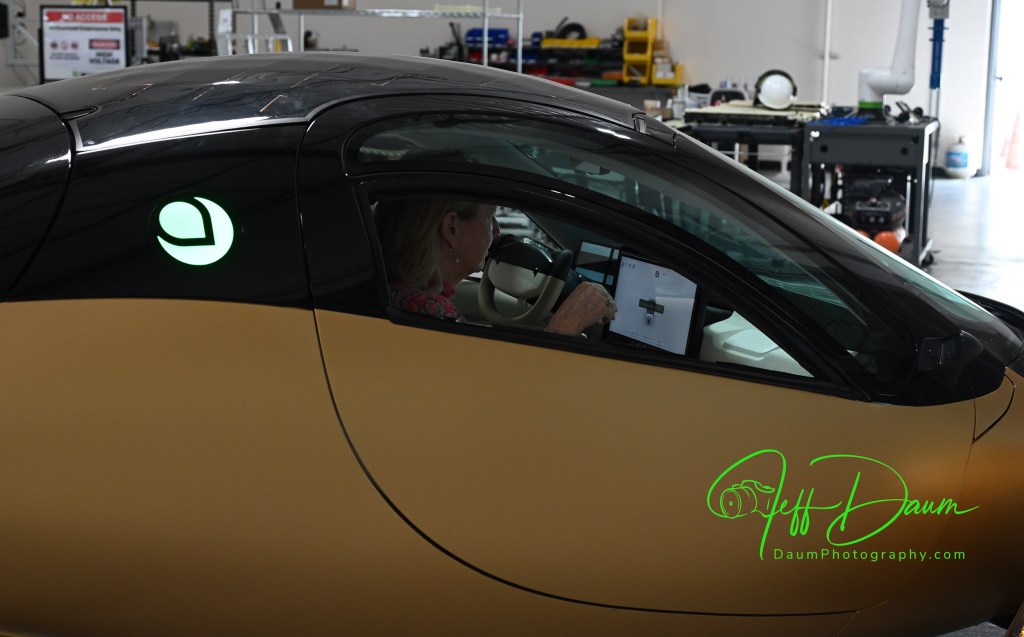
The gold unit “Gamma” in the following image is the most recent prototype, though they now have Production Validation versions. This is the one we rode in.
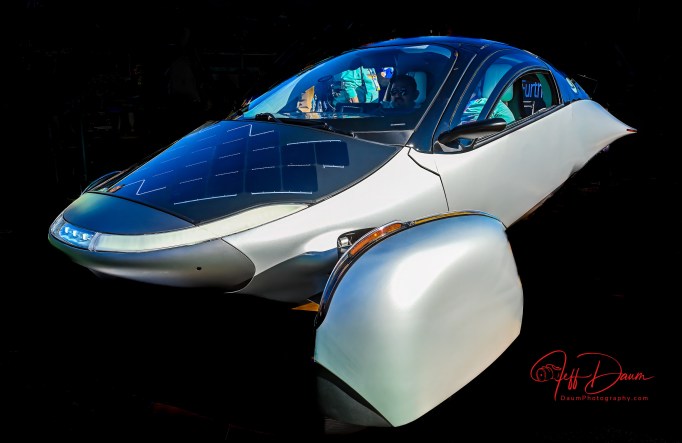
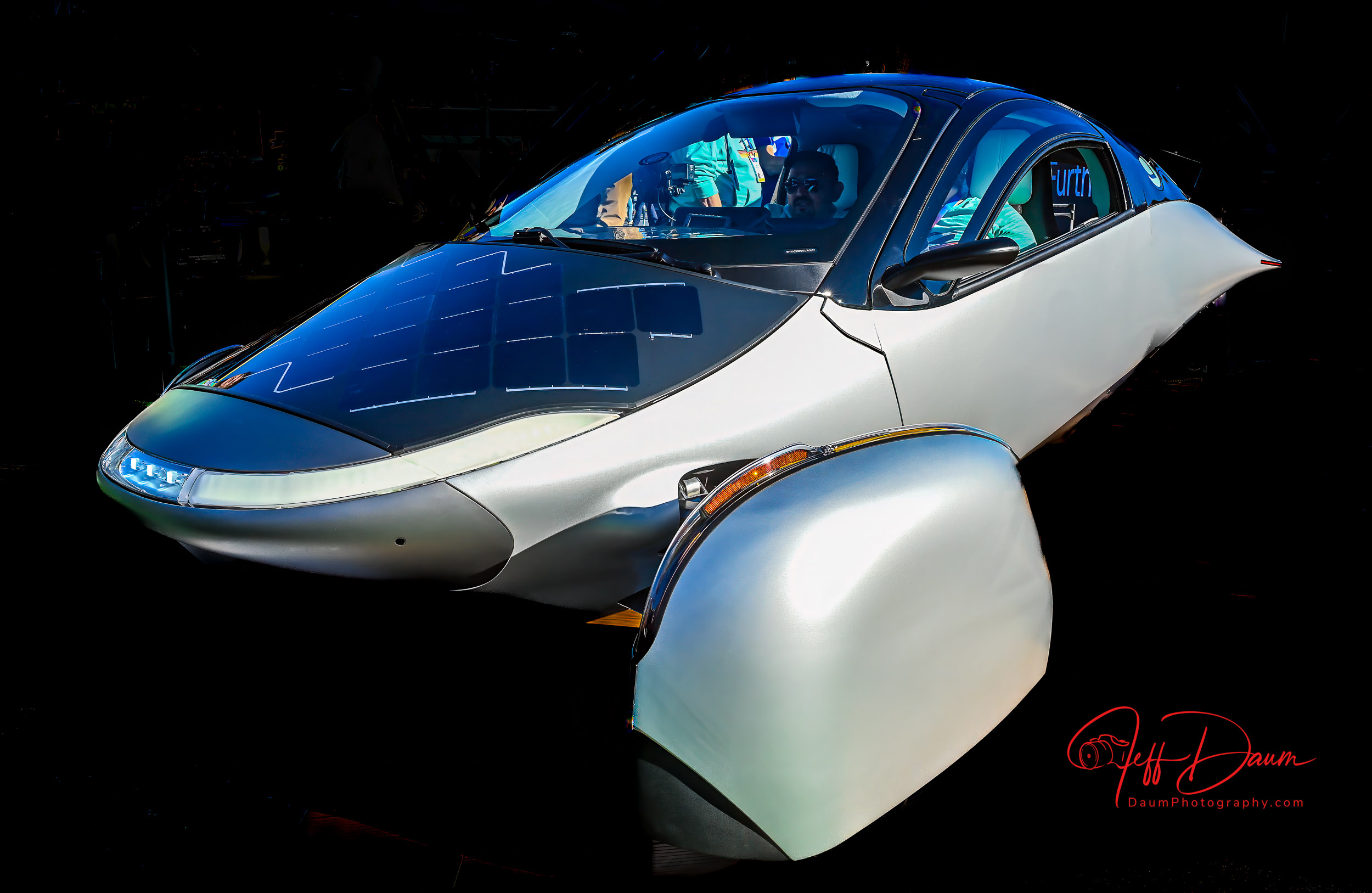
The silver unit is a current Production Validation Aptera called Artemis and is the one that they did the extended Route 66 trip.
There are a few additional things that Will pointed out. They have built-in fail-safe backups like having buttons behind the large central screen that will allow you to continue to drive the Aptera if the screen fails.
The trunk lid is designed to open part way without flying up so that if you have a low ceiling you don’t have to worry about it hitting it. You manually open the lid the rest of the way.
There are plans to have several options for the battery pack beyond the standard 400-mile range, including a 250-mile range, 600-mile range and 1000-mile range. Also having a Level 2 Autonomous driving option.
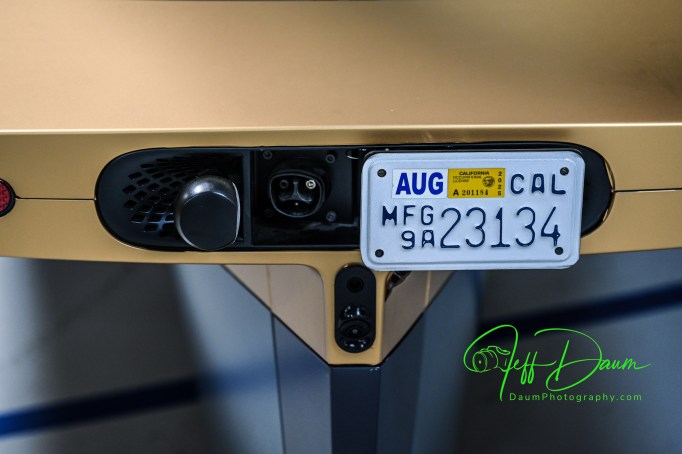
In the image above, you can see the North American Charging Standard (NACS) port located behind the license plate which slides to the side providing access
While Will is not permitted to discuss the status of funding he said once sufficient capital is obtained it will be about nine months until the first production vehicles are finished and out the door.
My thoughts following the tour and ride
Having driven several all-electric vehicles from different OEMs and currently owning one, I’ve come to expect lots of torque and rapid acceleration from an EV and Aptera doesn’t disappoint. What I did not expect was that Aptera, a three-wheeler, would feel so rock solid through turns at speed.
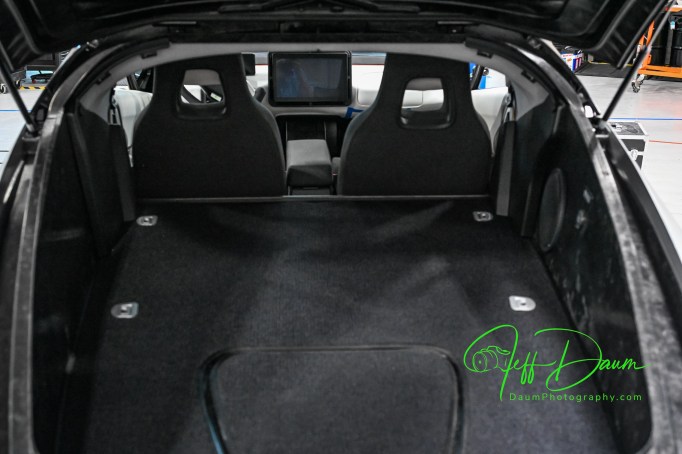
The interior is roomy and comfortable, feeling for example very comparable to my Corvette Stingray Coupe (but Aptera has more headroom) with a surprising amount of usable space behind the seats.
Visibility looking out is very good and supplemented by an electronic rearview central mirror as well as electronic side views on two screens directly in the driver line of sight.
Aptera has lots of ‘coolness factors’ including its slipstream shape, knock on the body to open doors and trunk (no outside handles) and the solar recharging.
I am left with two concerns at this point: One is a driving practicality issue and the other is whether Aptera will achieve financial fluidity to realize their objectives.
What I mean by driving practicality comes down to how the two “outrigger” front wheel units will survive in real world situations. They are quite wide at approximately 88” across when the wheels are straight and wider when turned off center. This width is further compounded by the fact that the tops of the wheel units are low with respect to the Aptera body. That wheel unit to wheel unit width is greater than many cars and even small trucks on the road today.
Here is why I think this may be a concern: If you backed your Aptera in the center of a typical parking spot in a parking garage, the slot often is only 9 feet or less wide, which leaves about 10 inches or less between the edge of your wheel unit and the edge of the next parking slot. If a car, or worse a truck, then goes to back in next to you and turns in rather than pulling straight in, what are the odds that they will only glance at the body of your Aptera and not see the outrigger front wheels? Since the Aptera front wheels contain also the driving motors if they get brushed or hit the damage could be considerable. Will the wheel units need some sort of pop-up flag or indicator to ensure they are seen and avoided when parked?
This width will also require drivers to maintain better vigilance regarding staying in the center of their lane and not straying on the road compared to driving other vehicles.
Regarding Aptera Motors Corp. viability I did some research on their current financial Issues. Based on Aptera’s August 27, 2025, Form S-1 filing for listing on NASDAQ here is their estimate of funding still needed for production: “Our production plan for our Carlsbad facility is phased and each phase is contingent upon a specific level of funding. The initial “low-volume” production phase is estimated to require approximately $65 million in capital to fund remaining necessary tooling and validation programs. Following the initiation of low-volume production, a second phase to ramp to high-volume production would require an estimated additional $140-$160 million. This high-volume rate, which we project to be approximately 20,000 vehicles per year at our current facility’s maximum capacity, was a figure determined in consultation with Munro & Associates, a firm specializing in lean manufacturing principles for the automotive industry.”
“Specifically, securing the capital estimated for both initial low-volume and subsequent high-volume production phases is critical. Until this funding is secured, the Company will be unable to predict if and when production will commence.”
Hopefully the listing on NASDAQ and subsequent offers will go well (and rapidly) for Aptera- I am so looking forward to having one in my garage!
P.S., My wife really enjoyed her ride and was impressed with the Aptera 😊.
Marques Brownlee has just posted an informative video based on his driving a preproduction Aptera. You can view it at https://www.youtube.com/watch?v=2OvyyVxQjuI He raises some excellent points.
Stay tuned for my next Aptera update! Thanks for visiting and reading. If you have a question or comment, please feel free to enter it below!
This is an initial look at the Aptera all electric solar vehicle presented at the 2025 CES (Consumer Electronics Show) in Las Vegas, Nevada.
Let me begin with a full transparency statement: I was so impressed with the Aptera, its cutting-edge technology and dual CEO team direction and commitment, that I have placed and received confirmation of a pre-order future variant all-wheel drive Aptera.
The first thing that you notice is its unique aerodynamic shape. In fact, because of this shape it has the lowest coefficient of drag of any road vehicle at approximately 0.15! The body was designed in concert with Pininfarina and is out of carbon fiber. It is manufactured in Italy and shipped to Aptera Motors facilities in Carlsbad, California.
Probably the next thing you will notice is that Aptera has two front wheels and one rear wheel- an autocycle. It is classified by the DMV as a motorcycle, specifically a Trike with full enclosure. This means that it is registered as a motorcycle but you will not need a motorcycle driver’s license nor need a helmet.
Like most sports cars, the interior includes side-by-side two passenger seating. It has all the normal accouterments: safety belts, frontal driver and passenger air bags, a steering wheel, accelerator and brake pedals, ac and heat, etc. In front of the steering wheel is a horizontal screen that continually shows full views of the right and left side of the Aptera virtually eliminating any blind spots. To the right of the steering wheel is the infotainment and information display. The electronic rearview mirror shows the unobstructed view behind the Aptera (from a camera on the roof). There is also a backup camera located adjacent to the license plate. The plate holder slides to the side, revealing the NACS charging receptor.
Aptera has bespoke solar cells on the hood, dash and roof capable of generating 700 watts of electricity. Each cell is incredibly thin, lightweight and glass covered yet capable of being bent to conform to the respective body shape. According to their website details, an individual cell could be cracked yet continue to generate power because of its unique wiring.
While I was at CES, one of the two Production Intent Vehicles was driven for 25 miles on the streets around Las Vegas. The solar cells generated and put back into the batteries the equivalent of 29 miles of electricity! Wait, what? Yes, it generated more power than it used. Of course it can be plugged in to recharge its batteries. Plugging into a regular 110-volt outlet will put approximately 150 miles of energy into the batteries overnight. It can also use Level 2 chargers which will put approximately 60 miles of energy into the batteries per hour or a DC fast charger can put approximately 500 miles of energy into the batteries in an hour. The Aptera recharges in about one fourth of the time of other EVs.
According to Aptera’s website, “the Launch Edition uses 21700 NMC 811 cylindrical lithium-ion cells, known for their high energy density and long life. The 44 kWh battery pack contains 2,304 cells, delivering 400 miles of range.” [ https://aptera.us/article/what-batteries-are-inside-aptera/ ]
I had the pleasure of talking with Chris Anthony, Founder and CEO Aptera Motors.
Chris image courtesy of Aptera
Chris’ partner, Steve Fabro, also carries the title of Founder and CEO.
Steve, image courtesy of Aptera
I started off asking Chris about Aptera’s design elements to ensure safety, Here are highlights from this interview:
Regarding Aptera’s safety: Able to do things with carbon fiber that steel and aluminum vehicles can’t do. Able to add protection such as great frontal impact strategies, offset frontal, side impact. Crash energy is diverted from the passenger area downwards to the well protected battery and frame. Aptera has front and rear crumple zones. Aptera has front and rear crumple zones and a carbon fiber roll bar.
Suspension dynamics: even though it is a three-wheel vehicle, because the heavy battery is mounted so low, it has almost the exact same suspension dynamics as a VW Golf.
Done lots of track testing and skid pad stuff, curb strike angles at forty-five miles per hour, pothole tests every which way you can think of with the vehicle, and because the battery weight is so low it is extremely stable.
We will be running Crash Tests shortly.
It has better ground clearance than a Honda Civic with six inches to the belly and five and one-quarter inches to the wheel pans, and ingress and egress a couple of degrees better than the Honda Civic.
Regarding stability, especially with the large area by the rear wheel, it has a low-profile mid-section. We have simulated cross winds up to 115 mph and it performs better than other vehicles because flat sided vehicles are much more susceptible to the winds. There is no float created because it is basically a downforce vehicle that creates a bit of downforce, though we attempted to keep it as neutral as possible.
The tires are 195-55 R16 low rolling resistance, specially formulated for them by Hankook Tires.
The ABS and airbags (passenger and driver frontal airbags) are currently undergoing calibration.
It has DC Fast Charge, Level 2 and regular 110 outlet capability. The 110-volt outlet will provide 150 miles charge overnight. The Aptera uses one quarter the energy of the average EV, meaning we charge four times faster. A DC Fast Charger will put 500 miles an hour into it, a Level 2 will put 60 miles per hour and a regular outlet will put 13 miles an hour into it.
Currently we have more than 50,000 preorders from across 115 countries, had the largest Crowd Funding in the industry with 20,000 individual investors, and now working on an IPO and hope to have production vehicles in people’s hands by the end of the year.
No dealerships, but have distribution centers around the world, and working with some Tribal communities in states that don’t like the lack of dealerships similar to what Tesla does.
In sum, the Aptiva is much more akin to a formula one car than anything else on the road. It is the penultimate in aerodynamic efficiency and has a carbon fiber chassis through and through. It is an interesting mix to try an be the most efficient vehicle in the world but also have really extreme performance, when you look at the how the vehicle is constructed and how we achieve 100-watt hours per mile and still keep safety paramount, and get all the solar power out of it we need. The Aptera is the most efficient vehicle in the world but still sporty and very nimble.
the core of our design is a safety cell crafted from Carbon Fiber Sheet Molding Compound (CF-SMC), which is both ultra-lightweight and stronger than steel, paired with metallic subframes that absorb impact energy.
Aptera’s body features a specialized composite structure known as Body in Carbon (BinC), primarily constructed from Carbon Fiber Sheet Molding Compound (CF-SMC) and Glass Sheet Molding Compound (SMC). CF-SMC is a lightweight material that utilizes a random arrangement of short fibers, allowing for the creation of intricately shaped parts with significantly higher stiffness and strength compared to standard SMC.
Aptera features an unequal-length dual wishbone suspension in the front and a double trailing link suspension in the rear. This advanced suspension system provides a balanced combination of stability, control, and ride comfort, allowing for smooth handling across diverse terrains.
The largest single component is the carbon fiber tub.
Use of SMC side panels on the body that won’t dent when hit.
Front wheel covers rotate up to allow access to tire valve stem and rear tire has a small access hole for the same purpose.
At Aptera, we’re redefining the repair experience by making it accessible, straightforward, and affordable. Whether you’re repairing your vehicle yourself or working with a local shop, Aptera will provide detailed documentation and make spare parts easy to order. Unlike typical processes where maintenance information and parts access can be limited, we believe in empowering owners with everything they need to keep their vehicles in top condition.
The Launch Edition’s dimensions are optimized for aerodynamics and stability. The vehicle measures 15 feet (4.56 m) in length, 7.3 feet (2.22 meters) in width, and stands 4.6 feet (1.4 meters) high, with a wheelbase of 9.2 feet (2.82 meters).
Aptera has integrated the Vitesco Technologies’ EMR3 drivetrain—a high-voltage axle drive that combines a permanent-magnet synchronous e-motor, inverter, and reducer in one compact unit.
Final thoughts:
I had a chance to sit in the Production Intent Aptera and found the seats very comfortable. The interior is airy with great outward visibility. The ‘double knock’ to open the door or trunk is a fun twist- there are no outside door handles. The trunk is quite spacious, easily carrying two regular golf bags or even, apparently, with the seats folded forward, room to lie down if you take the Aptera camping. There is also a small compartment under the regular rear floor that can be used to store charging cables or other supplies.
I am particularly impressed with Chris and Steve’s vision and approach. They are continually striving to use their own and their team’s knowledge, seek and use outstanding third party input and resources, and harness AI to refine the Aptera to be highly efficient, practical and fun. The use of Open-Source Software and Right To Repair sets the Aptera apart.
Of course, the ‘elephant in the room’ question, unanswered at this point is whether Aptera will make it where many others have failed. Their concept appears sound, the technology is there, Production Intent Vehicles validated, but the financial green light is still pending. According to Scooter Doll writing for electrek on Nov 5, 2024: “Last we heard, Aptera had raised over $135 million from over 17,000 investors, which the startup touted as the most successful crowdfunding raise in history. However, the company shared that it would need another $60 million in additional funding to begin low-volume SEV production, now slotted for late 2025.”
This is hopefully Part 1 of a multipart Aptera review. Stay tuned for Part 2: a factory visit and first drive…
Thanks for visiting and reading. What are your thoughts on the Aptera? If you have a question or comment, please feel free to enter it below!
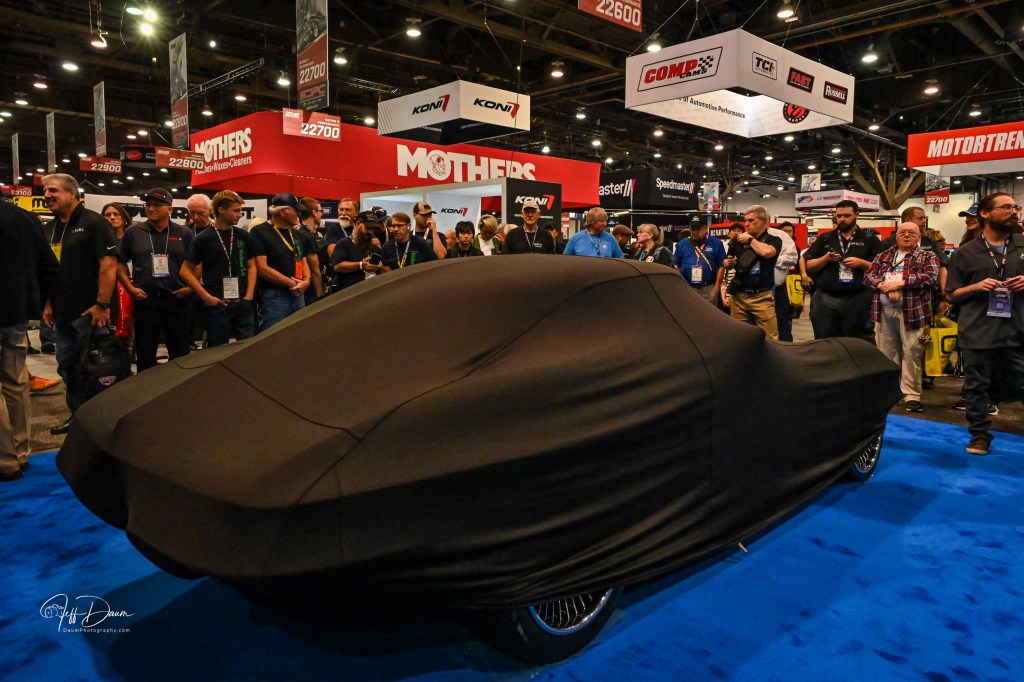
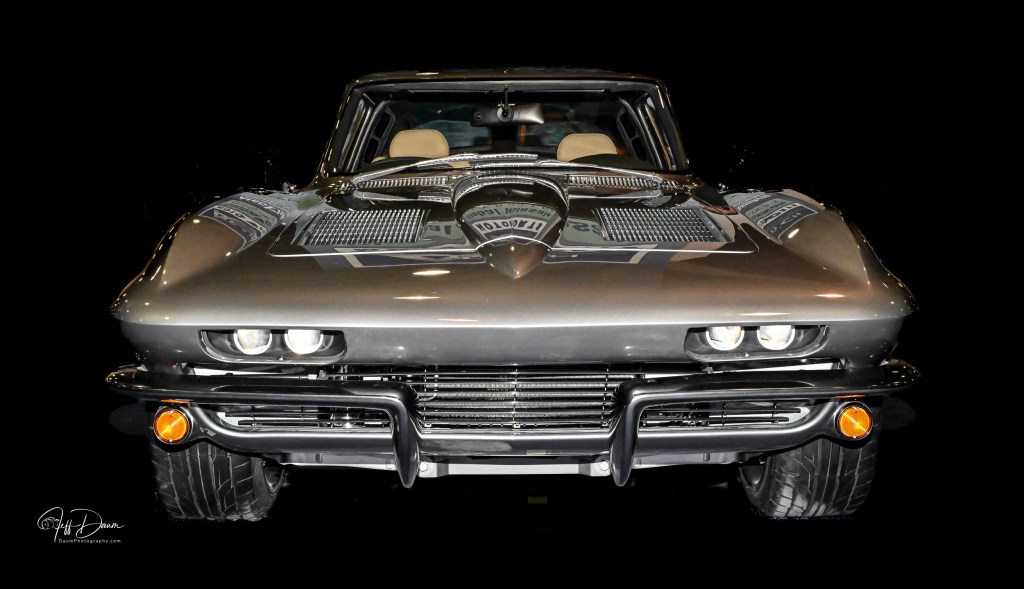
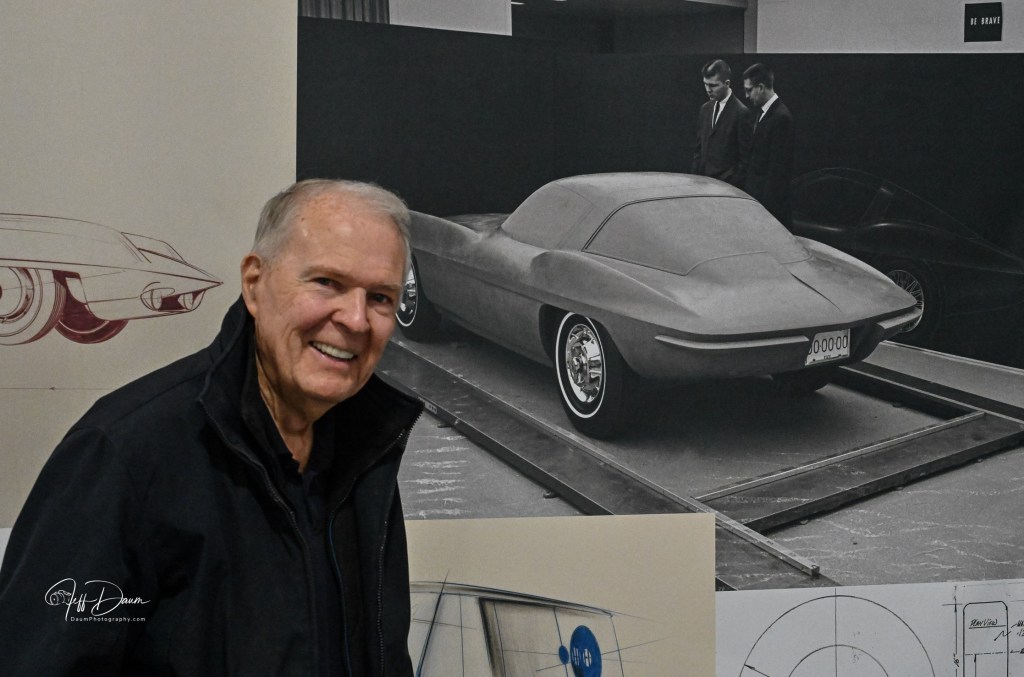
Sixty-seven years ago, Peter Brock penned the sketch that Bill Mitchell[2] chose to become one of the most iconic cars: the split window 1963 Corvette Sting Ray. At the time, Peter was the youngest designer at General Motors. He would go on to be a renown visionary and prolific designer with accolades and records for a broad range of his designs including the Datsun 510 Coupe, Cobra Daytona Coupe, Shelby-DeTomaso P70 and Aerovault trailer. But my focus here is on Peter’s latest achievement, the 2025 Sting Ray Studio Concept car[3] revealed at the 2024 SEMA[4] show in Las Vegas, Nevada.
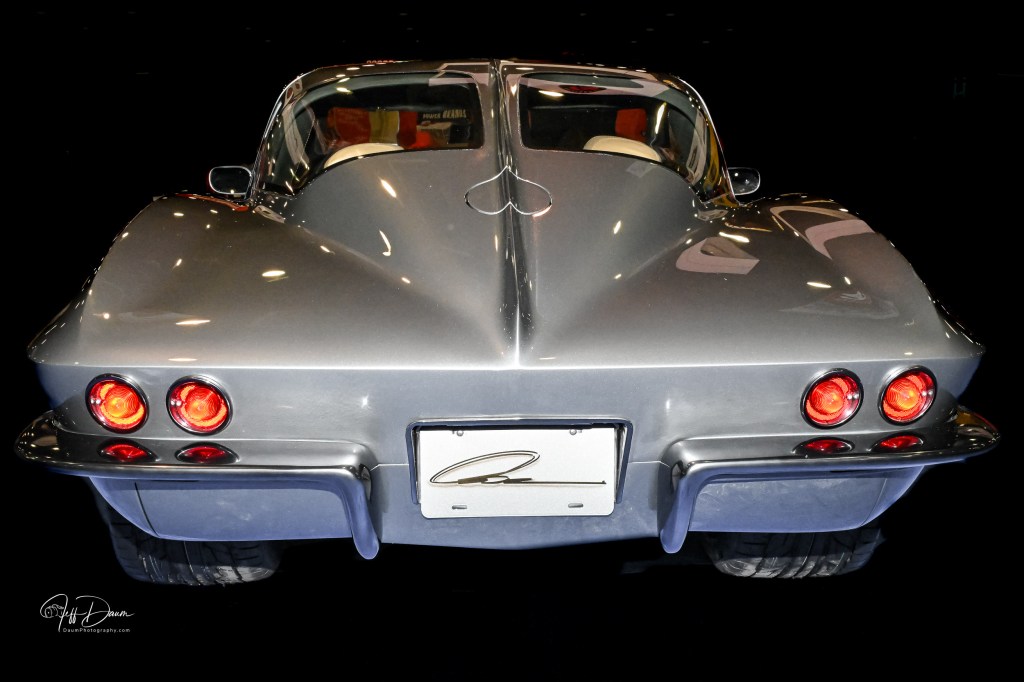
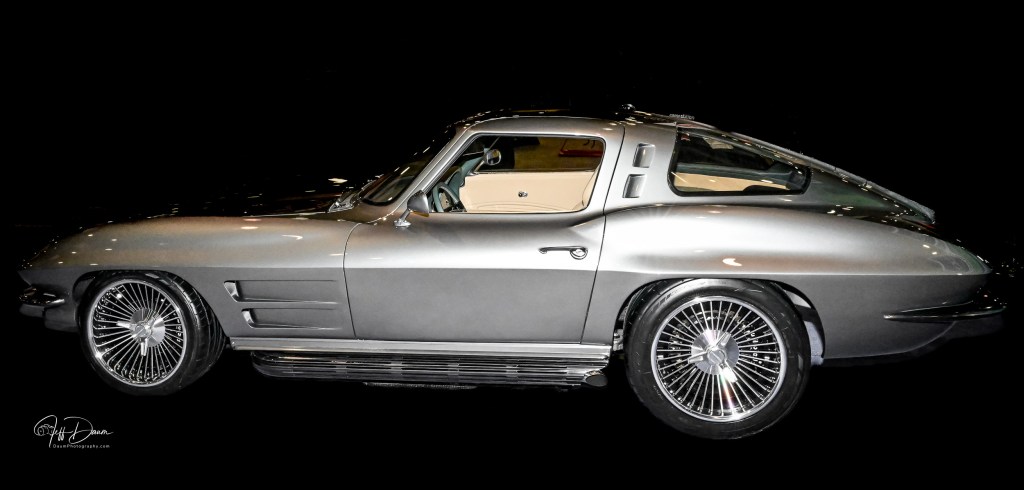
At first glance when the cover was drawn back on the 2025 Sting Ray Studio Concept car at SEMA, the body looked very similar to a well preserved 1963 Sting Ray even though it was described as a resto-mod. Peter had done something other resto-mod builders of the C2 Sting Ray had not. He retained the original body shape and design, staying away from radical changes such as widening the body, adding bulging fenders, etc. More importantly Peter added back into the 2025 Sting Ray subtle details and changes to bring it closer to what he had originally designed.
Peter shared with me the back story on how, and why, this came to fruition. He made a conscious decision to change as little as possible in the body to retain the original form since it was well established as an automotive design icon. In the five years it took to take its design to being a production car in 1963, GM was primarily focused on making money so there were compromises made on which details went into the final car. In this 2025 Sting Ray Studio Concept car Peter wanted to restore some of those important details.
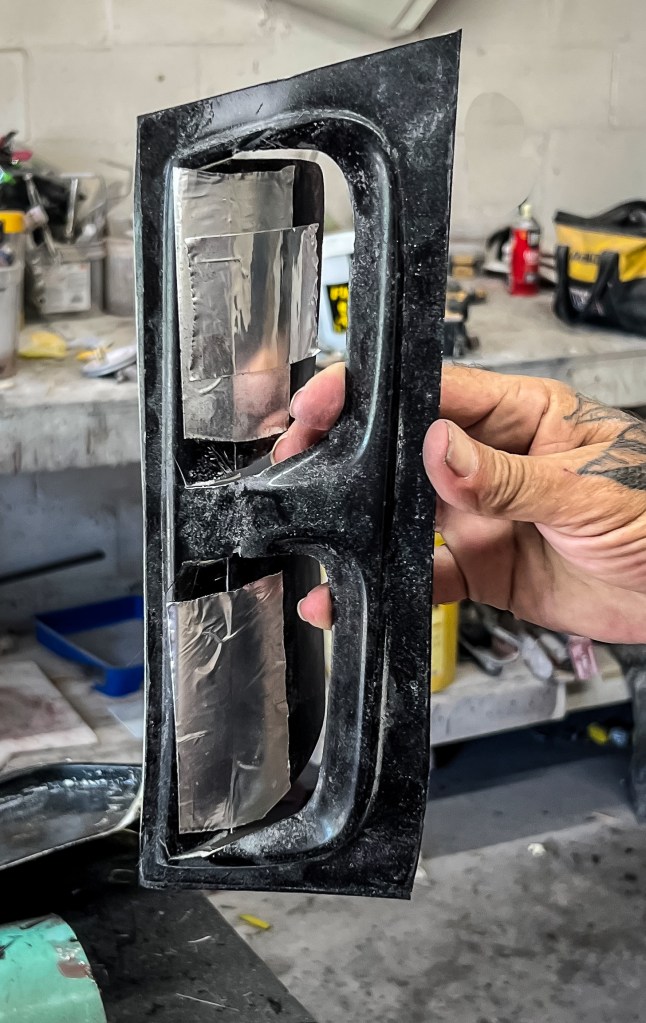
Peter worked with Mike Staveski and his company, Resto Mod Vette to build the 2025 Sting Ray. This is the second car that he did with Mike, but the first one that is designed fully to Peter’s specifications. Here are a few images of Peter at Mike’s shop making some of the modifications:
They began with a 1963 donor Sting Ray body. Mike decided on and sourced the modern drivetrain and chassis which included:
GM crate LS3 engine
Electronically raised and lower hood
Harrop fuel injection
Holley engine management
Dewitts radiator
4L60e transmission
PSC push button shifter
Ididit steering column with Sparc Industries Wheel
Dakota Digital gauges (with Peter’s signature)
Vintage Air AC
Art Morrison custom chassis
Cerakote frame
C7 front suspension with AME IRS, Ridetech Coilovers
Wilwood electric brakes
Additional Corvette parts from Corvette Pacifica
Additional parts from Atech Motorsports
Dynamat sound proofing
Custom glass from AM Hot Rod Auto Glass
Douglass Interiors Leather, Linen & Sage
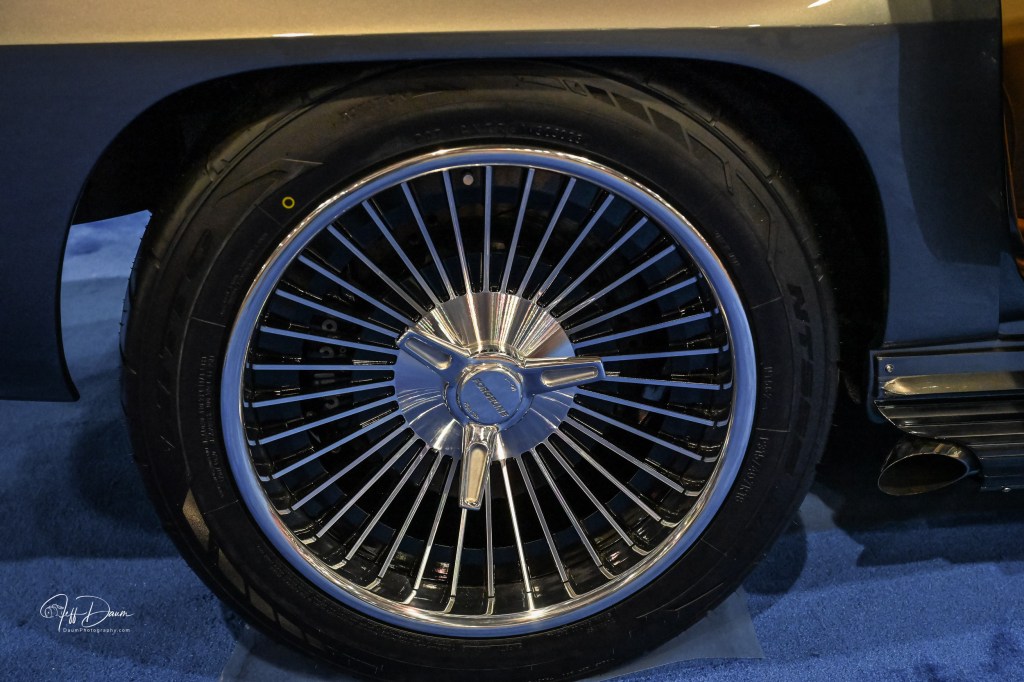
Forgeline 18 wheels
GM Hypersonic Gray paint
Peter designed and supervised the details he wanted to add back to the body. These included making all the vents and air scoops functional. Mitchell, at the time, wanted the nonfunctional vents because while it saved money by not making them real, it added perceived value to potential buyers as they viewed the car in the showroom.
[Note: clicking on an image in these mini galleries will bring it up to full size]
Another important change for Peter was to improve the interior visibility. Mitchell wanted a split rear window on the 1963 Sting Ray as homage to the Bugatti 57SC Atlantique, but that impacted the rearward visibility and Zora Arkus-Duntove[5] was really upset with Mitchell for mandating that. In Peter’s original sketch the glass was not split and went all the way down to the radius along the side. To improve this on the 2025 Sting Ray, Peter enlarged the area of each split window and eliminated the “B” pillar on the doors so that now the side windows are one continuous piece of glass. Together these changes result in better visibility from the inside of the Sting Ray and it feels more open. Complementing this, Peter used only the finest materials on the interior of the resto-mod. This is reflected in the new instrumentation, the top-grain leather on and around the dash, including around the air ducts. All that leather was hand stitched but resulted in a very high-end production finish.
Continuing with detail changes on this 2025 Sting Ray, two more can be seen when looking at it from the back. In addition to the enlarged split windows, Peter brought the fin all the way down to the midline of the body through and including the gas filler door. The fin is also slightly raised paying more homage to the Bugatti Atlantique. A nice detail is that the gas cap can now be placed into a holder inside of the gas filler door when removing it. At the front of the car the headlights have been changed from the flip up 1963 approach to built-in LED quad headlights with halos. Most of the original bright work on the body, like the bumpers, was downplayed and changed to black chrome encouraging one’s eyes to focus more on the overall form. Peter also put his race-type mirrors on the doors, which work well with the flow of the body.
At one point in our interview, Peter mused that this is based on a sixty-seven-year-old design, saying “how does something last that long and still evoke such admiration and desire from people that see the car.” He went on to add “the impetus for the Sting Ray grew out of Mitchell going over to Italy and seeing all the streamlined cars and bringing back photographs of them for us to study. I do not think he knew whether we could design a car that would meet his expectations. But once he saw what we were turning out, his enthusiasm grew, and he kept coming back into the studio to see the progress we were making. We did not always agree on direction, for example, I wanted the nose lower and back end higher, but Mitchell was traditional and knew the drop away in the rear would sell, so that is what we went with.” With emotion, Peter added that he had a particularly good relationship with Mitchell, and that he was a great mentor. Tony Lapine and Larry Shinoda, veteran design specialists, took over the final version as the Sting Ray was getting ready to go into production. Peter had been moved to work with Harvey Earl.[6] He added that it would have been super to have Tony and Larry around to work with him on this 2025 Sting Ray. Since that was not possible, he wanted to make sure it stayed true to their original efforts.
Peter said Mike has a super crew who worked on this 2025 Sting Ray. It came out so well and has been so successful that Peter and Mike have decided to do a series of these cars. Mike told me (JD) he has sold three of these already. This one is headed to Barrett-Jackson’s Scottsdale auction. Craig Jackson, CEO Barrett-Jackson, was at the SEMA reveal and was very impressed with the car and intimated it may be his feature car at the auction. Based on the level of enthusiasm and interest, Peter and Mike think they may do a dozen or two of these cars. Each will be different in terms of paint, interior and finish, but the overall design details will remain the same, so it becomes a limited production that follows the Studio Concept. Mike already has plans for a Z06 version that will follow this same approach. I mentioned to Peter that notably missing on this first 2025 Sting Ray were some safety features such as shoulder (three-point lap) belts and air bags. Peter said he expects more enhancements to make it into upcoming versions, and that the seat belts in this one will be changed before Scottsdale.
It almost seems heretical to talk about cost when discussing the sheer beauty, art, and evolution of the 2025 Sting Ray, but I know some readers will ask me if I do not. Mike told me he has priced these Studio Concept models starting at USD 495k. Of course, Barrett-Jackson’s Scottsdale auction will provide a real-world test of the market value of Peter’s 2025 Sting Ray.
Lest you think Peter, at 88 years old, is now resting on his laurels, he took me into his studio to show me his new car project. Of course, it is sleek with some neat aerodynamic features, and he is very excited about it. However, that is all I can share now, details are currently embargoed but stay tuned.
Thanks for visiting and reading. If you have a question, please feel free to ask below!
[1] Primary sources for content were interviews with Peter Brock and Mike Staveski. Other sources included Peter’s book Corvette Sting Ray Genesis of an American Icon and Brock Racing Enterprises publications.
If you have ever lost your OEM FOB you know what a hassle it typically is to get a replacement from the dealer and to get it programmed properly, let alone the steep cost you incur.
While there have been non-OEM FOBs available for years, most don’t end up working or require you to still go to the dealer to get it properly programmed, again at a significant cost.
Enter Car Keys Express.[1] Their byline elegantly sums it up: Replacing car keys is simple and affordable again.™ Founded in 2006 by CEO Mark Lanwehr, no not in his garage 😊 but on the dining room table of his one room apartment. By 2006 it was the first online retailer of automotive keys and keyless entry remotes. Two years later Mark started offering his services to dealerships and fleet owners and now serves over 3,000 cities in the US and Canada. Along the way they added self-serve kiosks and remote optical scanners for dealerships. They are now the largest key/key FOB replacement company around.
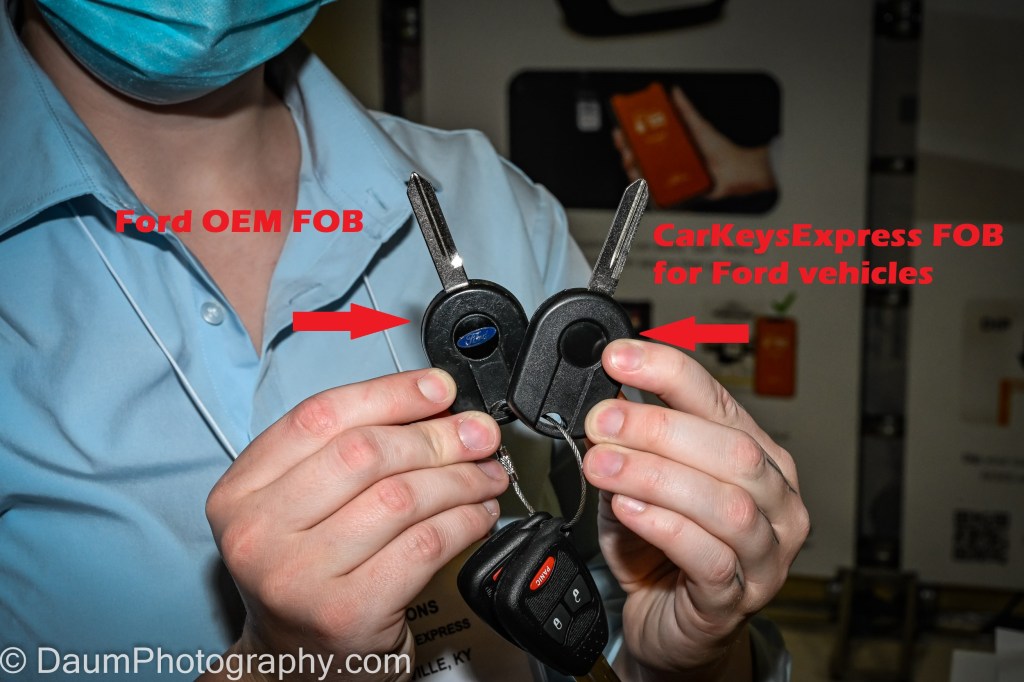
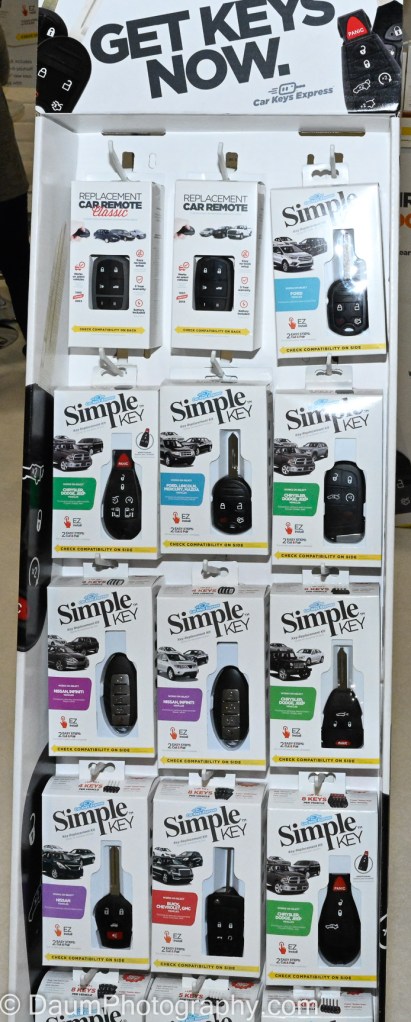
In their booth at AAPEX 2021 they had samples of their products including their ROKS or retail optical key scanner, their Keys Now, their Simple Key, the Universal EZ Installer™ and the EZ Installer™. The ROKS is stand alone unit that you insert your existing key for scanning. Then they send you the key completely cut. Their FOB to use with the key can then be paired up with your car using their Universal EZ Installer and a free phone app. The process saves you about 70% of the cost as compared to going to the OEM dealer.
Simple Key (a kit premade for each specific OEM) comes with the EZ Installer. Costs vary depending on the OEM and vehicle, but ranges from US$99 to $149 versus if you went through the dealer where you would pay in the range of US$300 to $500 or more.
The difference between the Universal EZ Installer™ and the EZ Installer™ is that EZ Installers are designed to only work with one OEM, such as Ford, GM, Mazda, etc., while the Universal will work with about 95% of OEMs (and since this is a brand-new product, they are working refine its software to work across all OEMs). Once purchased the Universal EZ Installer or the EZ Installer and connected to the owner’s vehicle via the OBD2 port, the imbedded software becomes linked to the VIN. This means the owner can make multiple duplicates but only for that specific VIN. It can not be used after that on another vehicle.
Options for the end user currently include purchasing a kit from them online, locating and driving to one of their Car Keys Express locations in your city, having their mobile service scheduled to come to you, and a priority option of having them come within 24 hours. The respective pricing ranges from about US$99 if you drive to them $169 for a scheduled come to you and $315 for 24 hours service. All well below the hassle and cost of getting it done through your OEM Service Dealership.
In my discussion with Kirk Stewart, Retail Marketing Director of Car Keys Express, he told me that it takes about 18 months on average for them to reverse engineer an OEM FOB, and develop their own proprietary software and chip design, extensively test it out before selling them. They design their units to exceed the OEM in terms of quality, latest electronics, and durability. The finished product is waterproof to 30 feet (OEMs are not) and have better battery life as well as range of operation.
They currently have their circuit boards made in China to their proprietary design, but are looking to bring that phase of the process to the United States. Car Keys Express design, engineer, load their own software on the boards, and package all of the units in the United States (Louisville, Ky). They guarantee their products for 3 years (parts and labor) versus the OEMs’ ninety days to one year.
A part of this review, the Blackvue DR900S-2CH was compared to my long term benchmark dashcam, the Papago GoSafe 30G. Additionally, I will focus (pun intended 😊 ) on the performance of the Blackvue DR900S-2CH.
Here is a brief comparison of the respective unit’s specifications (from the manufacturer’s web sites):
“The Papago GoSafe 30G comes equipped with GPS, and, supports up to 128GB for more than 20 hours of recording before footage loops over. With a 2.7” display screen to view your videos, this dash cam has the capability to record full HD 1080P 60FPS high resolution videos with an 140° wide view angle. The GoSafe 30G also comes loaded with 3 recording modes (video, parking, and monitor mode), and Papago’s exclusive driver assist features including stop sign recognition, headlight reminder, and driver fatigue alarm.”
The DR900S-2CH has an ultra-wide 162-degree front camera and wide 139-degree rear camera angle. The front 8-megapixel sensor produces spectacular 4K Ultra HD footage, letting you read license plates from farther away. With H.265/HEVC (High Efficiency Video Coding), the video files stay small so you can record for as long as a standard Full HD dashcam. DR900S-2CH also features dual-band 802.11ac Wi-Fi for super fast file transfer to your phone.
There are some basic differences you can see from the two manufacturers descriptions:
The Papago has a display screen, while the Blackvue does not. However, you can easily access the images from the Blackvue using your smart phone. Both, of course, have removable MicroSD cards for viewing on your computer or laptop.
The Blackvue includes a second recording camera, for capturing rear traffic images.
The Blackvue front camera has a wider lens capture at 162 degrees as compared to Papago’s 140 degrees.
Field Side-by-Side Comparison
For most dashcam users, the primary purpose is to document traffic as you are driving. Dashcams have become popular as a means of providing evidence in the event of road rage and/or an accident. Ideally the dashcam will capture clear, time and gps marked images, both during daytime and nighttime driving.
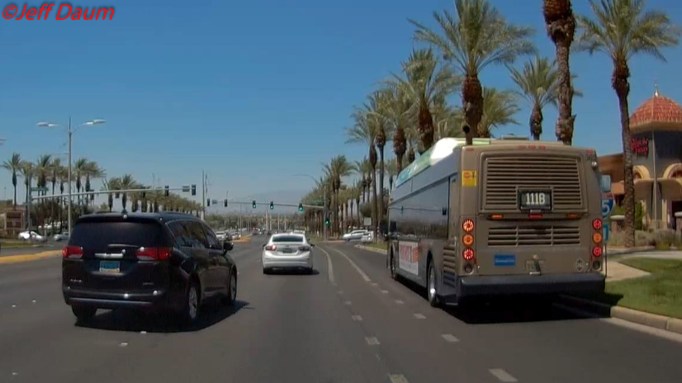
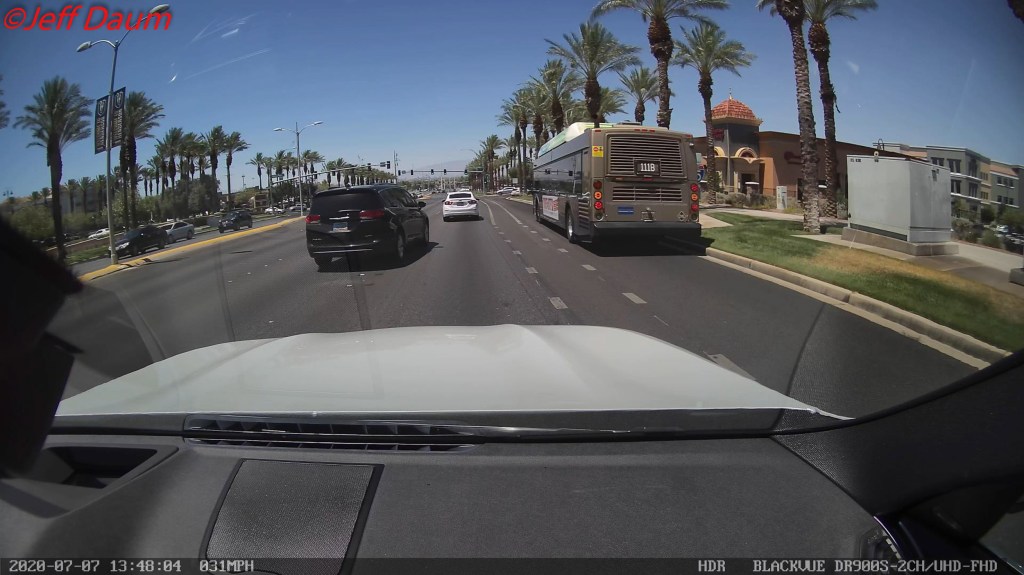
Let’s see how the Blackvue and Papago did. In general, both dashcams did fine during the daytime recordings. Both document the time, speed and gps. You can see at the bottom of each of the following images, the time, speed, and in Papago’s case, the GPS coordinates. Blackvue also captures GPS coordinates, but rather than display them on the image, they are imbedded in the image data and actually show where the vehicle is on Google Maps, when viewed with their app.
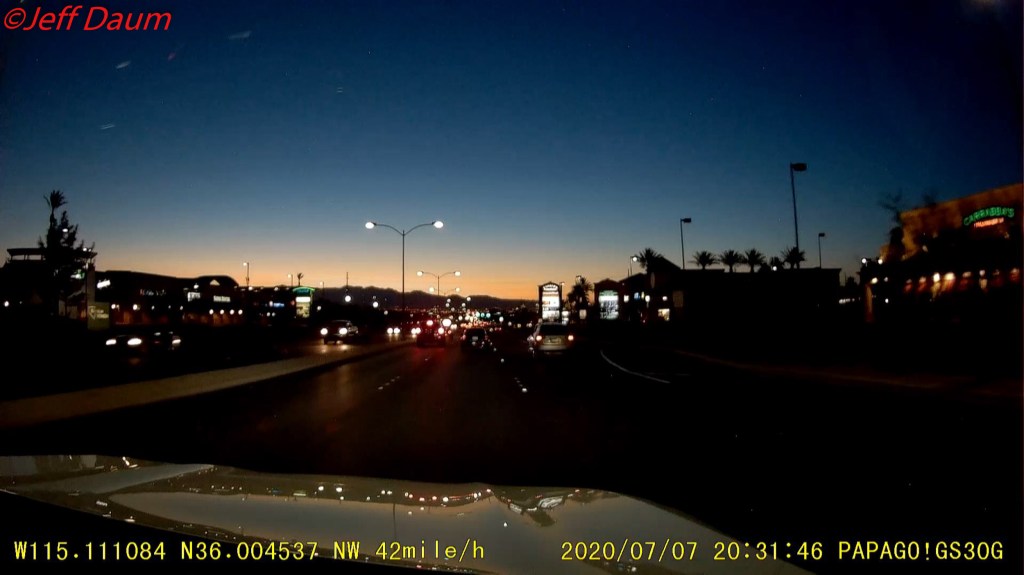
For all the following images, they are not retouched or corrected, but appear exactly as recorded. In each case the Blackvue image is the first of the two images.
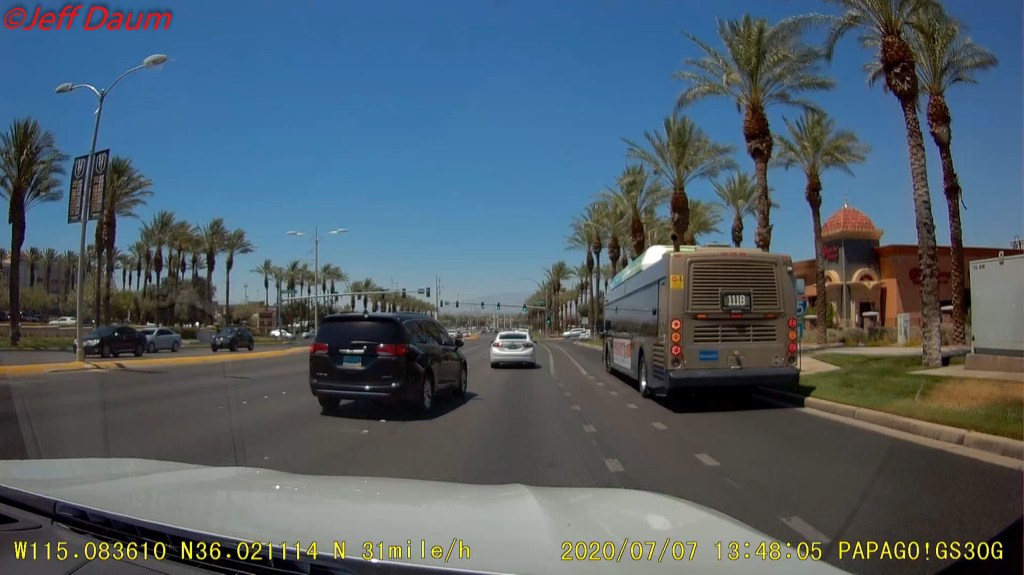
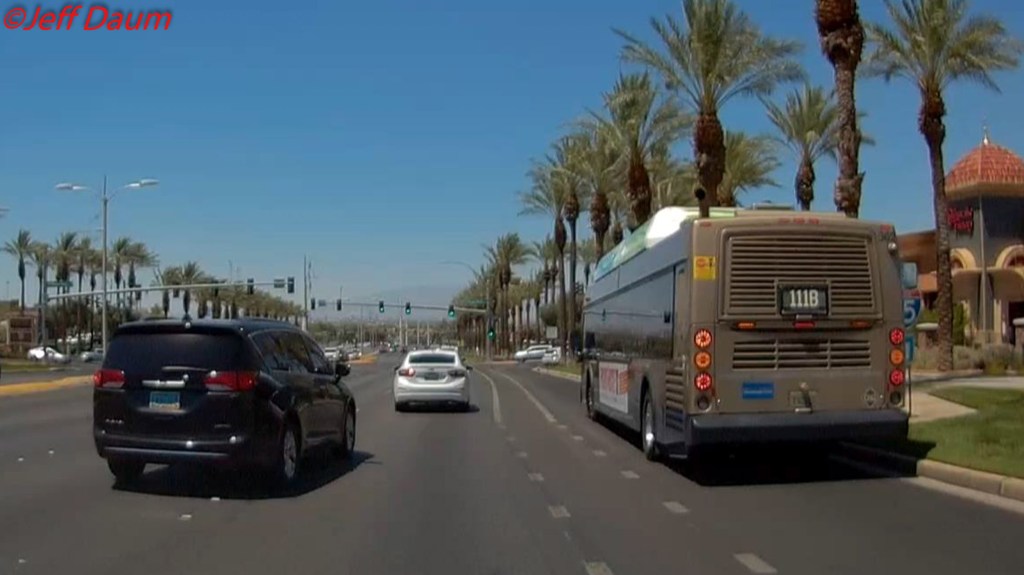
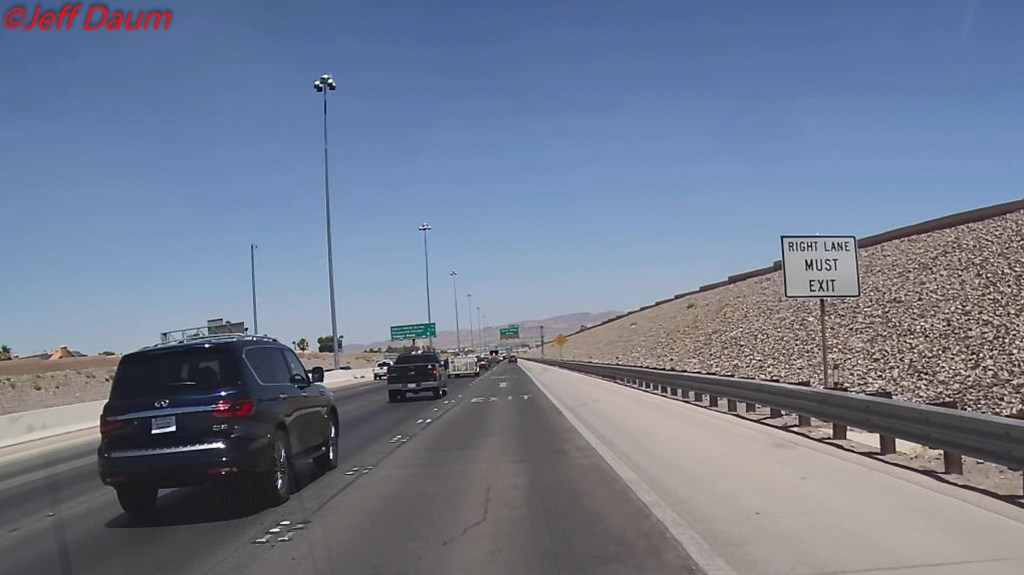
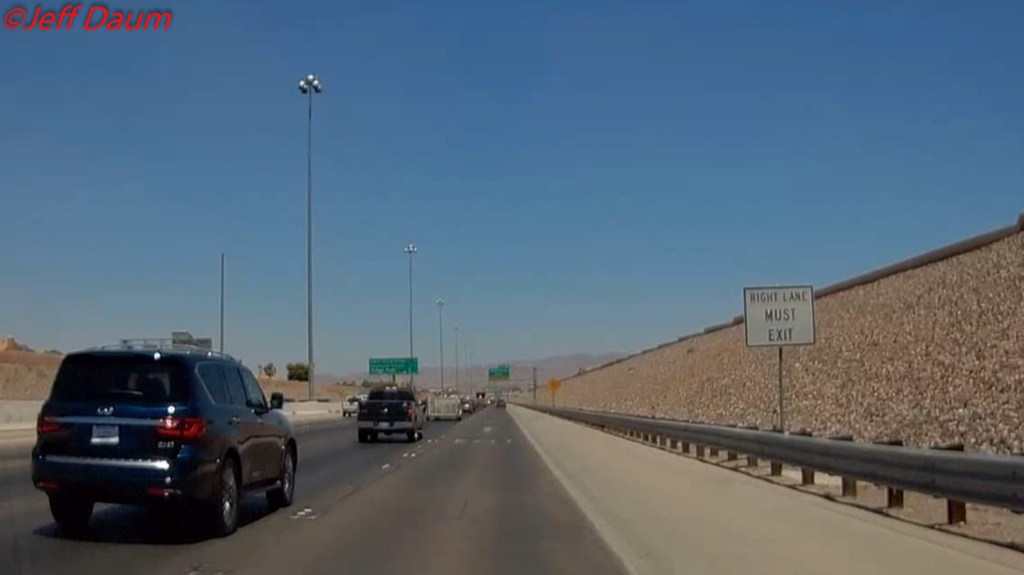
This first set shows the wider coverage of the Blackvue vs the Papago:
The Papago has a slightly more saturated image but is also a slight bit less sharp.
Here are the same images, enlarged about 30%:
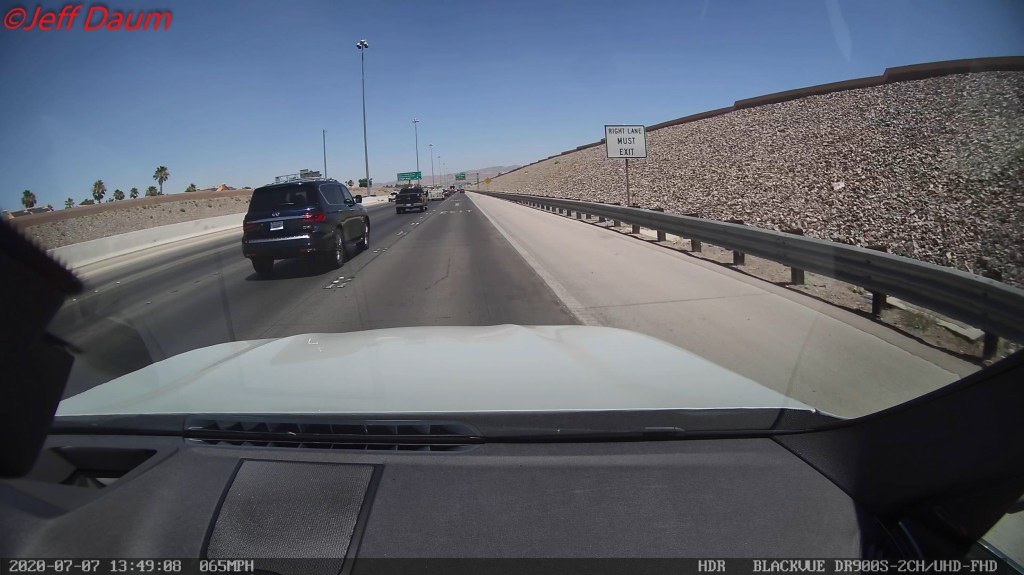
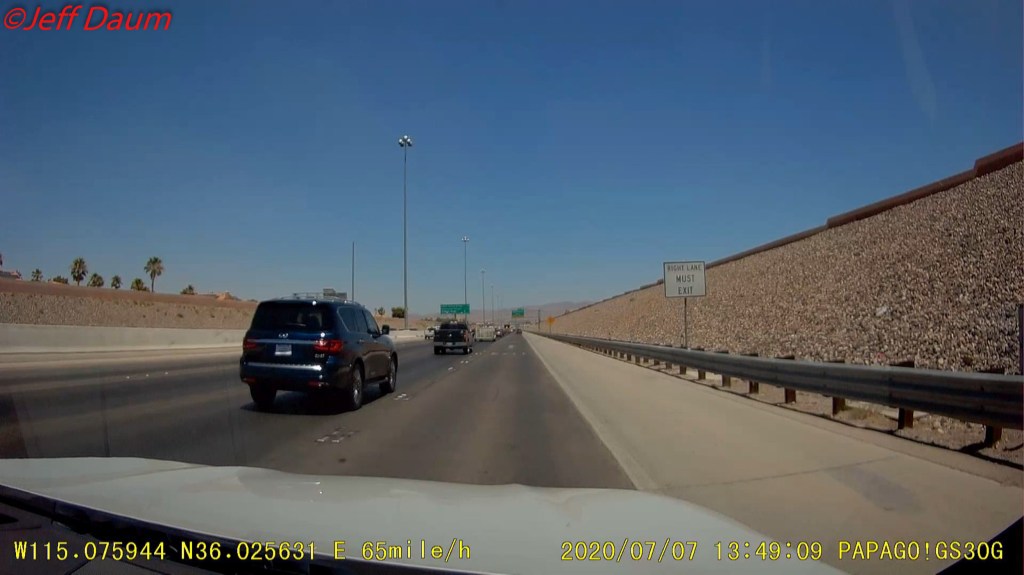
Here is are comparative shots from video on the highway:
Again, the Papago has more color saturation while the Blackvue is a bit sharper. This is more easily seen in the approximately 30 percent enlargements:
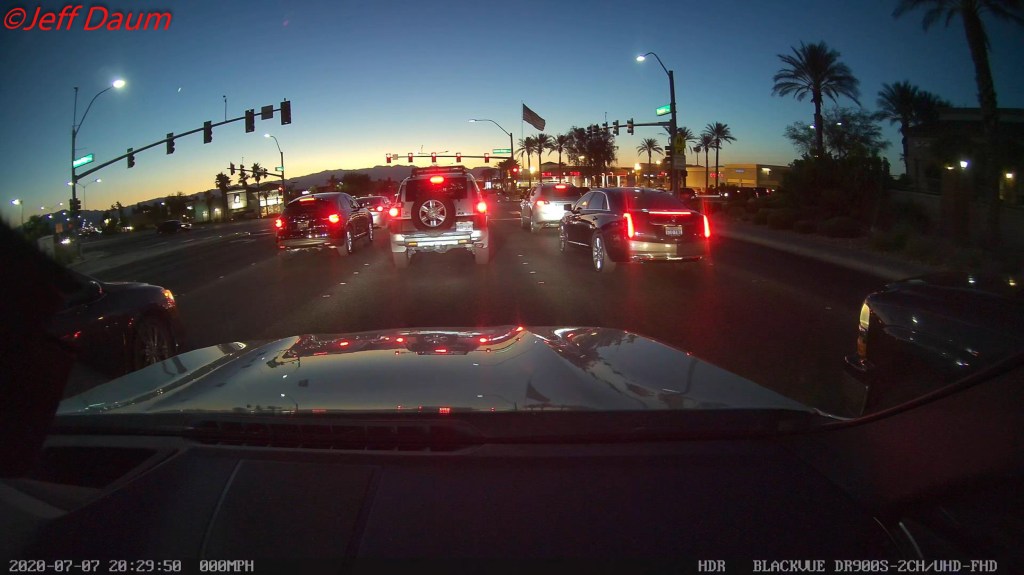
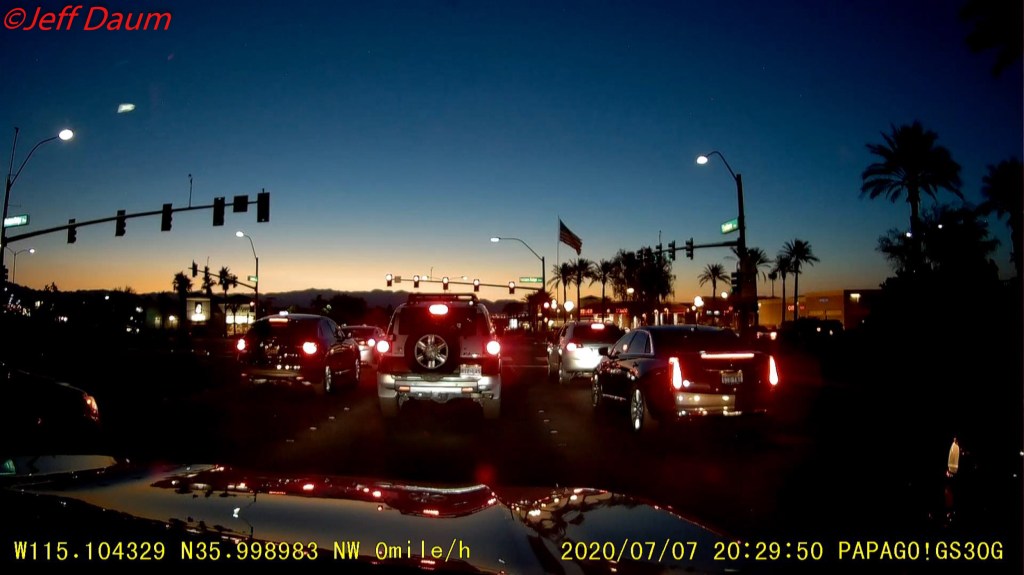
Now let’s look at night shots:
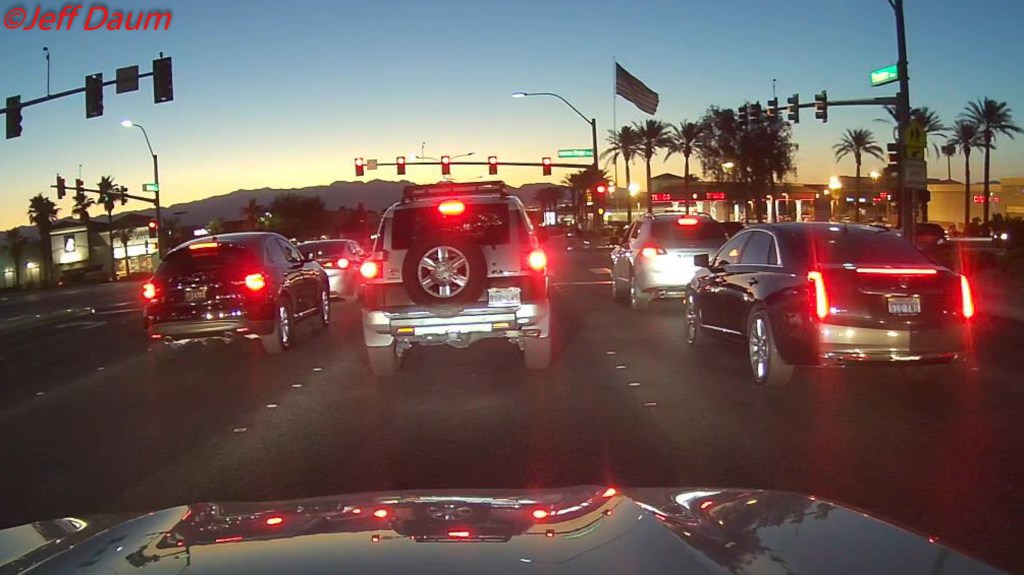
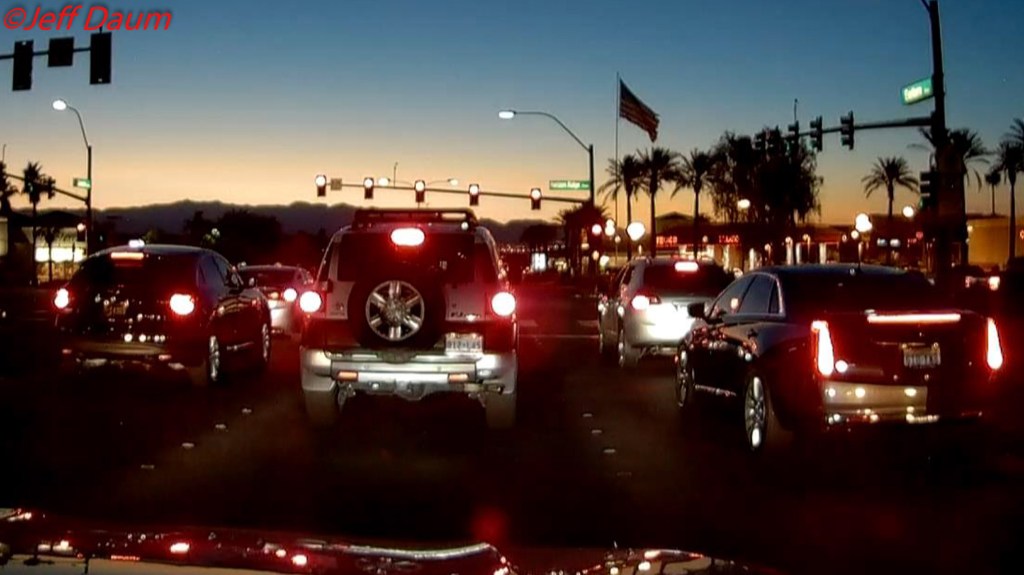
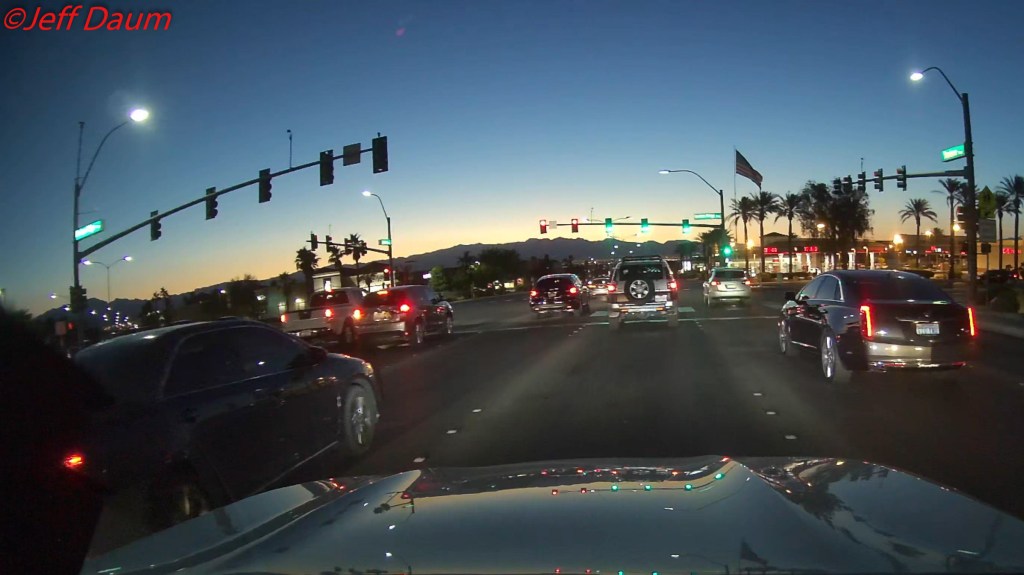
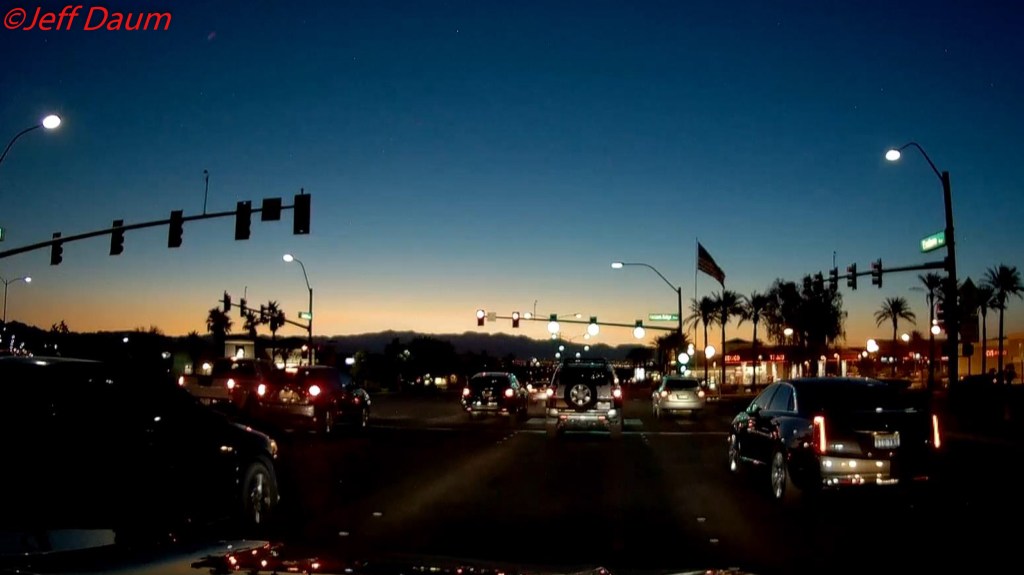
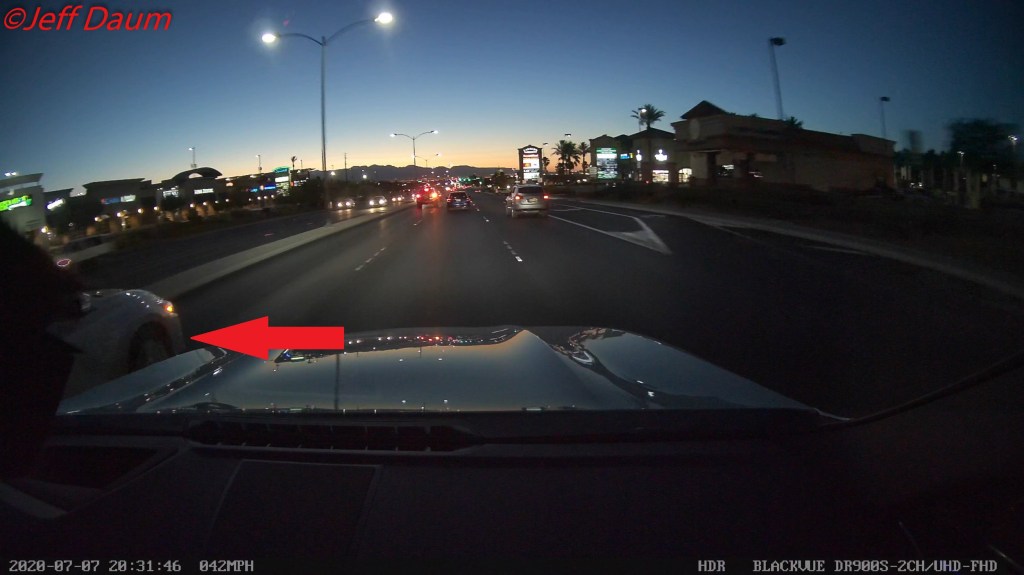
Here the Blackvue does a bit better job with low (nighttime) lighting: the image is sharper and for example, you can see the traffic signals are red, but only appear as lights in the Papago.
And another set of night shots:
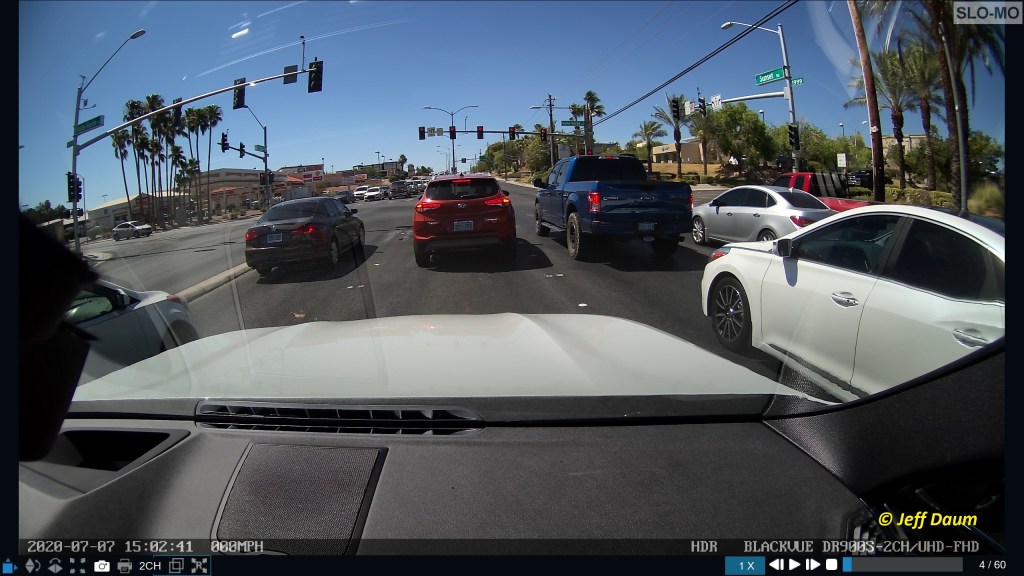
Finally, here is a shot that shows the advantage of Blackvue’s slightly wider lens coverage. You can see in the Blackvue image a car just off the left fender, but you can not see it in the Papago shot. This additional coverage could be useful for example, if your vehicle was sideswiped.
Here is an example of the video capture from the Blackvue front and back cameras:
You’ll note that the images are rock solid from both front and back cameras.
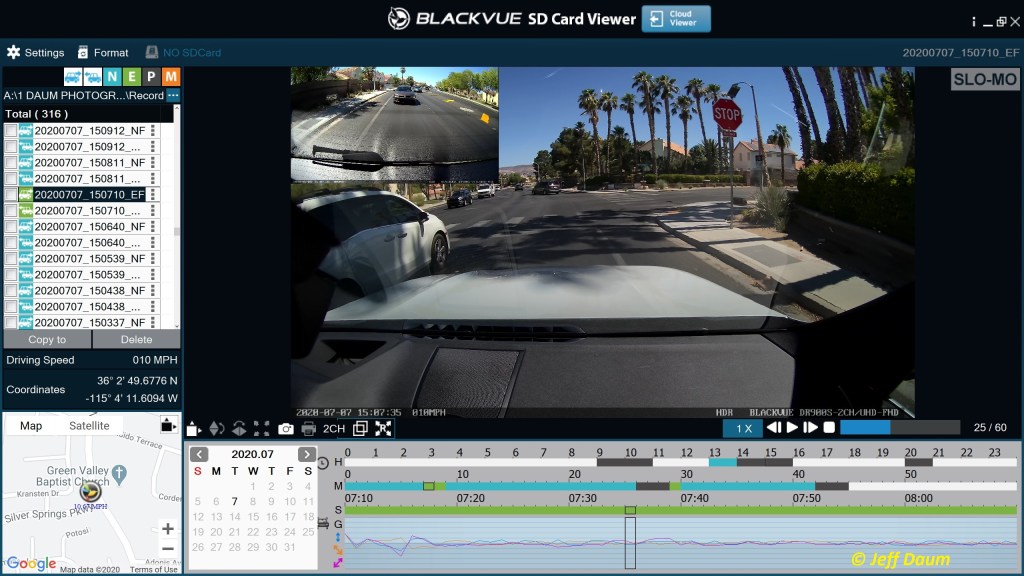
This is what the Blackvue SD Card Viewer looks like on a PC. It contains a lot of information, including the time, GPS coordinates, actual location on Google Maps, speed, and if selected, using picture-in-a-picture, simultaneous front and back videos. It allows you to capture and save a snapshot from the video at any time.
And here is the Viewer optioned as just the full image, without the surround of information:
Summary:
As noted at the start, both the Blackvue and the Papago provide solid documentation of what is occurring in front of the vehicle. It was nice to see that the software of both manufacturers captured the same GPS coordinates and indicate the same vehicle speed across various settings and at low through highway speeds.
When considering all factors, the Blackvue DR900S-2CH emerges as the best, if you put cost aside. While both Blackvue and Papago do a number of the same things, including most importantly, automated recording every time you start driving, Blackvue has the edge in image quality. It offers excellent front and back cameras, high quality video including HD recording, and ease of use with its free smart phone app and PC viewer.
That said, for some the price difference will be a deciding factor. The Blackvue currently can be found selling at around US$420, while the Papago is at around US$160.
A few minor Blackvue nitpicks:
Blackvue prefers (recommends) that you only use their own branded microSD card. During parts of the half year I have been using this unit, instead of the Blackvue microSD card, I used a very well respected 128 gb professional level card, designed specifically for handling the frequent record events typical of security cameras. I did not experience any recording problems, however, the Blackvue unit would randomly announce a restart. The non-Blackvue card was formatted using Blackvue’s own software app. This minor issue is known by Blackvue, as well as being documented by a number of users.
Blackvue does have a Parking setting, for use when your vehicle is not running. However, it requires a source of power to keep running beyond its stored capacitor. One option is to directly power the unit off your vehicle’s battery using a circuit that is continuously ‘live.’ This is problematic over an extended period because it could cause your battery to be drained to the point where it will not start your vehicle.
Another option is Blackvue’s Power Magic Pro. It goes between a continuously live circuit and the unit, and is designed to shut off the Blackvue at a preset voltage level of your vehicle battery, for example, 12.5 volts. However it does not work with the sophisticated and sensitive power draw software of the BMW (as well as possibly similar systems by other OEMs, designed to preserve the battery and ensure sufficient starting power), nullifying its use as a means to power the unit in “Parking Mode.” Basically, it causes the system to throw several electrical related codes.
A third option is to purchase Blackvue’s Power Magic Battery Pack or Power Magic Ultra Battery. The first is a rechargeable accessory plug driven system that provides about 12 hours of record time. The Ultra unit is a high capacity rechargeable unit that provides about 24 hours of record time, and can be piggy-backed to increase the total record time while parked. However, these are not ideal options for long term parking situations (like when you leave your vehicle parked for a week or more). The accessory plug unit has too brief a recording time to be of value, while the Ultra is a very expensive option- over US$300 per pack.
In conclusion, after six months of use, the Blackvue DR900S-2CH has proven to be a highly reliable unit, providing excellent video documentation. It has been unaffected by the extreme temperatures here in the desert. The smart phone app and PC microSD card Viewer are very well thought through, highly functional and easy to use. It just needs a better parking record option.
Day one of the 2019 Automobility LA show might be best summed
up in one word “Karma.” The first media
day is basically a series of thirty minutes (or more) technology update
panels. I find it interesting on a
number of levels, including what really is new and what is status of the field.
For the most part, especially if you have attended a number
of these over the years, you take what is said with a grain of salt and
consider it a lot of marketing hype designed to stimulate discussion, create
awareness, and in more cases than not, investor interest.
My ‘take-aways’ from today include:
The
new CEO of Faraday (he was the CEO of Byton last year) sees the real financial profitability
coming from the interconnected digital experience, rather than through the sales
of their FF91 (September 2021) at $150-200k, or of their FF81 after that at
$60-80k.
The
“living space” experience of future semi-autonomous and ultimately, fully autonomous
(levels 4 and 5) vehicles is the ‘hot’ topic focus of many presenters here.
Critical
is figuring out how to integrate all of the vehicle voice assistants, such as
OEM versions and Alexa, along with the artificial intelligence (AI) dynamic
data base so that it is a seamless experience for the end user.
Figuring
out how to gain the trust in the general public of autonomous vehicles (AVs)
One split in thinking and focus that I feel isn’t being given
enough effort is that there really are two very different AV ‘roads’ that need
to be integrated for this future disruption to succeed. That is, one faction sees AVs as ultimately
the replacement for the personal car as simple a means to primarily get from A
to B, while the other is attempting to create a whole new means of experience
that people will just want to do because of the experience. The later are focused on integrating lots of
monitors (screens), high end audio, augmented reality, etc. An overriding issue for both factions is what
the respective impact will be on reducing congestion in urban environments.
Continuing issues include lack of standardized intra and
inter vehicle communication (software), privacy of the ever-expanding data base
on each end user (incrementally increasing under the 5G capabilities), and lack
of interstate DMV regulation for AVs.
It still appears that the near future of AVs will be restricted
to proprietary lanes on highways and in urban environments, where human driven
vehicles are not allowed to drive. Under
this set-up, I believe we will see a significant reduction in accidents and
deaths.
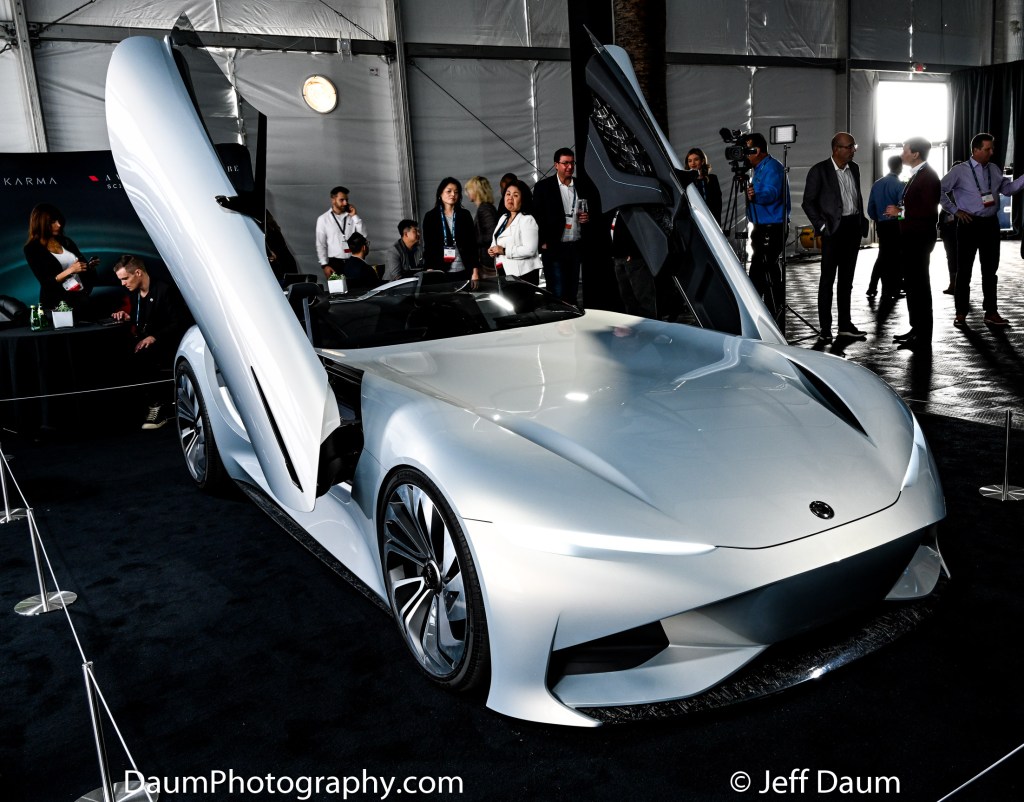
Oh, and why this first day is best summed up as Karma? The
simple answer is that Karma had their FF91 there, as well as functioning
protypes of their future vision cars the SC1 and SC2 (convertible and hardtop respectively,
each with ‘scissor’ doors), and their Revero GTS model. Alternatively, as a bit of tongue-in-cheek,
perhaps the future of AVs is just karma personified…
More to come. In the interim, what are your thoughts?
[Hold on there fellow gearheads, there may be some validity in this statement 😃 ]
By Jeff Daum, Ph.D., PPA Photojournalist, Technology & Product Analyst
Interview with Justin Rees (JR), Founder & CEO Ride Systems, Kelly Rees (KR), President Ride Systems, and Ilya Rekhter (IR), CEO DoubleMap.
Backstory:
Ride Systems and DoubleMap had just merged at the time of this interview,
bringing together two companies with a proven track record of providing safe,
fact-based real-time information on transportation alternatives for getting
from point A to point B. This includes
public transit and on-demand (Uber, Lyft etc.) transit. The combined data bases comprise public
transit riders, corporations (employee vans), airports, universities and
hotels. While now operating under one
holding company, both will maintain their respective brick and mortar
headquarters. Both companies have a free
app (Ride Systems and DoubleMap GPS) allowing the user to see alternatives
available to get from A to B either entirely on one service or in combination,
along with real-time indication of when the option will be at a specific
location.
(left to right) Ilya Rekhter, Kelley Rees, Justin Rees
JDLet’s start with a statement by you Justin: “Our services offer a quantum leap forward enabling everybody to say good-bye to privately owned cars soon.” Would you please put that in perspective?
JR Timing is everything, millennials are delaying the purchases of
large items, cars and houses for example.
They also want to live in big urban areas. So, they are already forgoing owning multiple
cars or even any car, for more liberating options. The other side of that is that you are seeing
even the automakers get into the services business. They want to be mobility companies. As you saw at CES, big companies are
investing heavily in autonomous cars, sensors, and smart cities. Those
companies are trying to shift from being a commodity producing company into service
and mobility sector.
So, you are seeing transportation
sharing options greatly increasing and providing short, medium and long-range
alternatives, from scooters to ride share, to on demand to public transit.
IR To piggy back on what Justin is saying, it starts with that
family that has one car and thinking about buying a second car, the easier we
can make it for them to ride public transit and not need to buy the second car,
the more it will continue trending that way.
Then you take it and make it more personalized with more options
including public transit, and combine in one place, and easy to use app, those
options to get from point A to point B and more and more people will use it.
JR So why do people hesitate to use the other modes of
transportation? It’s the lack of confidence in public transit, for example,
where is it? Will it ever get here? How
long do I have to wait? All those
questions prevent people from feeling comfortable in using public transit. You have to have confidence in it to want to
use it. Same thing is true for other
alternatives, such as scooters or bikes, on demand cars- you gain confidence if
you know where it is and how long you have to wait for it.
Having the information available
to them is where we come in. We own the
data in that middle market, we are in seven hundred plus locations. We provide real time information for public
transit and other modes of transportation.
Big cities, small cities, corporations, medical centers, universities. As a result, we have scooter companies, car
sharing companies and automotive companies come to us and say since you are
already in all of these places if we team up, instead of launching in just a
few select places, we can deploy on a large scale using your existing network
and contracts with the cities.
JD: Is your audience the same
for the public transit as it is for on demand rides?
IR For us it started with the transit riders, but now they can see
in the same app, a mesh network to get from point A to point B, an alternative
means to cover the distance from where they live to the bus, or from the bus to
their ultimate destination, or even not to take the bus at all but one of the
other options.
JDBut will the individual
who uses an Uber or Lyft, now decide because of your app, to use public
transit? What is the incentive?
IR Perhaps seeing there are clear options that can save money,
particularly if time isn’t critical. The
ride share companies are interested in being part of our app to get more
‘eyeballs’ to see their services. Also,
it depends on what a particular city has in terms of arrangements with
different ride share companies. If they
have agreements with for example, both Uber and Lyft, then both would be part
of our app for that city.
JDAre taxis favorable to
your app?
IR Using Dallas as an example, the city has brokered a deal with
Uber and Lyft, as well as the taxis.
That is a differentiation for our service, we don’t take a position pro
one service or another. The taxis in
Dallas have our software in their cars, so they can serve more as an on-demand
option.
JR The option comes down to the confidence, do I take a scooter to
get to the bus, take an Uber to get to the bus, or walk to the bus. Do I even want to take a bus, is there
another option to get downtown? They
will find all those options through our app.
We have the platform where all those options can be made available. It is all about options, giving the people
options to choose from, the freedom to choose how they want to do it. Of course, with your own car, you can hop in
it and go where and when you want, but you have the cost of the car, getting
there, garaging or parking it, etc. If
you don’t have a car, the perception has been that you don’t have freedom. We provide that freedom.
Of course, it will take some
time, but people are already doing it- the millennial crowd is already doing
it. We think people are anxious to find
a better way to get around. Traffic is
as bad as it has ever been, parking and the cost of owning a car is going up,
as is the related stress. These
technologies of making people comfortable to use alternative modes of
transportation will help alleviate a lot of that stress.
JDYou had mentioned the OEMs
are interested in it. Of course, they
are focused on the shift in buying habits and have started offering their own alternatives. You have Volvo, Lincoln and Cadillac offering
new types of quick leases, no obligation, easy swap from one model to another
and totally inclusive monthly payments covering the car, the insurance, maintenance
and swap potential. For example, Volvo I
think is $500 per month to virtually any qualified individual where they offer
the option. Is this in competition to
your service?
IR That is actually music to our ears, we don’t own any of our
vehicles except for our pending start of our Tesla X car share service fleet. The reasons the OEMs are starting these new
types of leases is because they want their cars on the road. We have the
advantage of offering the use of any of those vehicles as well. It will be a natural complement.
JDBut if you own a fleet,
won’t you be seen as pushing your cars vs other options?
IR I don’t think it is a question of one or the other, it is a
question of providing as many options as possible.
KR Let’s back up a do a little bit of background on the
company. That might help paint a picture
why it won’t be a big deal. For example,
some of our biggest clients are big corporations, closed campuses, etc. They are the perfect place to start the car
share aspect of our business, a specific program for a specific client.
IR For example, where a client may have a fleet of several hundred
vehicles and thousands of employees, they can use our app to create on demand
vs scheduled rides.
JR Another example, for a client in a big city, we are able to merge all different types of transportation modes (short, medium and long range) and make them available to their employees in one app. Instead of the client having to go to each of the services and try and negotiate and integrate, we do that for them. Cities are hard to get into on large scale because of the bid process and because cities have little incentive to share information with the specific companies in their area. Because of this we are already involved with a lot of these cities, we offer our clients and strategic partners that connection. That ranges from tracking buses and shuttles for commuters to launching new offerings to the communities members in the area like scooters and car share programs.
JDLet’s segue into details
on your app.
KR It is more than an app, it also includes hardware.
JR I look at it as three pillars- the first one is what we are
known for, our mobile application. It is
free. The second pillar is in the
vehicle. In buses, most are a step back
in time, with clickers for counting passengers, manually changing the route
sign, etc. We install hardware inside the bus that takes over all these
functions and frees up the driver to focus on safety and driving. The third pillar is that the hardware we
install integrates these functions on the bus and sends real time updates to
our servers where we do business intelligence. That is then reflected for
example, in our app, showing current position, time to next stop, etc., as well
as real time passenger load, a more efficient routing and use of buses.
IR It is really the analysis and use of that data for both the bus
(or car company) and user that is key.
For example, a user can look at passenger load and decide to take a
different bus, or if the next bus has a bike rack installed, or can pick up a
person in a wheelchair. While on the
bus, they can use the app to order a car to pick them up when they arrive.
We also have numerous
capabilities we can build into the onboard equipment, such as badge readers,
WiFi capabilities, etc.
JD Where are the buses that
you have this technology currently running?
JR For example, Reno, University of Nevada, here in Las Vegas, Arrow Stage Lines, a charter bus service, Houston, Tulsa, really in all 50 states., Guam, Mexico and Australia. We haven’t done a lot of press so it isn’t well known, but we are the single largest provider of this type of technology across the world. Our service sounds like an app, but it is like the tip of an iceberg in terms of the full range of services we provide.
JDWould you talk a bit about
your new roles now as a merged organization of your two companies?
JR Merging makes a lot of sense from a business perspective. We have been fairly selfless in figuring out
what will be best for our employees in both companies, our clients, and how to
not disrupt everything. I will be the
CEO, Ilya has the same abilities but he also is one of the best guys when it
comes to strategies, and numbers and sales and will be President, so that will
be his focus, Peter (SerVass) is always about 10 steps ahead of us in looking
into the future, he worked very hard on this merger, and will be the
strategist. Kelly, her focus will be in
marketing and press.
IR We are fortunate in that both companies have very capable and
strong individuals. Culture has been very important to us. We have both been self-funded and
profitable. This year we are projecting
to be an 18 to 19 million dollars revenue company. Basically, blending what DoubleMap and Ride
Systems has done really well and making one big win.
JDDo you think you will stay
self-funded?
JR We are doing great the way that we are, but if the right
opportunity comes along, we won’t turn it down, but we are confident in our
ability to do this. This merger enables
us to take a risk and really grow the businesses to the next level.
IR The key is that both companies came in with clean balance sheets
and profitable. We have the funding to
grow organically.
JR So we are open to the option, we don’t want to restrict our
growth if the issue is capital.
JDIn summary, what would you
like to emphasize?
JR Well, we are the largest real time transit information company
in the world, no one has as many and as much variety of clients in as many
locations as we do.
IR To our existing clients, it is important to know, there is no
turnover. We are taking the best from
both companies and combining it.
JDYou handle a lot of data
obviously, what type of security and back up do you have?
JR That’s a really great question. A big and important topic for
people. We have secure data centers, AWS
with Amazon Web Services, IBM secure data centers, all sorts of redundancy and
backups. We take security around
personal information very seriously.
JDAnything else you would
like to add?
JR We are just thrilled to make this merger finally happen and
excited for what it means for the people of our two companies, and for our
clients and future clients. The sky is
the limit.
IR We are both proverbial garage startups. To grow it to this, we couldn’t be
happier. We are going to keep the two
(apps) brands independent, but integrate across them as appropriate.
KR Looping back to where you opened this, needing to own a car
versus wanting to own a car are two different things. The automotive enthusiast, the hobbyist, the
love of driving is different from having to commute from A to B. As the information (transit options) is out
there, we believe more and more people will be giving up their cars.
JDIt
has been fascinating learning the details, and meeting all of you. Thank you
for taking the time and sharing your enthusiasm. Continued success!
This is the second blog on Autonomous vehicles, for the introduction and first part please see Autonomous Vehicles Part 1 .
Autonomous vehicles- the major potential ‘cons’:
Connectivity:
The sine qua non for the CAV (connected autonomous vehicle) is communications. It is at the same time its strength and, borrowing from Greek mythology, its Achille’s heal. To function, autonomous vehicles must rely on a tremendous amount of inter and intra connectivity. All of the on-board sensors (lidar, radar and cameras, engine parameters, lane departure, etc.) have to flawlessly communicate with one another, as well as vehicle to vehicle, and communicate with traffic management (lights, flow, emergency vehicles, etc.).
Sounds great in theory, but in actuality this is astoundingly difficult to pull off. Keep in mind, this connectivity has to function flawlessly all of the time. There was a bit of irony at CES 2017 in that every presentation I attended experienced a problem at least once with the remote presentation control unit communicating correctly with the media controller equipment. And this was connectivity at its very basic level! On a more complex level, there was Faraday’s problem during the press review where their car failed to accept the command to self-park.
Obviously, you can’t have a break in connectivity or the autonomous vehicle will come to a complete (unintended) halt (hopefully), and in doing so will become a potential accident instigator for both other autonomous and non-autonomous vehicles. What level of redundancy will be sufficient to prevent a loss of connectivity? While it seems feasible that intra- vehicle (between its numerous components necessary to have an autonomous system) redundancy is reasonably surmountable, what will be necessary to ensure the inter-vehicle, and traffic management, along with live web connectivity, is flawless?
Simultaneously with ensuring the continuous flow of connectivity, there are still two large problems to solve: All communication has to be hack proof (we have seen the videos of someone remotely gaining access to a vehicle’s electronics via one of the communication channels, and taking over one or more of the vehicles systems- acceleration, braking, steering. Hackers have demonstrated this remotely on cars ranging from Jeeps to Teslas.). Further a great deal, if not all, of the information has to maintain the privacy of the vehicle (and its occupants).
Additionally, complicating the connectivity issue is what was tagged “Babel” at the CES 2017 A United Language for the Connected Car session. The general definition of babel is a confused noise, typically made by a number of voices. Unfortunately, it applies to the current status of proprietary software designed for many of the components needed for a connected vehicle. The herculean challenge is to get a universal open language used across all components/systems for autonomous vehicles. Beyond the current Babel-of-software-language is the growing quagmire of state and federal regulations aimed at controlling autonomous vehicle access to our roads. Currently, an autonomous vehicle approved by nascent laws in one state, may not be able to continue driving when it crosses into an adjacent state. For example, while an autonomous car can be driven in Nevada, it can’t legally continue into nearby Oregon or Idaho, and if you are in an autonomous car in Florida, you could not continue on into any of its adjoining states.
Societal Impact:
The RAND Corporation pointed out in their 2016 publication Autonomous Vehicle Technology: A Guide for Policymakers, that rather than autonomous vehicles reducing congestion on our roads, they may, in fact, increase congestion. This conclusion is based on the reduced transportation costs borne by individuals. For example, the cost of automotive insurance shifts from the owner to that of the manufacturer of autonomous vehicles. This, combined with increased access (potentially no need for individual driver licenses), could see a substantial surge in the number of individuals travelling at the same time. Of course, it could be moderated by increased reliance on mass vs low occupancy vehicles. The elimination of the hassle often associated with finding a parking space (your autonomous vehicle could drop you off and then continue on to a remote parking area, awaiting your request for it to comeback and pick you up) may also contribute to a significant increase in willingness to ‘hop’ into your vehicle and head to a dense, high-use, urban area.
What are the implications for the potential loss of transportation sector jobs, their respective incomes and loss of tax revenues from reduced or eliminated parking garages, meters, etc.?
And while most believe that autonomous vehicles (or even semi-autonomous) will significantly reduce the number of deaths caused by crashes, the is one part of our society that has depended on these deaths- that of organ donations. “It’s morbid, but the truth is that due to limitations on who can contribute transplants, among the most reliable sources for healthy organs and tissues are the more than 35,000 people killed each year on American roads (a number that, after years of falling mortality rates, has recently been trending upward). Currently, 1 in 5 organ donations comes from the victim of a vehicular accident.” [From Future Tense: The Citizen’s Guide To The Future. Dec. 30 2016] The potential impact is catastrophic on an already stretched organ donation system. “All of this has led to a widening gap between the number of patients on the organ wait list and the number of people who actually receive transplants. More than 123,000 people in the U.S. are currently in need of an organ, and 18 people die each day waiting, according to the Department of Health & Human Services. Though the wait list has grown each year for the past two decades, the number of transplants per year has held steady in the last decade, at around 28,000.”[ Fortune: If driverless cars save lives, where will we get organs? By Erin Griffith Aug 15, 2014].
Moral Dilemma:
You may be familiar with the paradox of Buridan’s ass. As the story goes, a hungry donkey was placed equidistant between two identical bales of hay. Unable to choose which one to go to, the donkey died of starvation. The movement towards autonomous vehicles has at least two analogous conundrums: how many deaths by autonomous vehicles is an acceptable number of deaths, and, who is going to have the final approval of the algorithms designed to make a decision for an autonomous vehicle as to who should be sacrificed when a choice has to be made between certain death in a pending accident. The analogy is that if we can’t reach agreement on both of these issues, the movement towards autonomous vehicles may come to a halt.
Even though these two conundrums are inextricably related, let me briefly explore each separately. We know factually that autonomous vehicles can lower deaths currently associated with driver error, and that the number won’t rapidly be reduced to zero. Using the approximately 32,000 automotive related deaths per year (cited in my Part 1), what percent reduction would be ‘acceptable’? Would a 50% reduction resulting in 16,000 fewer deaths per year, but also 16,000 remaining deaths per year by autonomous vehicles be OK? Would it take a 75% reduction resulting in 8,000 deaths per year by autonomous vehicles to be considered OK? The consensus appears to be that while the astounding number of 32,000 deaths per year caused by human error behind the wheel, isn’t good, we seem to have ‘accepted’ it without demanding immediate action on a national or global level. However, few believe we would be as complacent if the news was filled with 16,000 or even 8,000 deaths per year as a result of autonomous vehicles.
Recently a number of articles have appeared highlighting the other conundrum: algorithms being designed to decide who lives and who dies when the outcome of a pending accident is unavoidable. For example: “A self-driving car carrying a family of four on a rural two-lane highway spots a bouncing ball ahead. As the vehicle approaches a child runs out to retrieve the ball. Should the car risk its passengers’ lives by swerving to the side—where the edge of the road meets a steep cliff? Or should the car continue on its path, ensuring its passengers’ safety at the child’s expense?” [Driverless Cars Will Face Moral Dilemmas by Larry Greenemeier, June 23, 2016, Scientific American] Or:” Imagine you’re behind the wheel when your brakes fail. As you speed toward a crowded crosswalk, you’re confronted with an impossible choice: veer right and mow down a large group of elderly people or veer left into a woman pushing a stroller.” [Driverless cars create moral dilemma. By Matt O’Brien, The Associated Press January18, 2017]. Who should be entrusted with developing and ultimately approving the necessary algorithms? Shall there be one algorithm for all autonomous vehicles globally or will there have to be country/culturally specific versions?
Real World Impediments To Fully Autonomous Vehicles:
At this point, autonomous vehicle developers have not been able to handle several frequent occurrences typical to our driving environments. If a fully autonomous car comes upon road construction, it doesn’t know how to ignore the programming that tells it not to cross a double yellow line, or purposely drive into a temporary lane without lane markers. It is basically programmed to shut down- or, in Nissan’s case, phone ‘home.’ At CES 2017, Carlos Ghosn, Chairman and CEO of Nissan, during his keynote speech said they are planning on having a centralized station staffed 24/7, to handle “edge” circumstances for their autonomous cars. In logic, the human contacted by the autonomous car would review the information available from the on-board sensors, and map an alternative route or action. It is unclear how would this approach be able to scale up instantaneously, for example, when a large section of a country has an extreme disrupter such as flooding, earthquake, etc.?
Similarly, autonomous vehicles cannot negotiate a dirt road, or a road that lacks up-to-date gps mapping. Neal Boudette in his article “5 Things That Give Self-Driving Cars Headaches” points out, autonomous cars will have a very hard time with unpredictable reckless drivers on the same road in a non-connected vehicle [New York Times, June 4, 2016].
Current thinking of many developers, is to require a (human) driver to serve as ‘back-up’ in those circumstances where the autonomous or semi-autonomous vehicle encounters a situation it isn’t programmed to handle. Unfortunately, there are severe limitations to how well most drivers would be able cope with such an unexpected/instantaneous hand-off (one doesn’t have to look any further than the tremendous increase in accidents attributable to drivers distracted by texting). The biggest problem is with a lack of sufficient reaction time even at moderate speeds, let alone highway speeds. This is further complicated by the well documented fact of vigilance decrement. The longer the autonomous vehicle is properly handling the driving, the less attentiveness and readiness the ‘back-up’ human will have to properly respond to the hand-off.
In order to succeed, there is going to have to be a significant educational effort of the current, and potential, driving public during the transition period when autonomous and semi-autonomous vehicles share the road with traditional non-connected vehicles. Part of this education will need to focus on the trust issue confounded by demographic and age differences in acceptance.
In some ways, many of the concerns today are parallel to those around one of the earliest autonomous vehicles designed to transport people- the elevator. Original elevators were relatively dangerous vertical transport platforms, operated by a trained elevator operator. As safety concerns were addressed, elevators vastly improved including having doors, fixed stopping points, redundant mechanisms to prevent free fall, etc. Shortly after the turn of the twentieth century push buttons were introduced that would permit selecting a specific floor and the elevator to proceed automatically to that floor. However, it wasn’t until after World War II -forty years after automation- that elevator operators were no longer placed in most elevators. One of the main reasons for the slow transition from manually operated to fully automated elevators was people were fearful of getting into an elevator that did not have a human operator. How likely are you to entrust your life to the newest mode of autonomous vehicles?
Autonomous Vehicles Part 3 will explore: What is next? Is the light at the end of the tunnel daylight or an oncoming train?































 Insight - Daum Photography