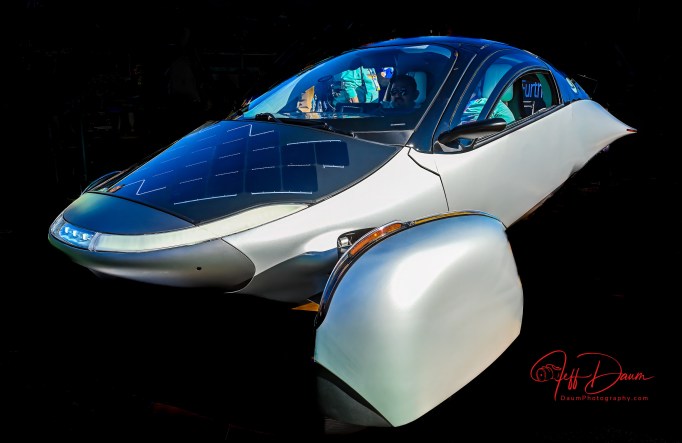
Is it a car, a UFO or…? First look at the Aptera: The Future of Electric Solar Vehicles

By Jeff Daum, Ph.D., PPA

This is an initial look at the Aptera all electric solar vehicle presented at the 2025 CES (Consumer Electronics Show) in Las Vegas, Nevada. 

Let me begin with a full transparency statement: I was so impressed with the Aptera, its cutting-edge technology and dual CEO team direction and commitment, that I have placed and received confirmation of a pre-order future variant all-wheel drive Aptera.
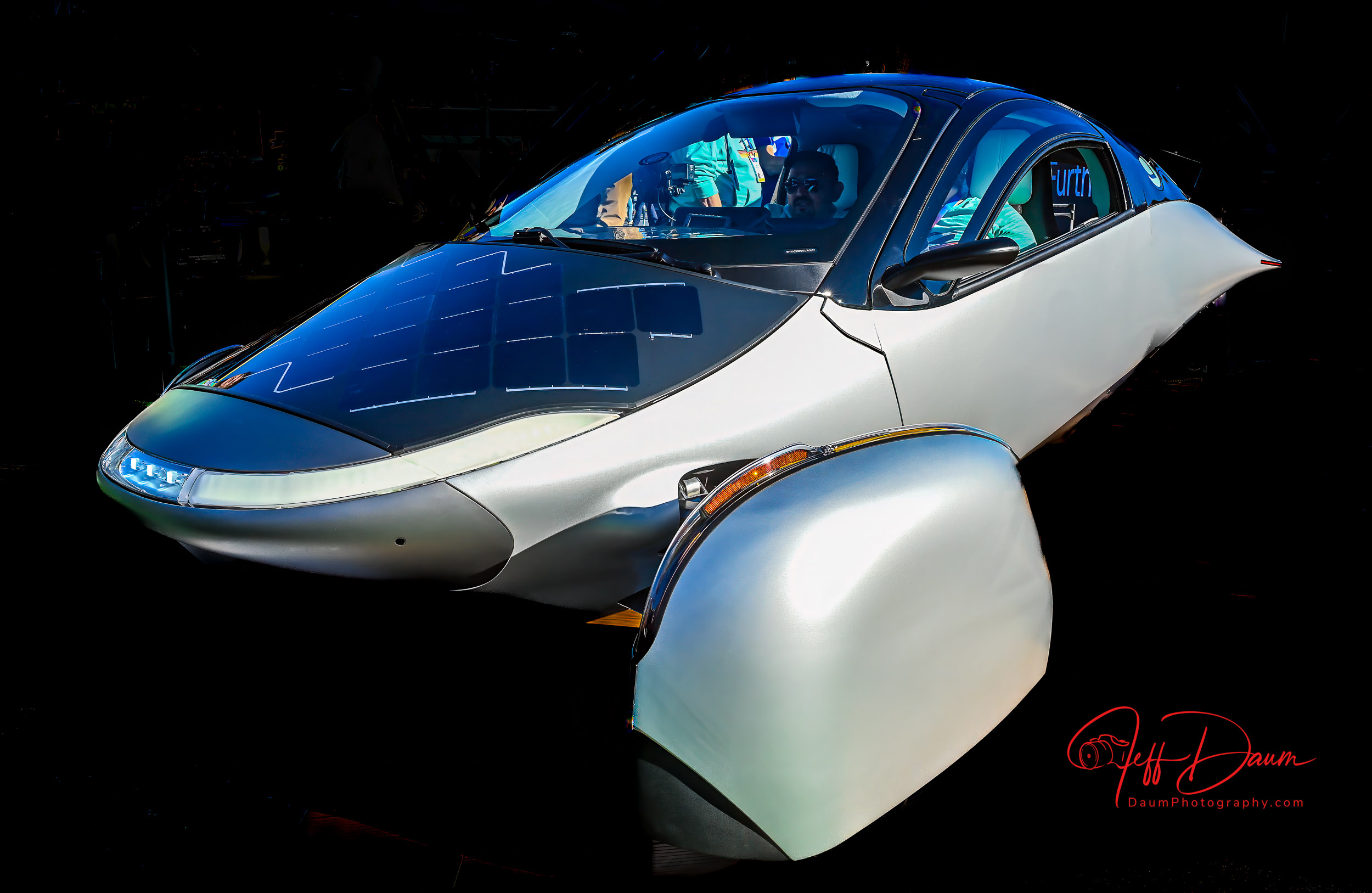
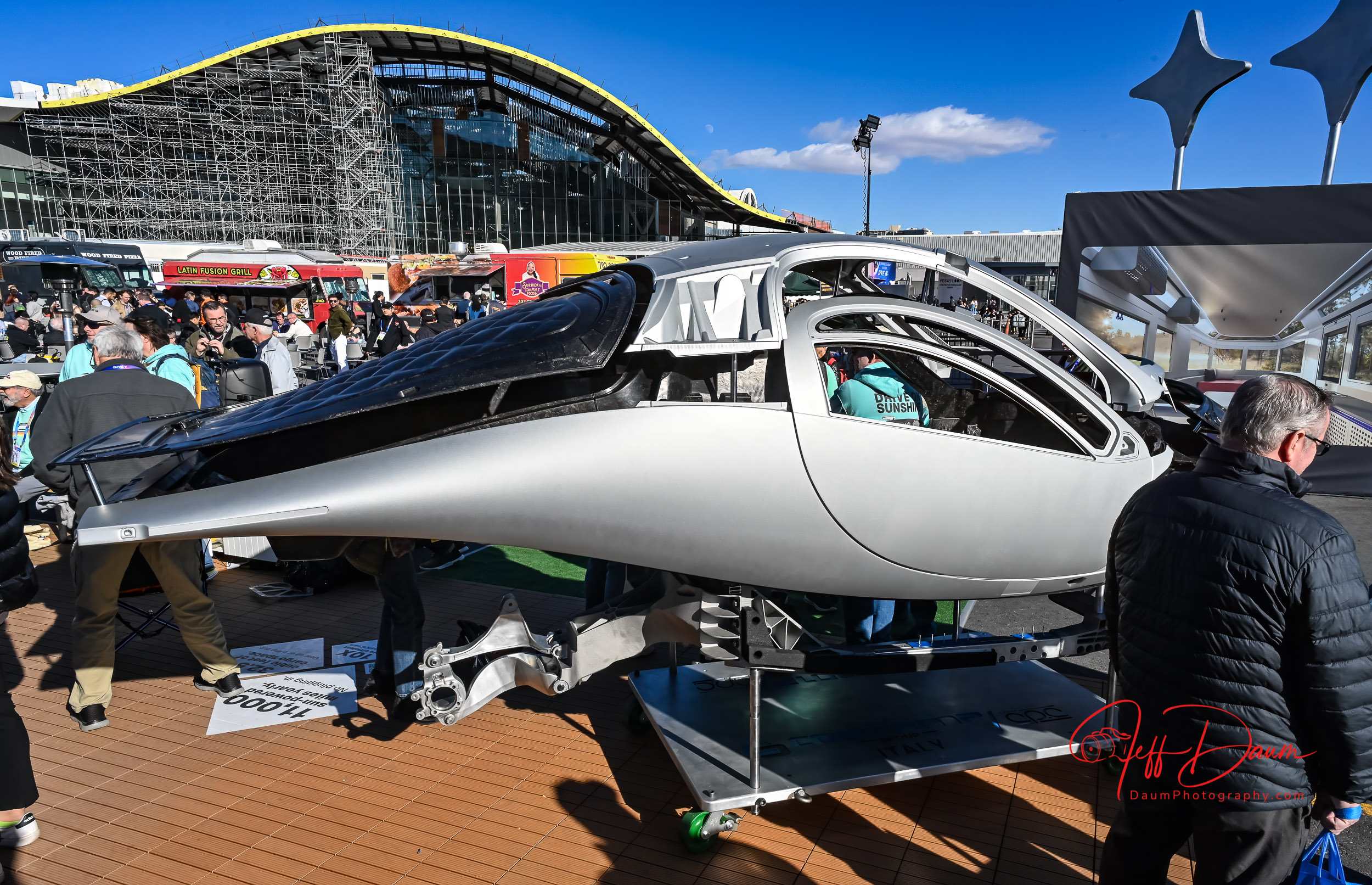
The first thing that you notice is its unique aerodynamic shape.  In fact, because of this shape it has the lowest coefficient of drag of any road vehicle at approximately 0.15!  The body was designed in concert with Pininfarina and is out of carbon fiber.  It is manufactured in Italy and shipped to Aptera Motors facilities in Carlsbad, California.
Probably the next thing you will notice is that Aptera has two front wheels and one rear wheel- an autocycle.  It is classified by the DMV as a motorcycle, specifically a Trike with full enclosure.  This means that it is registered as a motorcycle but you will not need a motorcycle driver’s license nor need a helmet.

Like most sports cars, the interior includes side-by-side two passenger seating.  It has all the normal accouterments: safety belts, frontal driver and passenger air bags, a steering wheel, accelerator and brake pedals, ac and heat, etc.  In front of the steering wheel is a horizontal screen that continually shows full views of the right and left side of the Aptera virtually eliminating any blind spots.  To the right of the steering wheel is the infotainment and information display.  The electronic rearview mirror shows the unobstructed view behind the Aptera (from a camera on the roof).  There is also a backup camera located adjacent to the license plate.  The plate holder slides to the side, revealing the NACS charging receptor.

Aptera has bespoke solar cells on the hood, dash and roof capable of generating 700 watts of electricity.  Each cell is incredibly thin, lightweight and glass covered yet capable of being bent to conform to the respective body shape.  According to their website details, an individual cell could be cracked yet continue to generate power because of its unique wiring. 

According to Aptera’s website, “the Launch Edition uses 21700 NMC 811 cylindrical lithium-ion cells, known for their high energy density and long life. The 44 kWh battery pack contains 2,304 cells, delivering 400 miles of range.” [ https://aptera.us/article/what-batteries-are-inside-aptera/ ]

I had the pleasure of talking with Chris Anthony, Founder and CEO Aptera Motors.

Chris image courtesy of Aptera

  Chris’ partner, Steve Fabro, also carries the title of Founder and CEO.

Steve, image courtesy of Aptera

I started off asking Chris about Aptera’s design elements to ensure safety, Here are highlights from this interview:

  • Regarding Aptera’s safety: Able to do things with carbon fiber that steel and aluminum vehicles can’t do.  Able to add protection such as great frontal impact strategies, offset frontal, side impact.  Crash energy is diverted from the passenger area downwards to the well protected battery and frame.  Aptera has front and rear crumple zones. Aptera has front and rear crumple zones and a carbon fiber roll bar.
  • Suspension dynamics: even though it is a three-wheel vehicle, because the heavy battery is mounted so low, it has almost the exact same suspension dynamics as a VW Golf.
  • Done lots of track testing and skid pad stuff, curb strike angles at forty-five miles per hour, pothole tests every which way you can think of with the vehicle, and because the battery weight is so low it is extremely stable.
  • We will be running Crash Tests shortly.
  • It has better ground clearance than a Honda Civic with six inches to the belly and five and one-quarter inches to the wheel pans, and ingress and egress a couple of degrees better than the Honda Civic.
  • Regarding stability, especially with the large area by the rear wheel, it has a low-profile mid-section.   We have simulated cross winds up to 115 mph and it performs better than other vehicles because flat sided vehicles are much more susceptible to the winds.  There is no float created because it is basically a downforce vehicle that creates a bit of downforce, though we attempted to keep it as neutral as possible.
  • The tires are 195-55 R16 low rolling resistance, specially formulated for them by Hankook Tires.
  • The ABS and airbags (passenger and driver frontal airbags) are currently undergoing calibration.
  • It has DC Fast Charge, Level 2 and regular 110 outlet capability.  The 110-volt outlet will provide 150 miles charge overnight.  The Aptera uses one quarter the energy of the average EV, meaning we charge four times faster.  A DC Fast Charger will put 500 miles an hour into it, a Level 2 will put 60 miles per hour and a regular outlet will put 13 miles an hour into it.
  • Currently we have more than 50,000 preorders from across 115 countries, had the largest Crowd Funding in the industry with 20,000 individual investors, and now working on an IPO and hope to have production vehicles in people’s hands by the end of the year.
  • No dealerships, but have distribution centers around the world, and working with some Tribal communities in states that don’t like the lack of dealerships similar to what Tesla does.
  • In sum, the Aptiva is much more akin to a formula one car than anything else on the road. It is the penultimate in aerodynamic efficiency and has a carbon fiber chassis through and through.  It is an interesting mix to try an be the most efficient vehicle in the world but also have really extreme performance, when you look at the how the vehicle is constructed and how we achieve 100-watt hours per mile and still keep safety paramount, and get all the solar power out of it we need. The Aptera is the most efficient vehicle in the world but still sporty and very nimble.

Some addition information from the Aptera website https://aptera.us/  :

  • the core of our design is a safety cell crafted from Carbon Fiber Sheet Molding Compound (CF-SMC), which is both ultra-lightweight and stronger than steel, paired with metallic subframes that absorb impact energy.
  • Aptera’s body features a specialized composite structure known as Body in Carbon (BinC), primarily constructed from Carbon Fiber Sheet Molding Compound (CF-SMC) and Glass Sheet Molding Compound (SMC). CF-SMC is a lightweight material that utilizes a random arrangement of short fibers, allowing for the creation of intricately shaped parts with significantly higher stiffness and strength compared to standard SMC.
  • Aptera features an unequal-length dual wishbone suspension in the front and a double trailing link suspension in the rear. This advanced suspension system provides a balanced combination of stability, control, and ride comfort, allowing for smooth handling across diverse terrains.
  • The largest single component is the carbon fiber tub.
  • Use of SMC side panels on the body that won’t dent when hit.
  • Front wheel covers rotate up to allow access to tire valve stem and rear tire has a small access hole for the same purpose.
  • At Aptera, we’re redefining the repair experience by making it accessible, straightforward, and affordable. Whether you’re repairing your vehicle yourself or working with a local shop, Aptera will provide detailed documentation and make spare parts easy to order. Unlike typical processes where maintenance information and parts access can be limited, we believe in empowering owners with everything they need to keep their vehicles in top condition.
  • The Launch Edition’s dimensions are optimized for aerodynamics and stability. The vehicle measures 15 feet (4.56 m) in length, 7.3 feet (2.22 meters) in width, and stands 4.6 feet (1.4 meters) high, with a wheelbase of 9.2 feet (2.82 meters).
  • Aptera has integrated the Vitesco Technologies’ EMR3 drivetrain—a high-voltage axle drive that combines a permanent-magnet synchronous e-motor, inverter, and reducer in one compact unit. 

Final thoughts:

I had a chance to sit in the Production Intent Aptera and found the seats very comfortable.  The interior is airy with great outward visibility.  The ‘double knock’ to open the door or trunk is a fun twist- there are no outside door handles.  The trunk is quite spacious, easily carrying two regular golf bags or even, apparently, with the seats folded forward, room to lie down if you take the Aptera camping.  There is also a small compartment under the regular rear floor that can be used to store charging cables or other supplies.

I am particularly impressed with Chris and Steve’s vision and approach.  They are continually striving to use their own and their team’s knowledge, seek and use outstanding third party input and resources, and harness AI to refine the Aptera to be highly efficient, practical and fun.  The use of Open-Source Software and Right To Repair sets the Aptera apart.

This is hopefully Part 1 of a multipart Aptera review.  Stay tuned for Part 2: a factory visit and first drive…

Thanks for visiting and reading. What are your thoughts on the Aptera? If you have a question or comment, please feel free to enter it below!

Thoughts on Automobility LA

Day one of the 2019 Automobility LA show might be best summed up in one word “Karma.”  The first media day is basically a series of thirty minutes (or more) technology update panels.  I find it interesting on a number of levels, including what really is new and what is status of the field.

For the most part, especially if you have attended a number of these over the years, you take what is said with a grain of salt and consider it a lot of marketing hype designed to stimulate discussion, create awareness, and in more cases than not, investor interest.

My ‘take-aways’ from today include:

  • The new CEO of Faraday (he was the CEO of Byton last year) sees the real financial profitability coming from the interconnected digital experience, rather than through the sales of their FF91 (September 2021) at $150-200k, or of their FF81 after that at $60-80k.
  • The “living space” experience of future semi-autonomous and ultimately, fully autonomous (levels 4 and 5) vehicles is the ‘hot’ topic focus of many presenters here.
  • Critical is figuring out how to integrate all of the vehicle voice assistants, such as OEM versions and Alexa, along with the artificial intelligence (AI) dynamic data base so that it is a seamless experience for the end user.
  • Figuring out how to gain the trust in the general public of autonomous vehicles (AVs)

One split in thinking and focus that I feel isn’t being given enough effort is that there really are two very different AV ‘roads’ that need to be integrated for this future disruption to succeed.  That is, one faction sees AVs as ultimately the replacement for the personal car as simple a means to primarily get from A to B, while the other is attempting to create a whole new means of experience that people will just want to do because of the experience.  The later are focused on integrating lots of monitors (screens), high end audio, augmented reality, etc.  An overriding issue for both factions is what the respective impact will be on reducing congestion in urban environments.

Continuing issues include lack of standardized intra and inter vehicle communication (software), privacy of the ever-expanding data base on each end user (incrementally increasing under the 5G capabilities), and lack of interstate DMV regulation for AVs.

It still appears that the near future of AVs will be restricted to proprietary lanes on highways and in urban environments, where human driven vehicles are not allowed to drive.  Under this set-up, I believe we will see a significant reduction in accidents and deaths.

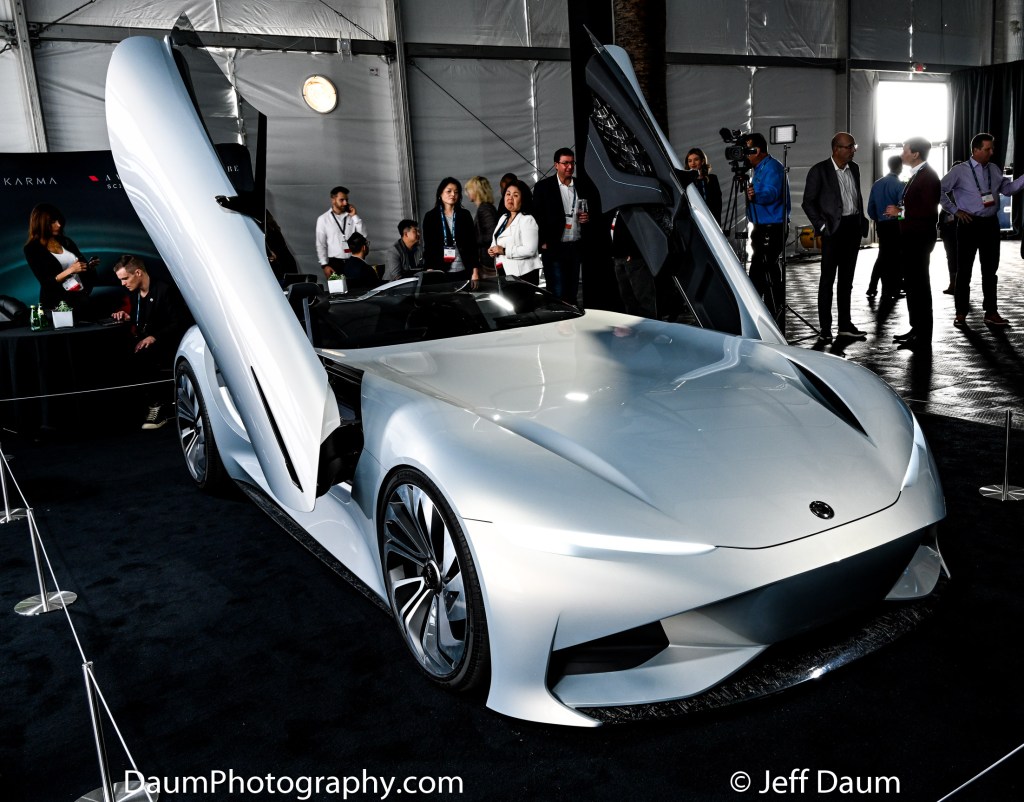
Oh, and why this first day is best summed up as Karma? The simple answer is that Karma had their FF91 there, as well as functioning protypes of their future vision cars the SC1 and SC2 (convertible and hardtop respectively, each with ‘scissor’ doors), and their Revero GTS model.  Alternatively, as a bit of tongue-in-cheek, perhaps the future of AVs is just karma personified…

More to come.  In the interim, what are your thoughts?

Autonomous Vehicles: Part 2

This is the second blog on Autonomous vehicles, for the introduction and first part please see Autonomous Vehicles Part 1 .

Autonomous vehicles- the major potential ‘cons’:

Connectivity:

The sine qua non for the CAV (connected autonomous vehicle) is communications.  It is at the same time its strength and, borrowing from Greek mythology, its Achille’s heal.  To function, autonomous vehicles must rely on a tremendous amount of inter and intra connectivity.  All of the on-board sensors (lidar, radar and cameras, engine parameters, lane departure, etc.) have to flawlessly communicate with one another, as well as vehicle to vehicle, and communicate with traffic management (lights, flow, emergency vehicles, etc.).

jdaum-1

Sounds great in theory, but in actuality this is astoundingly difficult to pull off.  Keep in mind, this connectivity has to function flawlessly all of the time.  There was a bit of irony at CES 2017 in that every presentation I attended experienced a problem at least once with the remote presentation control unit communicating correctly with the media controller equipment.  And this was connectivity at its very basic level!  On a more complex level, there was Faraday’s problem during the press review where their car failed to accept the command to self-park.

Obviously, you can’t have a break in connectivity or the autonomous vehicle will come to a complete (unintended) halt (hopefully), and in doing so will become a potential accident instigator for both other autonomous and non-autonomous vehicles.  What level of redundancy will be sufficient to prevent a loss of connectivity?  While it seems feasible that intra- vehicle (between its numerous components necessary to have an autonomous system) redundancy is reasonably surmountable, what will be necessary to ensure the inter-vehicle, and traffic management, along with live web connectivity, is flawless?

Simultaneously with ensuring the continuous flow of connectivity, there are still two large problems to solve: All communication has to be hack proof (we have seen the videos of someone remotely gaining access to a vehicle’s electronics via one of the communication channels, and taking over one or more of the vehicles systems- acceleration, braking, steering.  Hackers have demonstrated this remotely on cars ranging from Jeeps to Teslas.).  Further a great deal, if not all, of the information has to maintain the privacy of the vehicle (and its occupants).

Additionally, complicating the connectivity issue is what was tagged “Babel” at the CES 2017 A United Language for the Connected Car session.  The general definition of babel is a confused noise, typically made by a number of voices.  Unfortunately, it applies to the current status of proprietary software designed for many of the components needed for a connected vehicle.  The herculean challenge is to get a universal open language used across all components/systems for autonomous vehicles.  Beyond the current Babel-of-software-language is the growing quagmire of state and federal regulations aimed at controlling autonomous vehicle access to our roads.  Currently, an autonomous vehicle approved by nascent laws in one state, may not be able to continue driving when it crosses into an adjacent state.  For example, while an autonomous car can be driven in Nevada, it can’t legally continue into nearby Oregon or Idaho, and if you are in an autonomous car in Florida, you could not continue on into any of its adjoining states.

Societal Impact:

The RAND Corporation pointed out in their 2016 publication Autonomous Vehicle Technology: A Guide for Policymakers, that rather than autonomous vehicles reducing congestion on our roads, they may, in fact, increase congestion.  This conclusion is based on the reduced transportation costs borne by individuals.  For example, the cost of automotive insurance shifts from the owner to that of the manufacturer of autonomous vehicles.   This, combined with increased access (potentially no need for individual driver licenses), could see a substantial surge in the number of individuals travelling at the same time.  Of course, it could be moderated by increased reliance on mass vs low occupancy vehicles.  The elimination of the hassle often associated with finding a parking space (your autonomous vehicle could drop you off and then continue on to a remote parking area, awaiting your request for it to comeback and pick you up) may also contribute to a significant increase in willingness to ‘hop’ into your vehicle and head to a dense, high-use, urban area.

What are the implications for the potential loss of transportation sector jobs, their respective incomes and loss of tax revenues from reduced or eliminated parking garages, meters, etc.?

And while most believe that autonomous vehicles (or even semi-autonomous) will significantly reduce the number of deaths caused by crashes, the is one part of our society that has depended on these deaths- that of organ donations.  “It’s morbid, but the truth is that due to limitations on who can contribute transplants, among the most reliable sources for healthy organs and tissues are the more than 35,000 people killed each year on American roads (a number that, after years of falling mortality rates, has recently been trending upward). Currently, 1 in 5 organ donations comes from the victim of a vehicular accident.” [From Future Tense: The Citizen’s Guide To The Future. Dec. 30 2016]  The potential impact is catastrophic on an already stretched organ donation system.  “All of this has led to a widening gap between the number of patients on the organ wait list and the number of people who actually receive transplants. More than 123,000 people in the U.S. are currently in need of an organ, and 18 people die each day waiting, according to the Department of Health & Human Services. Though the wait list has grown each year for the past two decades, the number of transplants per year has held steady in the last decade, at around 28,000.”[ Fortune: If driverless cars save lives, where will we get organs? By Erin Griffith Aug 15, 2014].

Moral Dilemma:

You may be familiar with the paradox of Buridan’s ass.  As the story goes, a hungry donkey was placed equidistant between two identical bales of hay.  Unable to choose which one to go to, the donkey died of starvation.  The movement towards autonomous vehicles has at least two analogous conundrums: how many deaths by autonomous vehicles is an acceptable number of deaths, and, who is going to have the final approval of the algorithms designed to make a decision for an autonomous vehicle as to who should be sacrificed when a choice has to be made between certain death in a pending accident.  The analogy is that if we can’t reach agreement on both of these issues, the movement towards autonomous vehicles may come to a halt.

Even though these two conundrums are inextricably related, let me briefly explore each separately.  We know factually that autonomous vehicles can lower deaths currently associated with driver error, and that the number won’t rapidly be reduced to zero.  Using the approximately 32,000 automotive related deaths per year (cited in my Part 1), what percent reduction would be ‘acceptable’?  Would a 50% reduction resulting in 16,000 fewer deaths per year, but also 16,000 remaining deaths per year by autonomous vehicles be OK?  Would it take a 75% reduction resulting in 8,000 deaths per year by autonomous vehicles to be considered OK?  The consensus appears to be that while the astounding number of 32,000 deaths per year caused by human error behind the wheel, isn’t good, we seem to have ‘accepted’ it without demanding immediate action on a national or global level.  However, few believe we would be as complacent if the news was filled with 16,000 or even 8,000 deaths per year as a result of autonomous vehicles.

Recently a number of articles have appeared highlighting the other conundrum: algorithms being designed to decide who lives and who dies when the outcome of a pending accident is unavoidable.  For example: “A self-driving car carrying a family of four on a rural two-lane highway spots a bouncing ball ahead. As the vehicle approaches a child runs out to retrieve the ball. Should the car risk its passengers’ lives by swerving to the side—where the edge of the road meets a steep cliff? Or should the car continue on its path, ensuring its passengers’ safety at the child’s expense?” [Driverless Cars Will Face Moral Dilemmas by Larry Greenemeier, June 23, 2016, Scientific American] Or:” Imagine you’re behind the wheel when your brakes fail. As you speed toward a crowded crosswalk, you’re confronted with an impossible choice: veer right and mow down a large group of elderly people or veer left into a woman pushing a stroller.” [Driverless cars create moral dilemma. By Matt O’Brien, The Associated Press January18, 2017].  Who should be entrusted with developing and ultimately approving the necessary algorithms?  Shall there be one algorithm for all autonomous vehicles globally or will there have to be country/culturally specific versions?

Real World Impediments To Fully Autonomous Vehicles:

At this point, autonomous vehicle developers have not been able to handle several frequent occurrences typical to our driving environments.  If a fully autonomous car comes upon road construction, it doesn’t know how to ignore the programming that tells it not to cross a double yellow line, or purposely drive into a temporary lane without lane markers.  It is basically programmed to shut down- or, in Nissan’s case, phone ‘home.’  At CES 2017, Carlos Ghosn, Chairman and CEO of Nissan, during his keynote speech said they are planning on having a centralized station staffed 24/7, to handle “edge” circumstances for their autonomous cars.  In logic, the human contacted by the autonomous car would review the information available from the on-board sensors, and map an alternative route or action.  It is unclear how would this approach be able to scale up instantaneously, for example, when a large section of a country has an extreme disrupter such as flooding, earthquake, etc.?

Similarly, autonomous vehicles cannot negotiate a dirt road, or a road that lacks up-to-date gps mapping.  Neal Boudette in his article “5 Things That Give Self-Driving Cars Headaches” points out, autonomous cars will have a very hard time with unpredictable reckless drivers on the same road in a non-connected vehicle [New York Times, June 4, 2016].

Current thinking of many developers, is to require a (human) driver to serve as ‘back-up’ in those circumstances where the autonomous or semi-autonomous vehicle encounters a situation it isn’t programmed to handle.  Unfortunately, there are severe limitations to how well most drivers would be able cope with such an unexpected/instantaneous hand-off (one doesn’t have to look any further than the tremendous increase in accidents attributable to drivers distracted by texting).  The biggest problem is with a lack of sufficient reaction time even at moderate speeds, let alone highway speeds.  This is further complicated by the well documented fact of vigilance decrement.  The longer the autonomous vehicle is properly handling the driving, the less attentiveness and readiness the ‘back-up’ human will have to properly respond to the hand-off.

In order to succeed, there is going to have to be a significant educational effort of the current, and potential, driving public during the transition period when autonomous and semi-autonomous vehicles share the road with traditional non-connected vehicles. Part of this education will need to focus on the trust issue confounded by demographic and age differences in acceptance.

In some ways, many of the concerns today are parallel to those around one of the earliest autonomous vehicles designed to transport people- the elevator.  Original elevators were relatively dangerous vertical transport platforms, operated by a trained elevator operator.  As safety concerns were addressed, elevators vastly improved including having doors, fixed stopping points, redundant mechanisms to prevent free fall, etc.  Shortly after the turn of the twentieth century push buttons were introduced that would permit selecting a specific floor and the elevator to proceed automatically to that floor.  However, it wasn’t until after World War II -forty years after automation- that elevator operators were no longer placed in most elevators.  One of the main reasons for the slow transition from manually operated to fully automated elevators was people were fearful of getting into an elevator that did not have a human operator.  How likely are you to entrust your life to the newest mode of autonomous vehicles?

Autonomous Vehicles Part 3 will explore: What is next?  Is the light at the end of the tunnel daylight or an oncoming train?

CES 2017 Autonomous Vehicles: Part 1

Print

Autonomous Vehicles: Part 1

Probably the best way to start is to use CES’ clever one word campaign that defines CES 2017: Whoa!

Having spent 5+ days trying to take it all in, and by all I mean over 3,800 exhibiting companies, across several Las Vegas resort locations and the LV Convention Center, and is the largest event of its kind, I have to agree Whoa! best describes it.

CES Overview

If you are not familiar with CES, it used to be known as the Consumer Electronics Show, and now is called CES: the global consumer electronics and consumer technology trade show.  While the new official name isn’t as ‘catchy’ as the original one, it is more accurate.  Exhibitors and buyers from 150 plus countries attend, network, and place orders for this year’s hottest tech.

Additionally, it serves as a platform for the top experts in related fields and industries to come to share ideas and learn from one another.  While it is not open to the public, it has a massive attendance- over 175,000 this year, along with a large media presence to get the word out.

CES 2017 covered a broad range of technology and its impact on:

  • Aging and accessibility
  • Cyber security
  • Drones (from micro to those capable of carrying an individual)
  • Enhanced audio and video
  • Gaming, VR and AR (virtual and augmented reality)
  • Health, fitness and wearables
  • The Connected world
  • Sustainable and Eco-friendly tech
  • Vehicle technology
  • Startups
  • Family and lifestyle
  • Content and entertainment
  • Robotics

The focus of this blog is one slice of CES 2017 which, in my opinion, will ultimately impact virtually everyone- that of Autonomous Vehicles.   From my perspective, it truly reflects the synthesis and status of the technology found across most of the areas in the bullet list above.

Introduction: Just what is an autonomous vehicle?

Is it a car that can drive down the road by itself like a Tesla, or one that can park itself like a Toyota, or brake itself to avoid collision like a Cadillac, or is it reserved for something more like depicted in the 1960s series the Jetsons?

Courtesy of Newsday jetsons-flying-car

At CES 2017 there were numerous autonomous vehicles in all shapes and sizes.

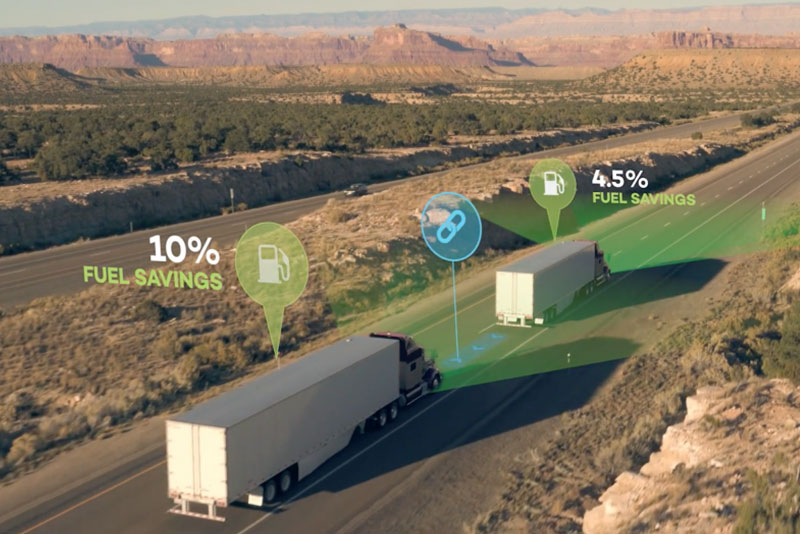
And there were even semi-autonomous trucks demonstrating platooning technology, where they are able to travel in a caravan fashion saving fuel and driver effort.

peloton-fuel-savings

SAE has developed the most broadly accepted definition of the levels of driving automation.  As seen on the accompanying chart, they have described five levels ranging from ‘no automation’ through ‘full automation.’  Most important is the transition role (responsibilities) between the human and the ‘system.’  The biggest shift is between levels 2 and 3, where the responsibility for monitoring the driving environment shifts from the person to the system.  The role of the human becomes one of back-up to the automated driving system.  Of course, this shift in responsibility is one of the thorniest and most complex components of the process.

jdaum-123

Autonomous vehicles– the major potential ‘pros’:

Among the top reasons to move towards automation level 3, 4 or ultimately 5, include anticipated significant reductions in vehicular deaths; reduction in congestion; reduction in pollution; facilitated transport of individuals unable to or who should not be driving (too old, infirm, disabled, too young, under medically induced or other impairment).

For example, there are approximately 32,000 automotive related deaths per year.  NHTSA has estimated that between 90 and 94% of those are due to human error.  Further, the economic cost is c. $242 billion and societal harm c $836 billion.  Automated drive systems, whether as low as SAE level 2 on upwards to 5, is expected to significantly reduce deaths due to human error.  Most agree it is reasonable to expect automation to quickly reduce the automotive related deaths easily by half or more.

Damien Riehl (a technology lawyer with a background in legal software design) summed up the critical advantages of the ‘hand-off’ from human to machine: “Computers do not share human drivers’ foibles: They cannot be inebriated, they don’t text, and they don’t fall asleep. Automated-driving systems can also have super-human qualities: 360–degree vision; 100 percent alert time; constant communication with the road, traffic lights, and other cars; “sight” through fog and darkness; and universal, system-wide routing for traffic-flow optimization. Computers react faster: Humans’ reaction time is approximately 1.5 seconds, while computers’ reaction times are measured in milliseconds (and, per Moore’s Law, improving exponentially). [ from the Bench & Bar of Minnesota, the official publication of the Minnesota State Bar Association; Riehl Oct. 4, 2016]

Another significant advantage of moving towards autonomous vehicles comes from the necessary connectivity in each vehicle.  Autonomous vehicles will need to be able to ‘communicate’ with other vehicles on the same road, the environmental variables such as traffic lights, weather, flow, etc.  This critical inter-connectivity will enable aggregated, and most cases, instantaneous learning by the vehicle’s system.  Much like we see today in applications such as WAZE and LIVE, where we as drivers hear of traffic issues, police actions, etc. in near real time, and they can choose to act upon such information, that is learn from it, or ignore it. But of course, the difference is that autonomous vehicles will be programmed with algorithms to instantaneously incorporate the new information and take appropriate corrective actions.  For example, if an autonomous vehicle is driving along a road where there is a traffic accident or construction, it would send the information to other autonomous vehicles further back on the same route, resulting in a seamless rerouting.  This built in collective and incremental learning will mean that the more the autonomous vehicles drive, the more of them on the road with vehicle-to-vehicle and vehicle-to-environs instant and continuous connections, the more efficient and expeditious each will become.

Potential applications abound (many you probably have heard about) including driverless pick up via Uber/Lyft; calling your own car to pick you up and drop you off; driverless public transportation like Olli; platooning of freight hauling trucks, etc.  Autonomous vehicles also open up new modes of transportation, such as the hyperloop.  For example, Hyperloop One is being built north of Las Vegas, Nevada as a proof of concept.  Here in their own words is an explanation: “The Hyperloop is a new way to move people or things anywhere in the world quickly, safely, efficiently, on-demand and with minimal impact to the environment. The system accelerates a passenger or cargo vehicle through a steel tube in a near-vacuum using that linear electric motor. The autonomous vehicles glide comfortably at faster-than-airline speeds over long distances due to the extremely low aerodynamic drag and non-contact levitation. There’s no direct emissions, noise, delay, weather concerns nor pilot error. “[By Bruce Upbin, VP Strategic Communications, Hyperloop One].  Ultimately the vision for hyperloop is to have direct connections (non-stop) between cities, with hubs where either you could drive your car or take an autonomous car to the hub.  At the hub you would drive onto an autonomous platform, be in a small grouping of platforms going to the same location, and be sent out within minutes of your driving onto the platform to your destination, non-stop, at speeds of up to 700+ miles per hour.  At your destination, you would leave the hub and drive or be driven to your objective.

Autonomous vehicles logically could also result in lack of need for personal car (or multiple car) ownership, personal automobile insurance, significant reduction in the need for parking garages in cities, decreased pollution, and increased personal time.

But is it all rosy?

In my Part 2, I will explore Autonomous vehicles- the major potential ‘cons’ https://insight.daumphotography.com/2017/01/25/autonomous-vehicles-part-2/

For a sample of my photographs from CES 2017 please see http://www.daumphotography.com/Events/2017-CES/