BlackVue DR770X Dashcam Review: Security Redefined

By Jeff Daum, Ph.D., PPA

BlackVue represents some of the best dashcam systems on the market.  You can see my reviews of previous models at for the DR970X https://insight.daumphotography.com/2024/02/02/blackvue-dr970x-2ch-plus-and-dr970x-2ch-lte-plus-dash-cameras-field-test/ and https://insight.daumphotography.com/2020/07/11/product-review-blackvue-dr900s-2ch-field-test/ for the DR900S.  This review focuses on BlackVue’s new DR770X Box-3 channel Pro version.  It is primarily designed for the individual who wants up to three cameras- a front facing, rear facing and interior facing dashcams, and a system that is designed to provide protection from someone else getting to the recording memory card or attempting to physically remove the connections to each of the dashcams.  You might want this added security, for example, in a ride share or taxi vehicle.  Of course, the DR770X can be used in your own vehicle even if you don’t need the added security of a tamper proof set up.

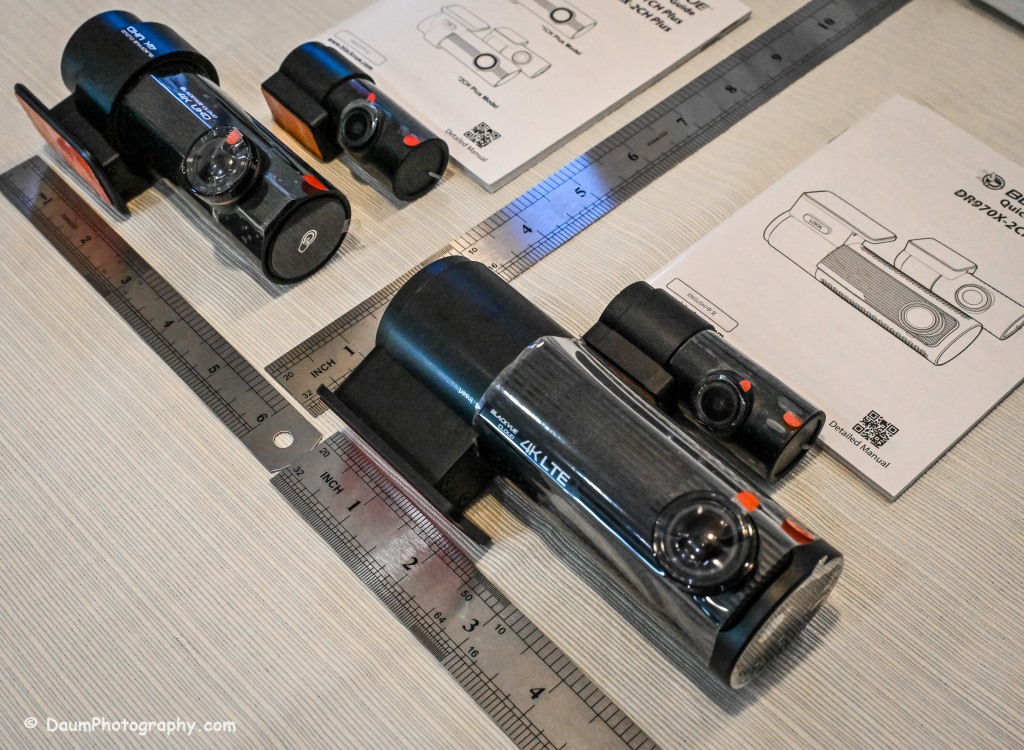
The first thing you’ll notice is that the front facing DR770X is physically a lot smaller than most other BlackVue dashcams.  Specifically, the DR770X is approximately 3 inches (76mm) long compared to their DR970X and DR900S at approximately 4.7 inches (118.5mm) long or the even longer DR970X-2CH LTE Plus at approximately 5.4 inches(137.6mm).

The lockable main box comes with a large Velcro pad on the back so that it can be positioned out of sight but convenient to remove to gain access to the microSD card.

While BlackVue’s marketing states the DR770X has a faster lens at f/1.7, it depends on what other dashcam they use in the comparison: The DR970X Plus also has a f/1.7, but the DR970X’s is f/2.8.

The DR770X has a narrower coverage area with Diagonal 139°, Horizontal 116°, Vertical 61° for the front camera and Diagonal 115°, Horizontal 95°, Vertical 49° for the rear facing camera.  The DR970X has front: Diagonal 155°, Horizontal 130°, Vertical 70° and rear: Diagonal 139°, Horizontal 116°, Vertical 61° while the DR900S had front: Diagonal 162°, Horizontal 136°, Vertical 77° and rear: Diagonal 139°, Horizontal 116°, Vertical 61°.

The DR770X is a 4K dashcam with Sony STARVIS, the DR970X and DR900S an 8-megapixel CMOS Sensor.

The DR770X Pro has an increase in the event buffer recording time to 10 seconds up from 5 seconds compared to prior models.  Events are when the system senses a bump, hard turn, crash, etc., and automatically mark the recording as such preventing it from being overwritten when the MircoSD card is full.

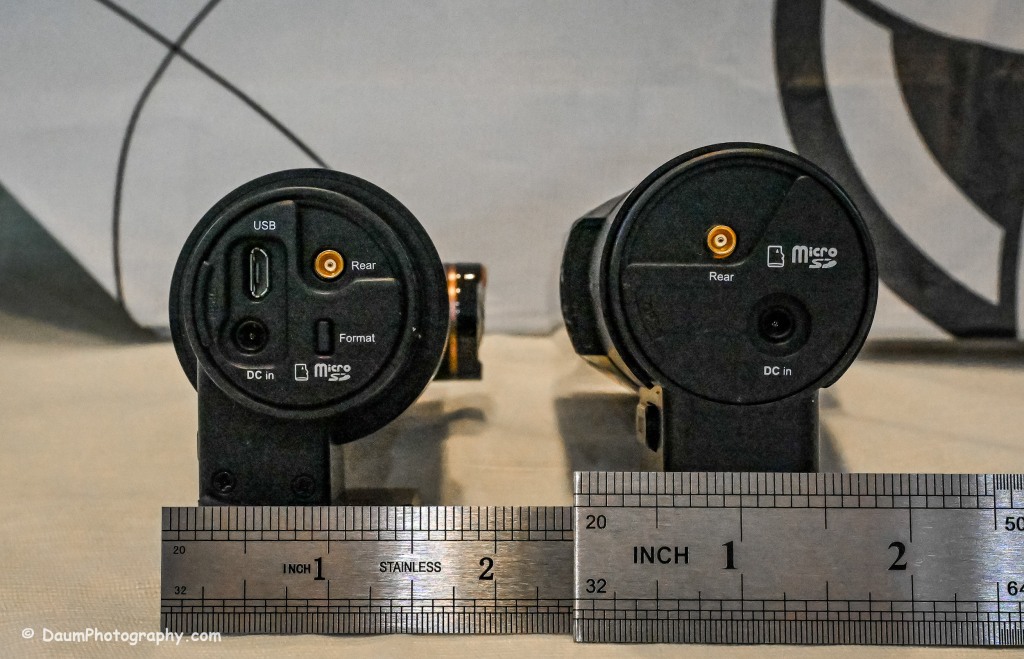
Note: prior to setting up your DR770X system in your vehicle, I suggest you jot down the unique password that is on the camera behind the tamper proof end cover.  You will need this if the auto-find in their app doesn’t locate and load your cameras on your initial set up.

All three models incorporate a built-in microphone in the front facing camera that can be set to always record interior sounds (voices, turn signals, music, etc.) or be turned off.  They also include a speaker that lets you know the system is functioning when it turns on.

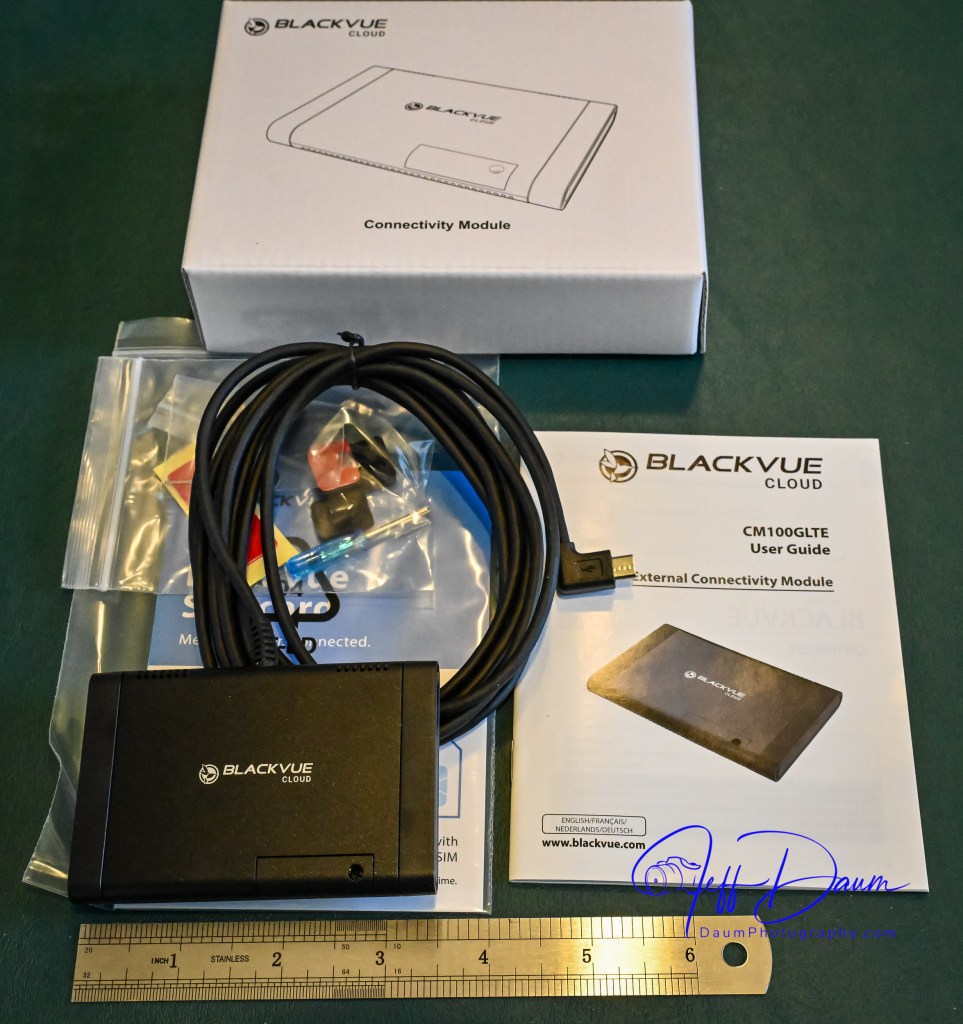
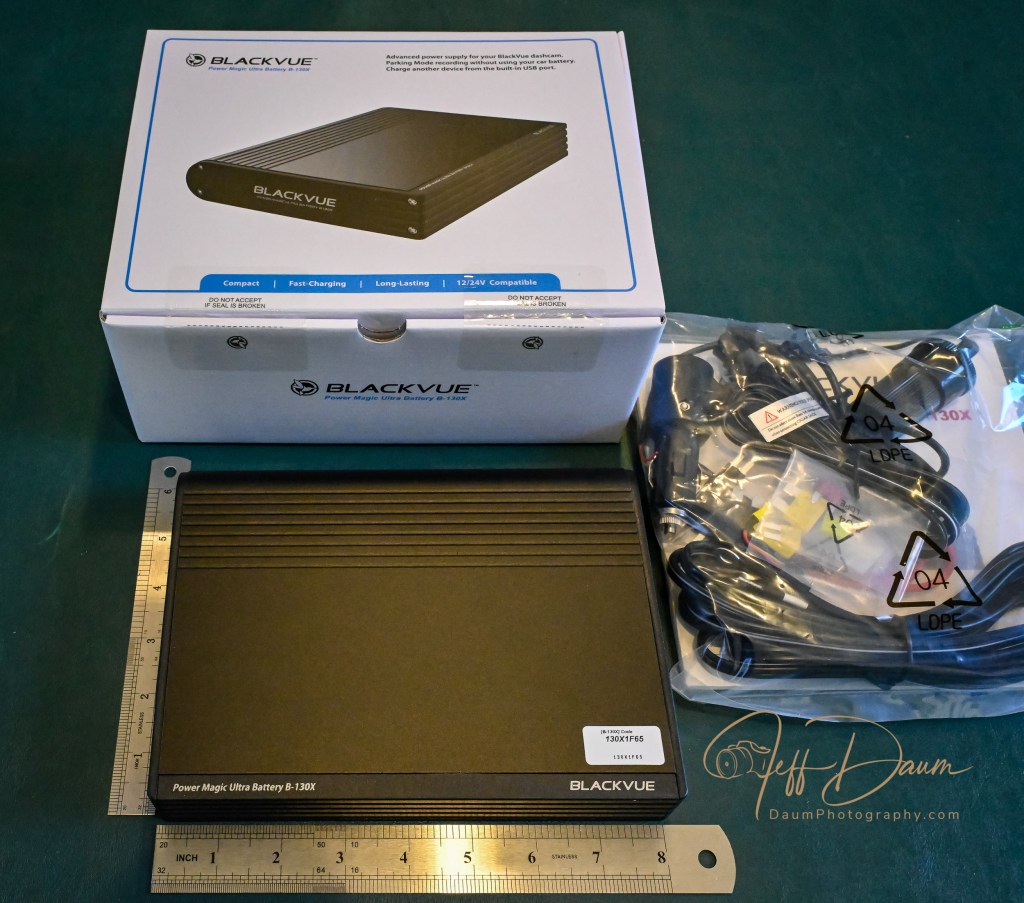
At the same time I tested the DR770X Box-3 channel Pro, I tested BlackVue’s LTE BlackVue cloud Connectivity Module and their B-130X Power Magic Ultra Battery system.
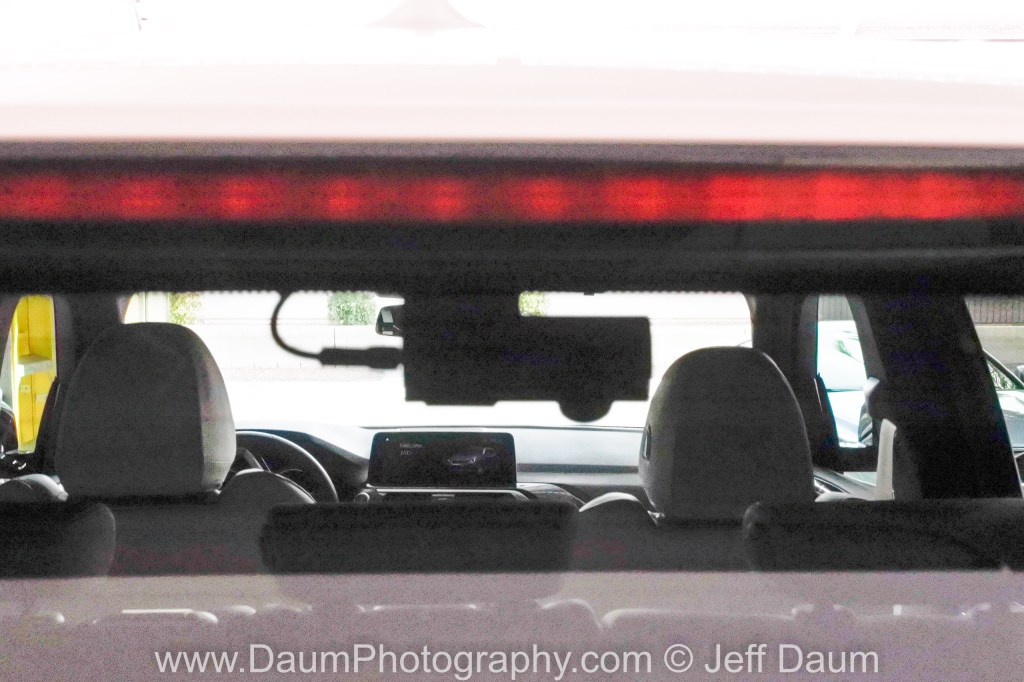
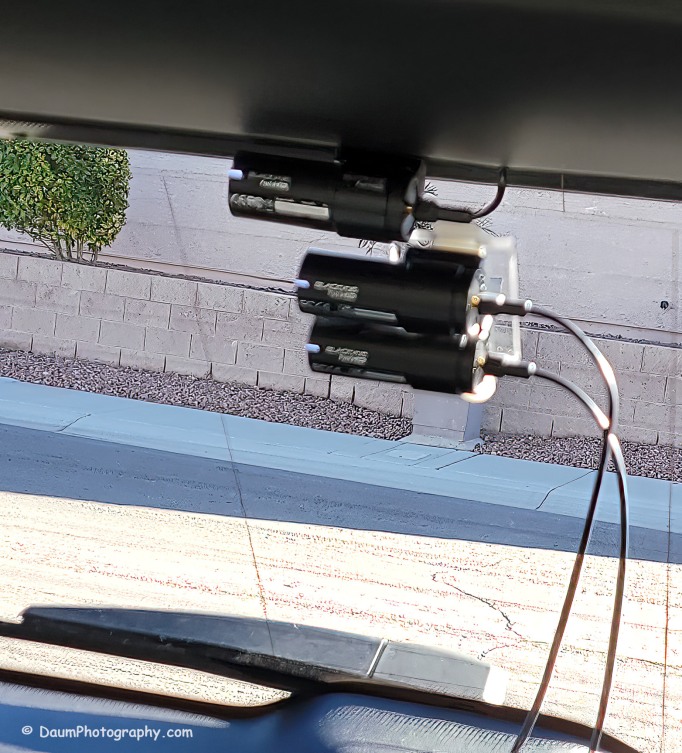
The DR770X dashcams were tested by mounting them in nearly the same perspective on the front and rear windshields as the DR900S, as can be seen in these images.
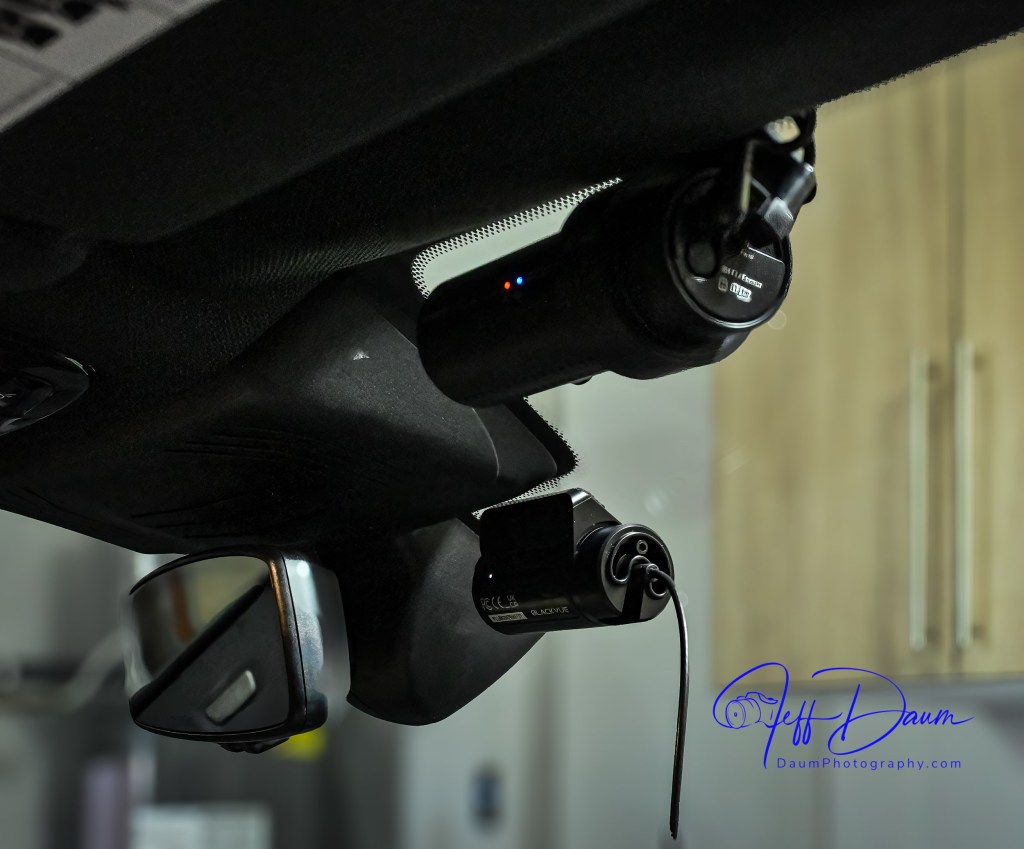
The main lockable box and B-130X Power Magic Ultra Battery were temporarily placed on the floor, with the GPS module or the LTE BlackVue cloud Connectivity Module antenna temporarily mounted near the top of the windshield.

Field Test

In this as well as all my tests, the images here are unmodified and based on the factory settings, which can be fine-tuned if one wants to.

Here is a look at the front facing cameras during the day.  In this comparison the DR900 images are slightly darker than the DR770.  The DR900 has a wider perspective, meaning you would see vehicles on either side earlier than with the DR770.  Both systems capture solid images along with documenting your position and speed (though you can turn that off in the set-up).  When I looked at enlarged images, the DR900 captures a bit more detail than the DR770.

[Note: a higher resolution video can be seen by clicking on “Watch on YouTube” in the lower left section of each video]

Here is a comparison of the rear facing cameras, with similar conclusions as the front facing cameras. Again, the DR770 has a smaller angle of coverage with its rear facing camera than the DR900S.

Turning to night captures, the front facing DR900 appears sharper with less flare around bright lights than the DR770. 

Looking at the night rear facing cameras, the DR900 has more flare around bright lights than the DR770, but still a bit more detail on examination.

The interior facing camera of the DR770 provides similar quality during the day to the front facing camera, but with a much wider range of 180 degrees.  It captures everything from the driver door to the passenger door and back seat.  This camera includes Infrared LEDs and sensors that automatically come on in low light, providing clear images in total darkness.

The free BlackVue app provides easy access to check on the B-130X remaining power.  If you have the optional LTE Connectivity module connected, the app also allows you to see what your dashcams are seeing, stored recordings, etc.  Even if you do not have the Connectivity module, the app will allow you via WiFi to see what your cameras are seeing and to modify their and the system’s settings.

There is also a free BlackVue app for your computer that is very useful.  While you can remove the MicroSD card and view the recordings on your computer without the app, the app offers several real advantages.  When you use the app to view your recordings, it enables you to see all cameras (front, rear and interior) simultaneously as well as providing a sidebar with a dynamic map and GPS position.  Another nice function of the app is it will automatically join the individual recordings one after another, simplifying the viewing.

Here is a screen shot of what the BlackVue computer app looks like with the DR770X.  On the right side of the screen, you see a narrow column with a dynamic map showing my vehicle’s position with street names, my speed, and actual GPS coordinates. On the bottom of the screen, you will see a line with date, time, vehicle speed, and the BlackVue camera(s) on the recording.  In the main part of the screen, you see a picture in a picture that has the rear facing camera and the rest is the front facing camera.  You can adjust what is included in the screen.
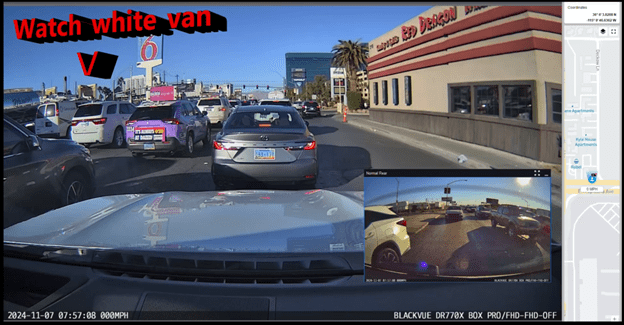
When you look at the following example from the app, you can see how the map is dynamic, and somewhat amusing, the white van will attempt to cross three lanes nearly perpendicular to the flow of traffic!

Preliminary Field Test Conclusions

Set up of the DR770X was straight forward, especially since this system uses the included wireless button to pair the cameras with the BlackVue phone app.  Once you power up everything, you simply press the wireless button which pairs with the app, and then you use it to confirm the DR770X cameras you installed.  Once that is done, you are all set.  You can use the system immediately or use the app to modify software defaults.

As in prior comparisons, BlackVue continues to produce top line dashcams with the most important features built in.  Of course, quality does come at a price with the DR770X 3CH Pro including a 64GB microSD card retailing at US$474.99.

The Power Magic Ultra Battery B-130X retails at US$359.99. The LTE module retails at US$159.99.

BlackVue customer service has been excellent in responding to any set up questions and/or issues.

The BlackVue DR900S has been in my vehicle for nearly 5 years now and has performed flawlessly in all temperatures from freezing to extreme desert heat. I have no reason to think the new DR770X Box-3CH Pro series won’t perform equally well and it adds the ability to have the IR interior camera along with added security of the locking main box and tamperproof camera mountings.

BlackVue states that you should use their microSD cards for optimal performance. I experimented early on with several non-BlackVue microSD cards (all were name brand high-quality professional level cards, designed specifically for handling the frequent record events typical of security cameras designed for video recording), and while they would work for a period, inevitably they would stop working or have glitches.  Once I went back to BlackVue’s own card I never had it stop working or fail.

These cameras offer pricing plans for saving files to the cloud as well as in the case of the option LTE connectivity module, a built-in SIM card to simplify the recording directly to the cloud.  As noted, it is easy to either download the video files or temporarily remove the microSD card and transfer the files to your computer.

The fit and finish of the new DR770X is excellent and all the components included are high quality.

If you are highly concerned about your vehicle when it is parked and unattended, you should consider purchasing the optional Blackvue Power Magic Ultra Battery.  I was impressed with how it elegantly solves the OEM battery management software issue.  I am adding it to my cars.

A final thought worth repeating from my earlier reviews: Many of my readers have asked ‘Do you really need a dashcam, and if so which one?”  Hopefully this review is helpful in reaching a decision.  For me personally I always want to have documentation of what is going on around my vehicle when I am driving, so all my cars have dashcams and when I rent a car, I put in a portable dashcam before I leave the lot.  I also find it is nice to have videos of scenic drives and the ones from BlackVue are perfect for this.

Thanks for visiting and reading. If you have a question, please feel free to ask below!
BlackVue DR970X-2CH Plus and DR970X-2CH LTE Plus Dash Cameras Field Test

By Jeff Daum, Ph.D., PPA

The focus (yes, literally and figuratively 😊 ) of this review is a comparison of two new BlackVue dash cameras, DR970X-2CH Plus and DR970X-2CH LTE Plus, to my current benchmark, the BlackVue DR900S-2CH camera unit.  I reviewed the DR900S in 2020 and found it to be an excellent choice out of the already crowded field of dashcams.  You can see my review here https://insight.daumphotography.com/2020/07/11/product-review-blackvue-dr900s-2ch-field-test/ .  The new DR970X Plus units were provided to me by the Marketing Team of Pittasoft Company, who manufactures the BlackVue units in their own factory in Korea.

Technically speaking based on BlackVue press releases, the DR970X Plus appears to have several improvements over the DR900S including a faster processor chip, improved CMOS sensors, and in the case of the DR970X-2CH LTE Plus, built in SIM card capability.   Top of my interest in carrying out this comparison and review is the DR970X Plus noticeably better in actual day-to-day use?

Before jumping into the field results, here are some of the respective technical specifications.

Physical dimensions:

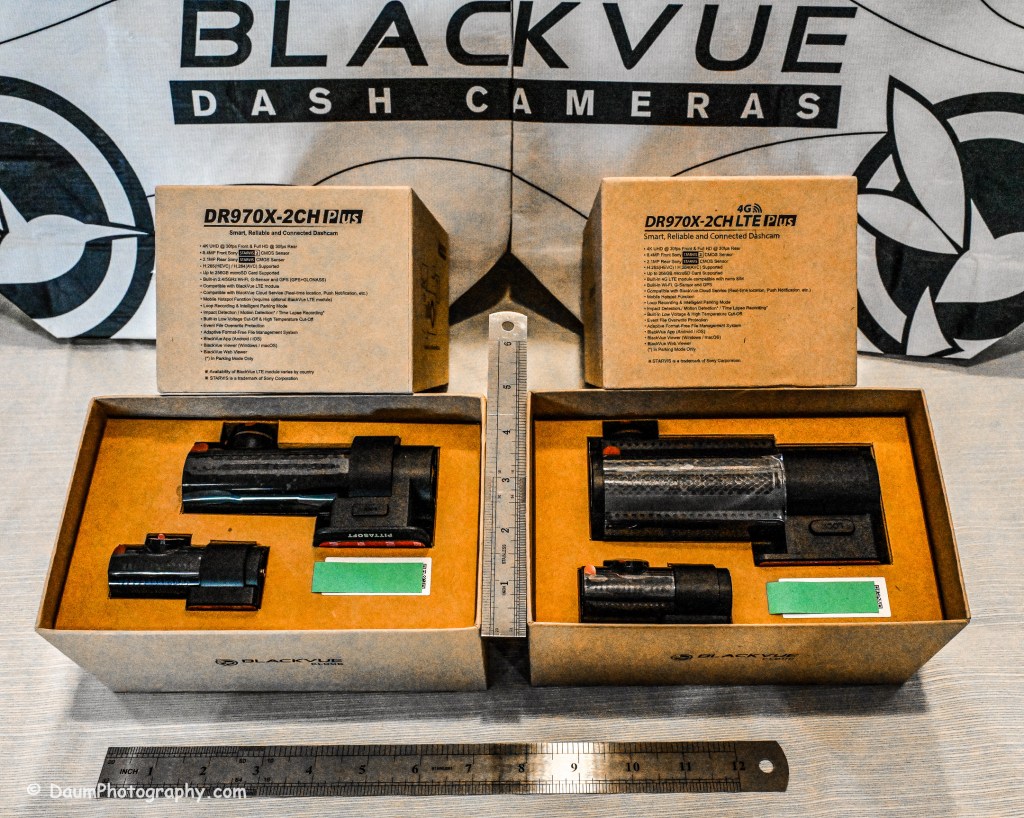
The DR970X-2CH Plus and DR970X-2CH LTE Plus have identical core components, that is, the lens, sensor, chips, etc., with the exception that the DR970X-2CH LTE Plus has a built-in LTE SIM micro card receiver and related circuitry.  This results in the DR970X-2CH LTE Plus being a little larger and slightly heavier than the sister unit.

DR970X-2CH LTE Plus vs DR970X-2CH Plus vs DR900S:

  -Weight with mount: 6.8 oz (192.7g) vs 5 oz (141.7g) vs 4 oz (113.39g)

  -Dimension: 5.42in (137.6mm) L x 2.67in (60.3mm) W x 1.69in (43mm) H vs 4.67in (118.6mm) L x 1.86in (47.7mm) W x 1.4 (36mm) H vs 4.66in (118.5mm) L x 1.4in (36mm) H

The rear camera is essentially physically the same on all three models: 2.6in (66mm) L x 1.1in (27.94mm) D and 1.0 oz (28.35g)

The DR970X Plus and the DR900S are almost the same physical size and weight, with the DR970X-2CH LTE being almost 2 ounces (56g) heavier as well as somewhat longer and rounder than the other two.

The lenses:

The DR970X-2CH Plus cameras (remember, both units are identical with respect to cameras and image capture) have a 125-degree horizontal and 68-degree vertical lens in the front unit, with a 107-degree horizontal and 55-degree vertical viewing angle in the back camera.  The DR900S-2CH camera has a slightly wider capture with a 136-degree horizontal and 77-degree vertical lens in the front unit, with a 116-degree horizontal and 61-degree vertical viewing angle in the back camera.

The resolutions and frame rates are identical for all three units at their highest settings: 3840×2160 @ 30 fps.

Image quality for the DR970X-2CH Plus units is 60+10 Mbps at the highest setting vs the DR900S is 25+10 Mbps, and all three have the same 8+6 Mbps with quality set to Normal.

Compression Codec is the same on all three units: H.265 (HEVC), H.264 (AVC)

Additional technology:

The DR970X-2CH Plus cameras use a STARVIS 2 CMOS Sensor of approximately 8.4 Megapixels on the front camera and a STARVIS CMOS Sensor or approximately 2.1 Megapixels on the rear camera, while the DR900S uses an 8-Megapixel CMOS Sensor on the front camera, and a Sony STARVIS CMOS Sensor of approximate 2 Megapixels on the rear camera.

All three cameras record in 4k UHD front and full HD rear.

All three camera units have built-in GPS but the DR970X Plus has dual band GPS, GLONASS.  They also have built-in WiFi with the DR900 supporting 802.11 2.4 GHz and 802.11 ac 5GHz dual band while the DR970X supports 802.11 a.b.g.n.ac.

All three record automatically when powered up and automatically over-write Normal recordings when the microSD card is full.  They also record and preserve impact detection events that occur while driving and while in parking mode (if powered).  Manual recording is also preserved.  They can take microSD cards from 16GB to 256GB (but strongly recommend only using BlackVue cards- more on this later).  Power is retained for a short period after shut down via built-in Super Capacitors.

All three cameras have a built-in microphone and speaker. One or both can be turned off via the BlackVue app.

All three camera units offer video recording saving to the cloud using optional paid plans, and the DR970X-2CH LTE Plus includes a free one-month trial SIM card and optional paid plans.  However, you don’t have to use the cloud and can either view your saved videos or live images by means of the free BlackVue phone app.  You can also download to your phone or remove the microSD card and transfer the files.  More on this shortly.

Power consumption per hour (really only important if you are using a dashcam in Parking Mode with the engine turned off) as expected, highest for the DR970X-2CH LTE being 590mA/12V in Normal Mode, 430mA/12V in Parking Mode vs the DR970X-2CH Plus at 480mA/12V Normal Mode, 370mA/12V Parking Mode vs the DR900S 380mA/12V in Normal Mode (Parking Mode was not part of the DR900S, so no equivalent power consumption available)

Recorded file size:  The typical DR970X Plus series front camera file size per recording (each is 1 minute in length) is 443 MB and for the rear camera 79.7 MB, while the DR900S file size per recording (1 minute in length) is 188 MB and for the rear camera 81.1 MB.  So, the DR970X Plus files for the front camera are more than 2.3 times larger than the DR900S, while the rear camera files are close in size.  This means that your microSD card is going to hold less than half the videos before it starts over writing as compared to the DR900S.

All come boxed with everything you need for either accessory plug powering or hard wire powering (both sets of power cords included), a starter BlackVue microSD card, connector line for linking and powering the rear camera, plastic trim pry tool, 3M adhesive for the cameras, small self-adhesive wire holders, Quick Start Guidebooks and a set of ‘nifty’ BlackVue stickers.  In my experience, the supplied power lines (hardwire or accessory, and rear camera) are more than adequate for proper setup in most vehicles.

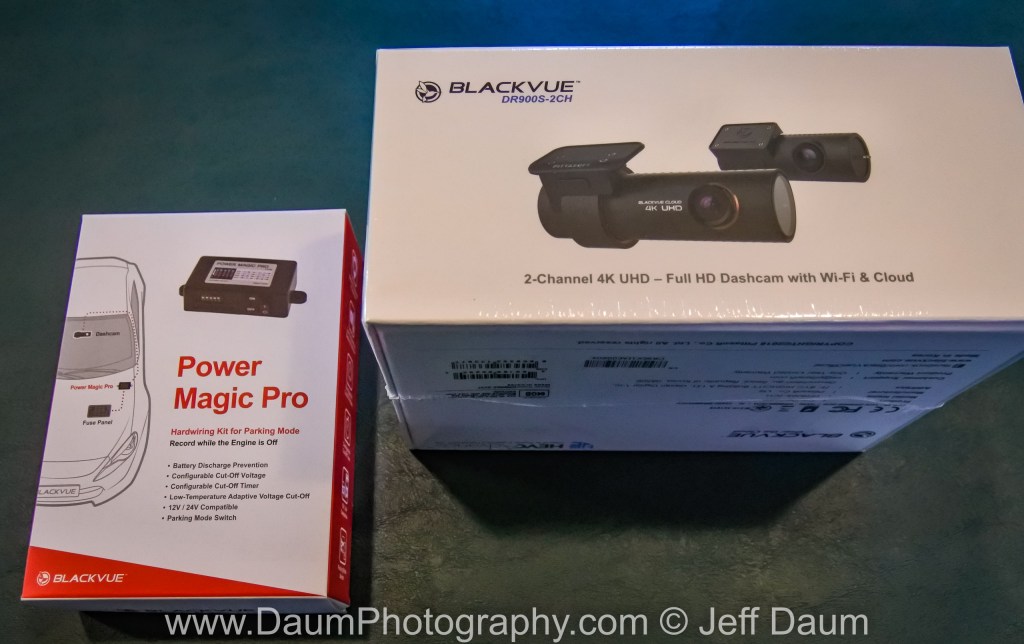
Here is what the unboxing and components look like:

Preliminary Field-Testing Results

Though I will not cover permanent mounting in this review, it is fairly straightforward.  Running and tucking (hiding) the wiring needs some patience and varies from the OEM and type of your vehicle.  For an example you can check out my install in a BMW X3 here https://insight.daumphotography.com/2020/02/19/blackvue-dr900s-2ch-dash-cameras-install/ .   I will be doing a hardwire installation within a few months in a couple of different vehicles- a BMW i4 and a Chevrolet Corvette.  A link will be provided to that when available.  While these cameras all (the DR900S needs the optional Parking accessory wiring component) support automatic switch over to ‘Parking’ recording when hardwired, many vehicles today have battery management software built-in that will either cut the power to the dashcam or cut other non-essential power draws when the vehicle is turned off and the draw exceeds a certain level, to ensure the main battery has sufficient power remaining to start the engine.  You can buy optional battery packs to power a dashcam for a specified amount of time, typically from a few hours to a few days by piggybacking them per manufacturer’s directions.  BlackVue sells them for their cameras as do other organizations.  Currently these battery packs add considerable cost especially if you are looking for several days of parking coverage.  Beyond that, long term parking will require the auxiliary battery packs get recharged either by removing them to charge them or by a solar panel placed in the windshield if feasible.

The videos (MP4) can be viewed and/or downloaded through the excellent (and free) BlackVue app, or you can remove the microSD card and load the files onto your computer.  Again, BlackVue has an excellent app for either PCs or Apple (I will discuss it shortly).  For this review I removed the respective microSD cards and transferred the videos to my PC.  All video captures and still images presented here are not retouched or corrected and appear as recorded.  In some examples I have enlarged or cropped images for easier evaluation.

As I stated in my earlier dash camera review, for most dashcam users, the primary purpose is to document traffic as you are driving.  Dashcams have become popular as a means of providing evidence in the event of road rage and/or an accident.  Ideally the dashcam will capture clear, time and gps marked images, both during daytime and nighttime driving to aid in this objective.  To begin evaluating how well these BlackVue cameras achieve this, let’s first look at a short comparison between the DR970X Plus and the DR900S.

A couple of observations- both BlackVues do well in documenting what is happening. To my eye, the DR900S images are slightly sharper during the day than the DR970X, while the opposite is true of the nighttime images.  This is probably a result of the new STARVIS 2 CMOS Sensor in the DR970X.  I should mention that Pittasoft has indicated a firmware update is planned for the DR970X series, while I don’t know what it will fix, perhaps focus refinement will be part of it.

You might be wondering what is in the right side of the DR900S.  That is actually the bracket supporting the two DR970X cameras mounted below. Here is the set up I used:

Here are comparisons between the DR970X Plus and DR900S where you can see both the respective front and rear facing camera views, one day time and one nighttime set:

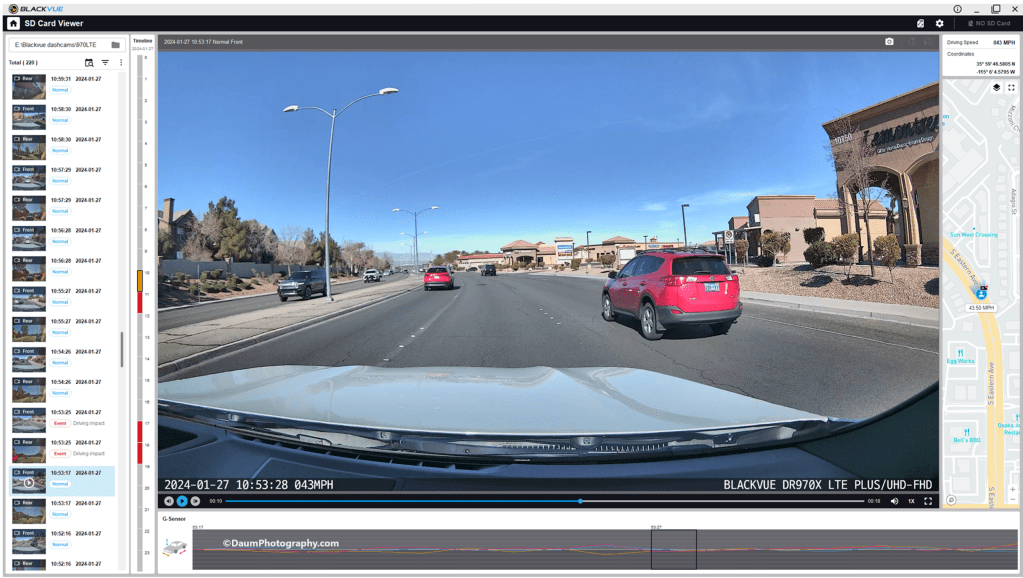
By the way, those simultaneous front and back views were generated using the free BlackVue PC app.  It is a very easy to use application that also can show each video along with a GPS location on a dynamic map, as well as a g sensor graph.  The g sensor shows any impact or bumps/rough road (which will also result in the video getting an “Impact” vs “Normal” label.  Here is what it looks like:

Here are some still images with the DR900S on the left and DR970X on the right:

Front camera

Rear camera

As with the videos, the greatest difference between the DR900S and DR970X is in the nighttime comparisons.  All images are viable straight from the respective cameras and could, if necessary, be sharpened with editing software.  One real advantage of the DR970X Plus series is that the WiFi is always on and that allows you to quickly view any saved or live images using the BlackVue app on your phone.  For the DR900S you have to turn on the WiFi at the front camera unit by pressing a button until it turns on (and it will automatically turn off in a few minutes).  Once turned on you can then link to the camera using the app.

Summary

As in prior comparisons, BlackVue continues to produce top line dashcams with the most important features built in.  Of course, quality does come at a price with the DR970X 2CH Plus including a 64GB microSD card retailing at US$474.99 and the DR970X LTE 2CH Plus including a 64GB microSD card, SIM card with a free trial of 1GB for one month retailing at US$544.99.  The BlackVue DR900S has been in my vehicle for four years now and has performed flawlessly in all temperatures from freezing to extreme desert heat. I have no reason to think the new DR970X Plus series won’t perform equally well. 

BlackVue states that you should use their microSD cards for optimal performance. I did experiment early on with several non-BlackVue microSD cards (all were name brand high-quality professional level cards, designed specifically for handling the frequent record events typical of security cameras designed for video recording), and while they would work for a period, inevitably they would stop working or have glitches.  Once I went back to BlackVue’s own card I never had it stop working or fail.

These cameras offer pricing plans for saving files to the cloud as well as in the case of the DR970X Plus LTE, a built-in SIM card to simplify the recording directly to the cloud.  As noted, it is easy to either download the video files or temporarily remove the microSD card and transfer the files to your computer.

The fit and finish of the new DR970X Plus is excellent (as was the DR900S) and all the included components are high quality.

If you are highly concerned about your vehicle when it is parked and unattended, you should consider purchasing optional battery packs to power the dashcam when the engine is off. One option is BlackVue’s Power Magic Battery Pack (US$159). It is designed for plugging into your accessory outlet and in turn your dashcam.  It provides about 12 hours of front camera recording or about 7.6 hours of front and rear camera recording.

A second option is to purchase Blackvue’s Power Magic Ultra Battery (US$389.99).  It is designed for either accessory plug or hardwire installation and then connection to your dashcam.  The Ultra unit is a high-capacity rechargeable unit that provides about 30 hours of record time for just the front camera, or about 19 hours record time with both front and back camera recording and can be piggy-backed to increase the total record time while parked.

Final thoughts:  Many of my readers have asked ‘Do you really need a dashcam, and if so which one?”  Hopefully this review is helpful in reaching a decision.  For me personally I always want to have documentation of what is going on around my vehicle when I am driving, so all my cars have dashcams and when I rent a car, I put in a portable dashcam before I leave the lot.  I also find it is nice to have videos of scenic drives and the ones from BlackVue are perfect for this.

Thanks for visiting and reading. If you have a question, please feel free to ask below! 
BLACKVUE DR900S-2CH dash cameras install

Background:

This is a step-by-step documentation of the BLACKVUE DR900S-2CH install on a 2019 BMW X3.  It will be followed by a review of the image quality and a comparison to other dash cams.  While this has some steps that are specific to the install in the BMW X3, in general, the process will be very similar for any vehicle application of the BLACKVUE™ DR900S-2CH system.  It also includes the install of the BLACKVUE™ Power Magic Pro, to allow for 24/7 coverage.

The BLACKVUE™ system was supplied to me by Pittasoft (distributers of the BLACKVUE™) for independent long-term evaluation.  Please note: This write-up is for information and explanation purposes; if you are going to install the BLACKVUE™ DR900S-2CH you are strongly encouraged to carefully review their installation guidelines and respective manuals.  All information and opinions expressed are my own and not that of Pittasoft.  I anticipate there are other ways to accomplish this install. If my steps aid you when you do your own, all the better.

The BLACKVUE DR900S-2CH is a high-end dash cam system that includes (all specs as provided by manufacturer):

  • Front 8-megapixel CMOS sensor camera and rear facing 2.1-megapixel Sony STARVIS CMOS sensor camera
  • Front viewing angle: diagonal 162º, horizontal 136º and vertical 77º
  • Rear viewing angle: diagonal 139º, horizontal 114º and vertical 59º
  • Resolution: max of 4k UHD (3840×2160) @30mfps front, Full HD (1920×1080) @ 30 fps rear
  • Video Codex H.265 (HEVC), H.264 (AVC)
  • MP4
  • Built in Wi-Fi and GPS
  • Built in microphone and speaker
  • 3-Axis acceleration sensor
  • Built in super capacitor
  • Operating temperatures -20ºC +70ºC / -4ºF to 158ºF

Additionally, there are free apps for the phone and computer.

If you want to record while driving (engine running), then after the install all you need to do is plug in the provided cord to your accessory outlet.  If you are also interested in recording any incidents while your vehicle is parked, you will need to add either the BLACKVUE™  Power Magic Battery Pack or the Power Magic Pro.  I decided to go with the hardwire Power Magic Pro, allowing the option of recording both while driving and while parked.

Most vehicles shut off the cabin accessory outlets either when the engine is turned off or within a preset time frame of 5 to 10 minutes after the engine is shut off.  Because of this, if you have your dash cam powered by plugging into the accessory outlet, it will stop recording shortly after the vehicle is shut down.  Conversely, if your vehicle has an accessory outlet that stays on even with the engine off (more common on older vehicles), if you have your dash cam plugged into the accessory outlet, it will continue to record even with the engine turned off.  The problem with doing it that way, while certainly simple, is that if you leave your vehicle parked for extended periods of time, the dash cam can eventually drain your battery and you won’t be able to start.

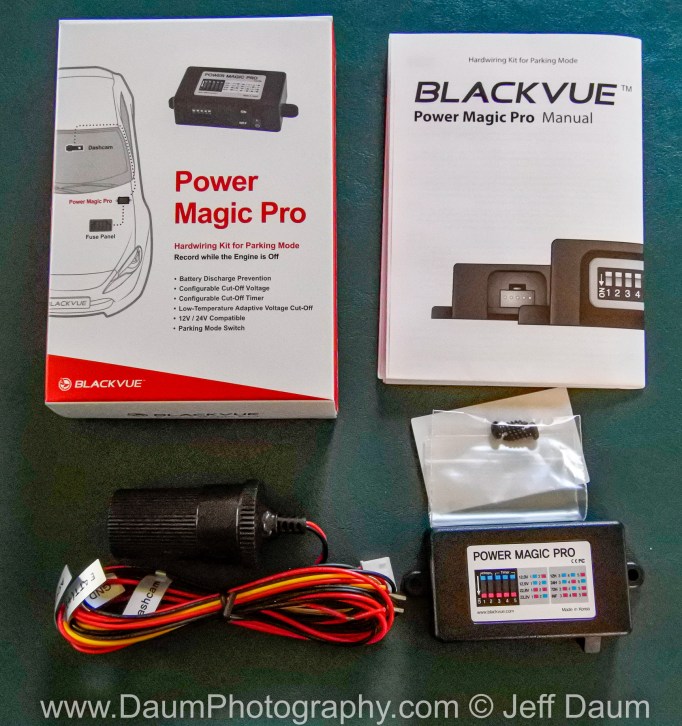
The BLACKVUE™  Power Magic Battery Pack or the Power Magic Pro gets around that problem by either relying on its on external battery (Power Magic Battery Pack)  or using its micro-processor (Power Magic Pro) to shut off the camera at a predetermined voltage level of your vehicle battery or a predetermined amount of time.

Install:

What you need-

As can be seen from the accompanying images, the BLACKVUE™ DR900S-2CH and Power Magic Pro come with just about everything you need to do the install.

Basically, the only addition items you will need include a role of electrical tape, a microfiber towel and isopropyl (rubbing) alcohol (to clean the windshield before affixing the cameras with the supplied 3M tape), and if you are doing the hardwire install: the fuse layout of your vehicle, a fuse puller (or long needle nose plyers), and a pair of fuse taps adaptors (aka add-a-circuit) and appropriate fuses.

Installing the Power Magic Pro [Note: you skip this section if you are going to plug the BLACKVUE™ DR900S-2CH directly into your vehicle’s 12-volt accessory outlet]

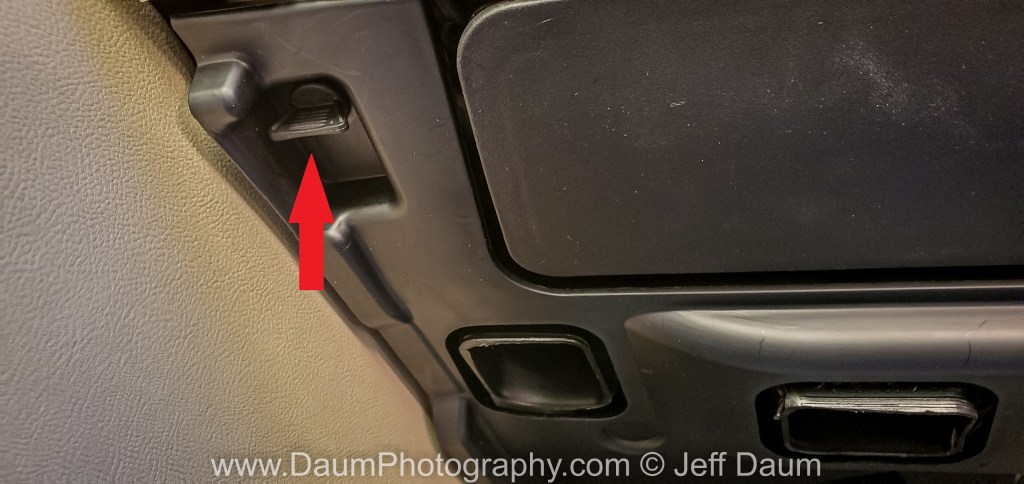
First step is to locate your nearest fuse block to the dash.  [Some vehicles have multiple fuse blocks.  If you don’t know where yours is located, first check your Owner Manual and/or search on the web for its location.]  Depending on your vehicle, the fuses are either labeled on the fuse block cover, or in your Manual.  In the case of the (US version) BMW X3, there are two fuse blocks inside the vehicle- one on the right (passenger side) interior rear behind a compartment door and behind sound insulation.  As it turns out, BMW doesn’t include a fuse diagram in the Manual, but rather has one printed on a sheet of paper that is folded up and placed in clips in this rear fuse block. It also contains the fuse puller.  The other fuse block is located in the front passenger seat foot well.  To get to it you first need to turn two plastic ‘locks’ in the cover located up under the glove box.  The cover actually contains the footwell light.  Here is what the lock on the left of the cover looks like:

Here is what the cover looks like once you release and remove it.

In this picture you see 3 red arrows- you will need to uncouple the power to the cover light, and pop out the 2 cord holders so that you can get the cover out of the way as you access the fuse block.

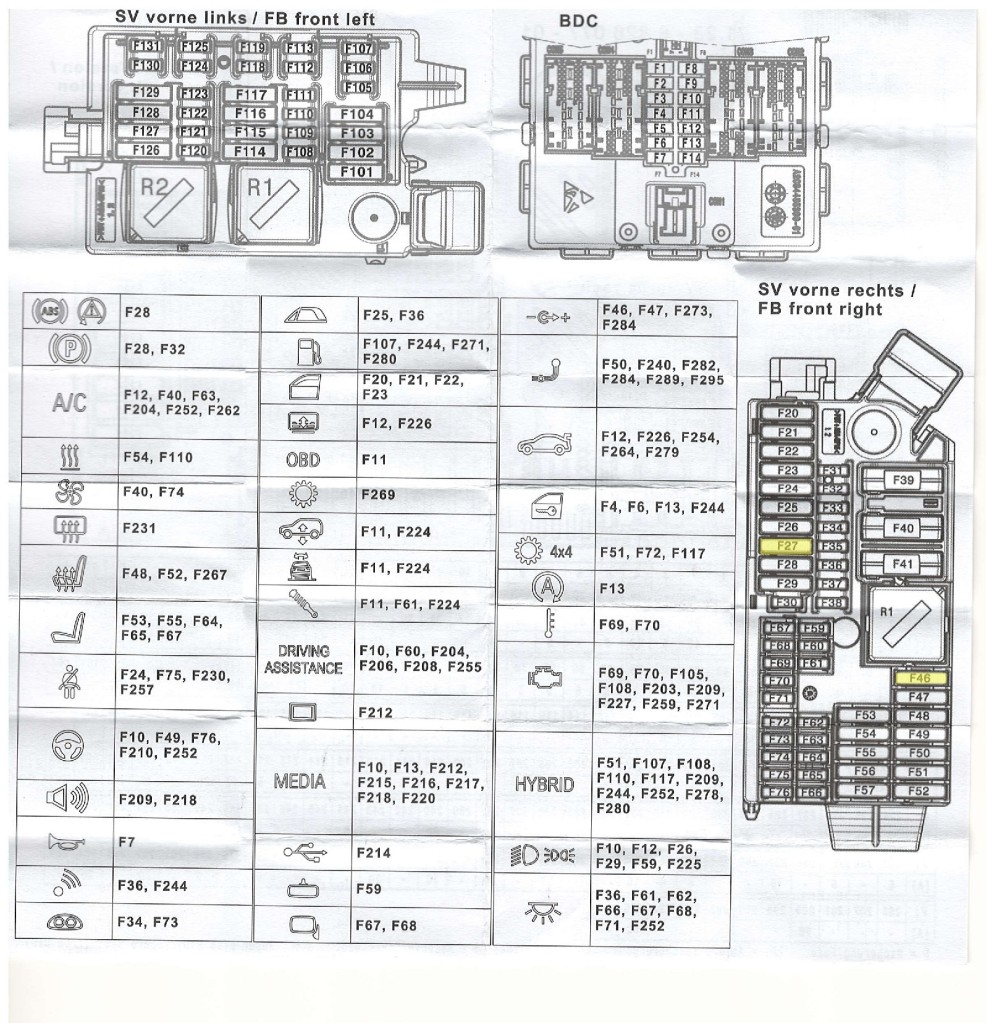
Here is what the BMW X3 fuse block and labels looks like.  Note, the diagram reflects what you are seeing if you were lying on your back, feet toward the engine, and looking up at the fuse block.

You are going to want to use fuse taps adaptors on slot F27, constant power, and slot F46, accessory power (only on when the engine is on).  If you are installing on another vehicle, you similarly need to identify a fuse slot that has constant power and one that is powered only when the engine is running.  If you haven’t used the add-a-circuit tap before, it is really easy to do.  It is much better, in my opinion, than wrapping the wire you want to power around the existing fuse.  You simply pull the fuse from the existing slot (using a fuse puller or needle nose plyers), insert the fuse you pull into the fuse tap ‘front’ slot (the one that does not have the new wire coming from it), and add a new fuse for your dash cam to the other slot (the one that does have a wire next to it.  By using this add-a-circuit fuse tap, you maintain the exact same circuit integrity for the original slot and application, and your new circuit is protected by the new fuse you put in.  Then you simply push the add-a-circuit fuse tap back firmly into the same slot you pulled the fuse from.

Most add-a-circuit fuse taps include a crimp or crush connector to wire your dash cam line to.  I prefer to cut that off and solder the two lines together, finishing with heat shrink tube around the solder joint.  This results in a permanent connect between the two lines; sometimes crimped connections do not fully capture the second wire, and ultimately fail due to vibration.

Here is what the add-a-circuit fuse taps look like added to the X3 fuse block.

In this case, I used slot F46 for the accessory tap (power only when the engine is running) and the empty slot F27 for the constant power tap.  If you look closely at the picture, you will see that the one I have labelled ACC has two fuses in the tap- the original fuse from F46 and the new fuse for the dash cam.  The tap in F27 only has one fuse inserted for the dash cam, since the slot F27 was empty.  At this point you also will attach the ground line from the dash cam Power Magic Pro wiring harness, to a grounded nut.  There is one just above the fuse block that I used.  Back off the nut and slip the metal connector from the Power Magic Pro black line under the nut while retightening it.

At this point I suggest verifying that your connections work as intended.  I use a volt meter and first checked the tap at F27 to confirm power with the engine off.  Then I checked the F46 connection to ensure no power with the engine off, and power when the engine is on.  It also makes sense to check that your ground connect in fact is grounded.

Next you set you desired low voltage cut and time setting on the Power Magic Pro by moving the respective switch ‘fingers’ on the unit.  Initially I set the low voltage cut to 12.5 volts and the time setting to Infinity.  As it turns out, the 12.5 volt was too high for the BMW, which apparently has a normal non-running voltage of slightly less than 12.5 volts.  So, I changed it to 12 volts and it works perfectly.

Installing the front and rear dash cams

I started with the rear dash cam, since in the BMW X3, it required the removal of some trim pieces and a bit more finesse in routing the wiring, than does the front dash cam.  To begin with, you need to remove the center trim piece that runs across the back inside of the rear trunk door.

This trim piece comes off using a plastic trim ‘pry’ tool (one is supplied with the BLACKVUE™ system), but I have several around.  Carefully insert the plastic pry tool between the trim and body, and then use your fingers to gently pull the trim from the body as the plastic attachments release.

You will also need to remove the trim piece on the right side to give you easier access to the back side of the hinge, where you will be feeding the wire through.

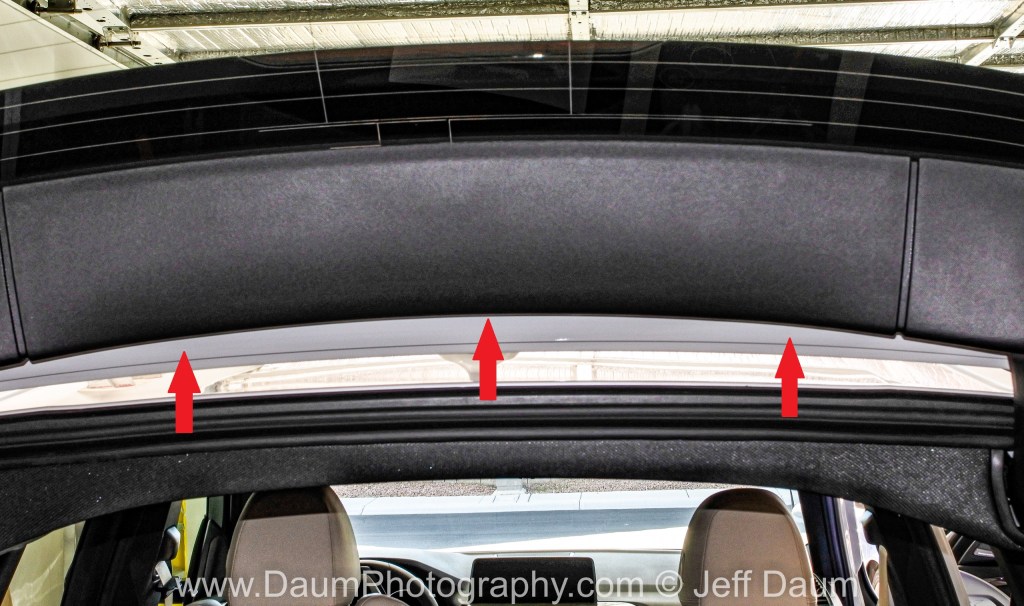
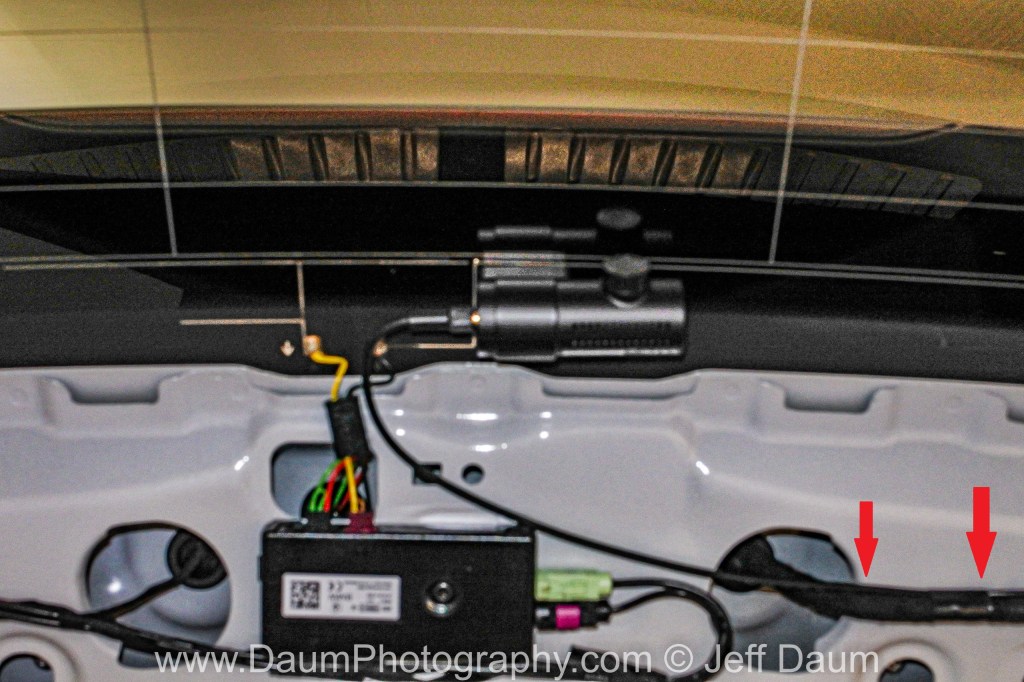
Decide where you are going to mount the rear camera.  Close to the center top of the window will work perfectly.  Clean the window with the isopropyl alcohol and microfiber towel to ensure good adhesion of the 3M pad already attached to the rear camera mount.  Note the camera direction before you mount it- when you are facing the camera and your vehicle from the back looking towards the front, the mount goes on your left-hand side and lens on the right-hand side, with the cord plugging in from the left side.  You can see this here:

Start to route the cable horizontally across the rear window, following the existing power cable, as shown by the two red arrows in the above picture.

I recommend using several small pieces of electrical tape to secure the dash cam cable to the existing cable.  Next you will be sliding the cable down the back side of the hinge (where there are already cables running).  To be on the safe side, I recommend using electrical tape and making a protective wrap for about a foot along the dash cam cable, where it will be going down the backside of the hinge.  If possible, secure the dash cam cable to the plastic sleeve in the inside channel of the hinge. Next, fish the cable out between the liner and the hinge and begin to use the plastic pry tool to ease the cable to the right front of the vehicle.  You’ll find that you can use the pry tool to spread the opening between any hard-plastic liners and ease the cable into that opening, and along the roof line where there is rubber weather stripping into which you can easily slip the cable.  Use this technique to bring the cable up to the right edge of the front windshield.

Next, install the front camera.  Again, you want to get reasonably close to the center top of the windshield.  Since the BMW X3 already has the actual center taken up with its monitors and cameras, I choose a location slightly to the right.  Remember, you need to leave room for the camera to slide out of its mounting bracket, and that can only be done to the left of the bracket (facing the windshield from the interior).  Again, be sure to clean the windshield with the isopropyl alcohol and microfiber towel to ensure good adhesion of the 3M pad already attached to the front camera mount.

Once you have attached the mount for the front camera, you will need to run the cable from the rear camera to it from where you stopped at the right side of the windshield, and the power cable that attaches to the front camera.  It is very easy to push these two cables up under the header at the top of the windshield.  Remember to leave enough line of the cables exposed near the front camera, so that you can comfortably attach them to the camera when you are ready.

Next bring the power cable down from the windshield down along the weather stripping between the door frame and body, down towards the fuse block.  Also, if you have excess cable from the rear camera, you can easily bring that down at the same time as the power cable.

Continue to bring the power cable down to the fuse block area.  [If you are not going to use the Power Magic Battery Pack or the Power Magic Pro, continue to tuck the power cord up behind the area above the carpeting in the passenger foot well and bring it to your center compartment accessory outlet.]  Now attach the wiring harness that you connected via the add-a-circuit fuse taps and grounded to a grounding nut, to the Power Magic Pro.  Connect the accessory plug to the Power Magic Pro receptacle.  I suggest you use some electric tape to wrap and secure the plugged accessory connection.

Next, tidy up your excess cable and place it in the area behind or above the footwell carpeting.  Also, place your Power Magic Pro where you would like it.  As you can see, I placed it in the same general area, since I don’t anticipate I will be needing to turn the unit off.

At this point, your Power Magic Pro should show power on (LED lit) and your front and back dash cams should be powered up.  Be sure to remember to remove the plastic lens cover from both the front and rear camera lens.  If everything is working, now go and replace the trim pieces on the back window.  Reconnect the power cable to the passenger footwell cover and then slide that back on, engaging the catches on the frame with the back right and left of the cover.  Relock the plastic locks.

Now you are ready to download the BLACKVUE™ app for your phone and app for your PC or iPad.  Though these you can adjust the respective setting, ensure your software is up to date, etc.

Here is what the rear camera looks like from outside the vehicle

And what the front camera looks like looking into the windshield

Finally, here is a view from the driver seat showing the rear-view camera visible in the rearview mirror (red circle), and the front camera to the right of the mirror.

Note: Once I got the Power Magic Pro functioning properly, I ran into an unexpected issue.  The CPU battery management software on the BMW is designed to detect unknown power draws once the vehicle is parked.  As a result, while it (the BMW) allowed the Power Magic Pro to fully power the dash cams in ‘parking mode,’ it twice documented electrical problems and to preserve the battery, began to shut down non-essential functions in its control (like remote key FOB control) after about 24 hours of the BlackVue power draw.  This means that even though the Power Magic Pro enables the BlackVue DR900S- 2 ch system to operate in parking mode correctly, it is incompatible with the BMW because of the continuous power draw for parked periods of several days or more.  This unfortunately defeats the purpose/value of using the Power Magic Pro for anything other than shorter parked periods.

Update: As I discussed in my install write-up, the Magic Pro is basically incompatible with our BMWs because of the ‘unknown’ power drain. Until I find a viable independent power source solution that could power the BlackVue dual cameras in parking mode for periods of a week or more, I decided to hard wire the BlackVue system to one of the accessory circuits.

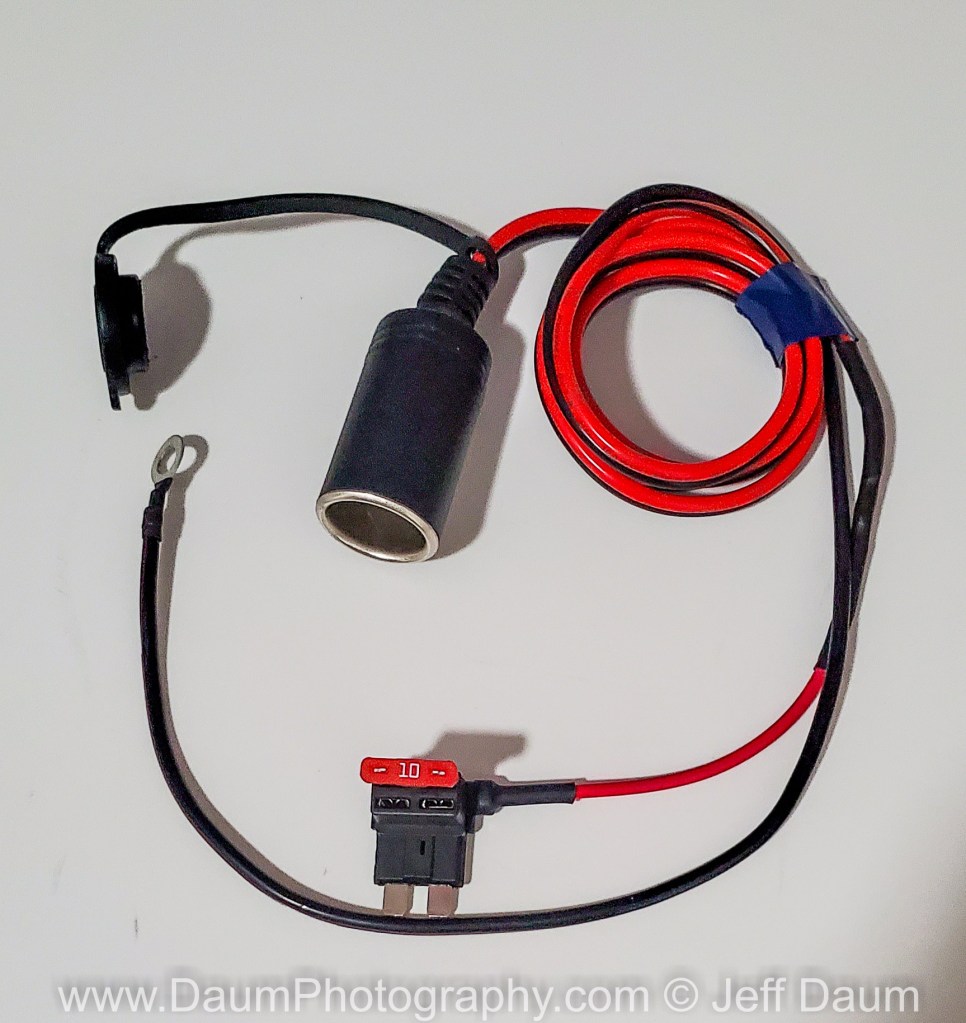
I chose to use an add-a-circuit fuse tap to F46 in the fuse block (accessory). I purchased a female cigarette lighter outlet (accessory outlet) which came with 16awg wires, one terminating in a grounding eyelet, and one in a fused power line. I cut off the end of the fused power line, and soldered it to the hot-line on the add-a-circuit fuse tap, and then heat shrink sealed the solder joint. I connected the ground eyelet to the existing stud and nut near the fuse block (removed the nut, put the eyelet on, reinstalled the nut).

Then I connected the accessory plug from the BlackVue cameras to the new accessory outlet and used electrical tape to ensure the plug remained properly connected. Finally I placed the excess wire up by the top of the passenger foot-well near the fuse block.

Now the BlackVue front and rear dash cams start recording as soon as the engine is turned on, and stops after the engine is turned off and the power to the accessory circuit is cut.

I hope this write-up makes your install go smoothly.  I will add a link in the near future to my review of the image quality of the BLACKVUE™ along with comparison to other dash cams.

Product Review- Dash Cameras with Navigation: The evolution of Man’s need for direction & documentation.

The Evolution of Man’s Need for Direction and Documentation.

All of us have to some degree experienced the increasing reliance on electronic gadgets to help us get from A to B, especially if we don’t know exactly where B is.  Along the way paper maps, TripTiks, and (often as a last resort) calling or stopping and asking for directions, has given way to dependence on electronic navigation units.  These range from apps on smart-phones, to dedicated free standing navigation units such as Garmin and Magellan, to OEM built-in units in our cars.  Each of these options typically has its own strengths and weaknesses.

More recently, at least in the United States, dash cameras have started to come into their own.  Similar to navigation units, some are now OEM equipment built-in cars, while more commonly, they are free standing units.  There are three primary reasons for their increasing popularity: a desire to share images of a car trip, to have a record of driving on a high-performance track or circuit for learning and review, and documentation in the event of an accident or road rage.

In this review, I look at the latest units from two of the key navigation players, Garmin and Magellan, who have combined units housing both navigation and dashcam capabilities.  This is the first of several ongoing reviews I am doing on these units.  Both manufacturers are providing their respective units to me for review.

In theory, there are some real advantages of combining both navigation and dashcams into one unit, not the least of which is fewer wires and a smaller combined footprint resulting in less blockage of view out the windshield.  While we know they do a very good job providing navigation, the key question is how well do these units do in accomplishing both tasks?  To provide a comparison for the image quality, a pure dash cam unit is included.  I am using dash cams from Papago, a leader in the field of after-market dash cams, and one that has proven itself in prior testing I’ve conducted.

Initial test results:

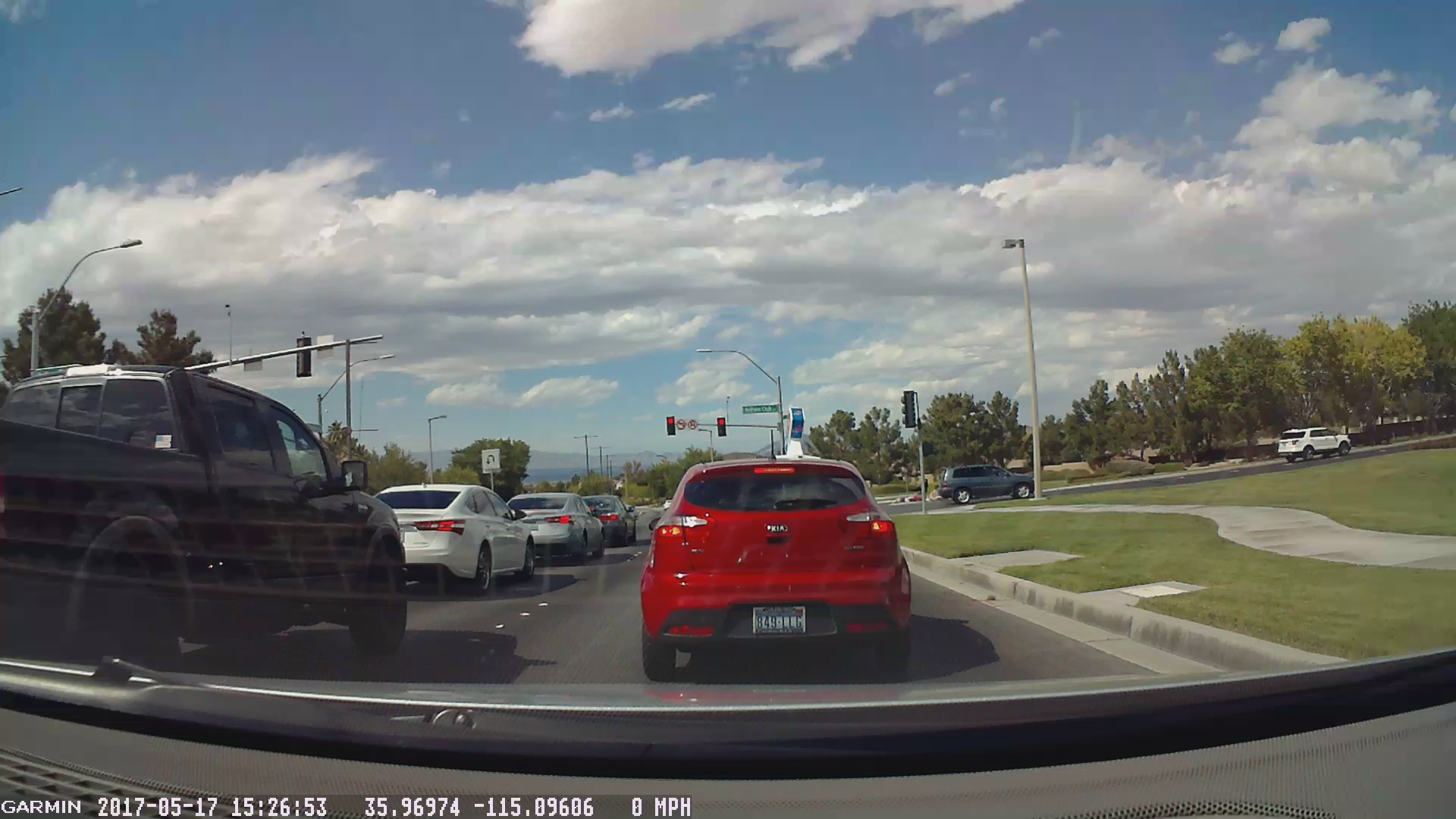
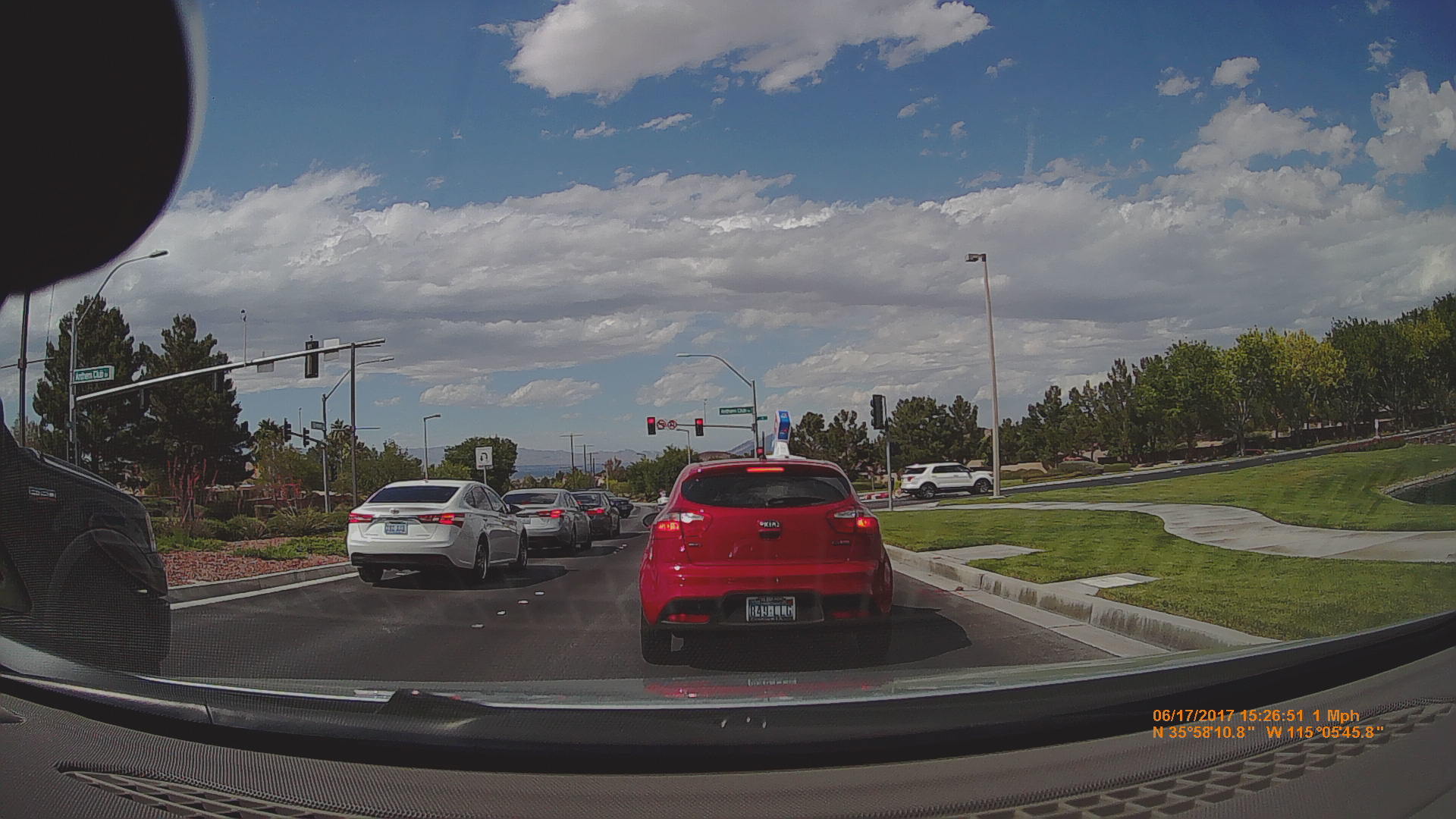
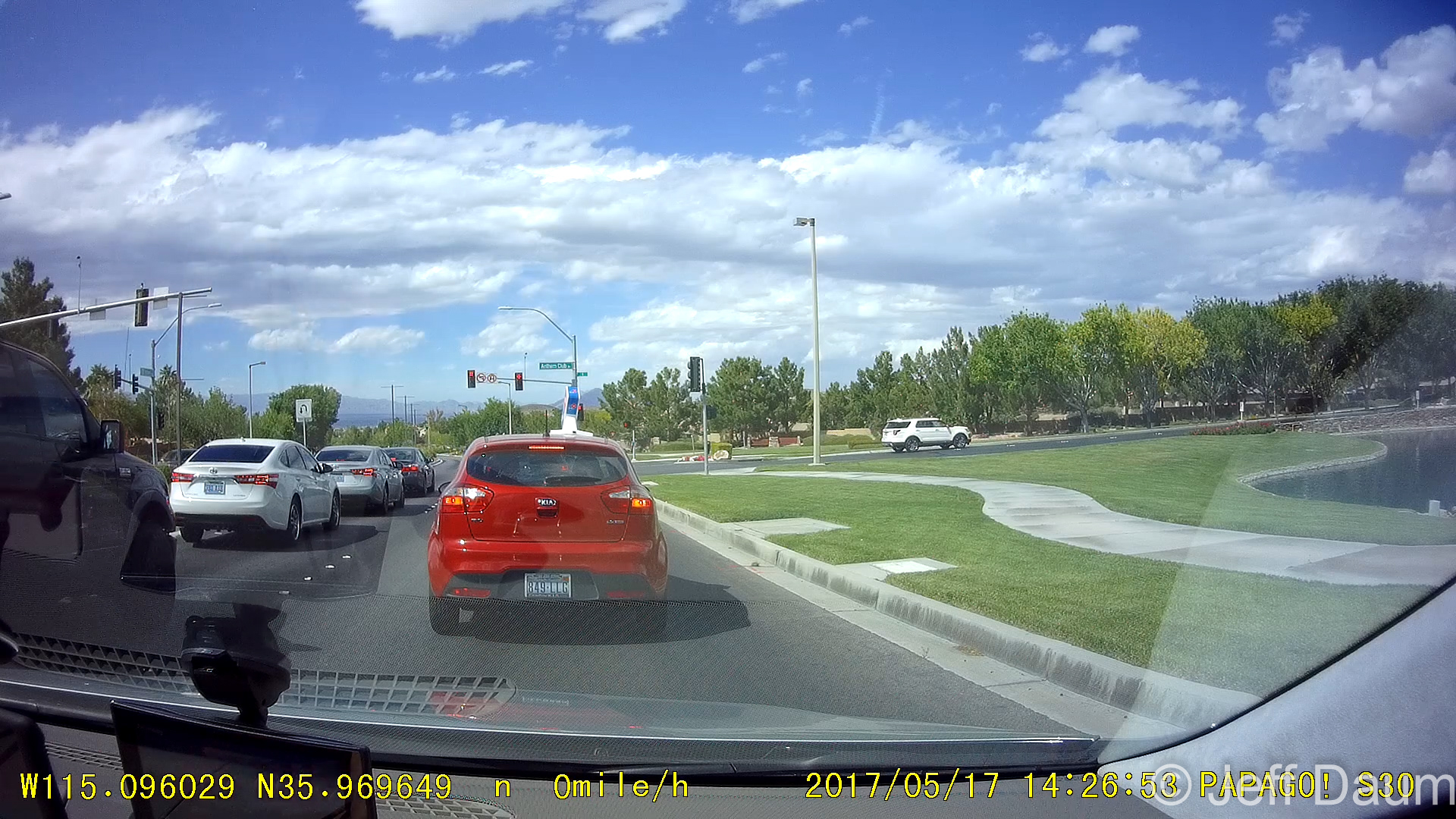
Here are “raw” (no post-shoot software enhancement) still images generated by each unit at virtually the same time.

From the Garmin


From the Magellan

IMG170617-152651F

From the Papago

JWDaum (3 of 2)

You can see that all units adequately capture the scene and the license plate on the vehicle directly in front is certainly legible.  They also document the GPS coordinates, time and mph.  The image in the Garmin is slightly less wide than the Magellan, resulting in objects being slightly closer.  The captured colors, while slightly different for each unit, are close enough to be a non-issue.  On close inspection, the Magellan has a slight edge on sharpness of the image and matches the Papago.

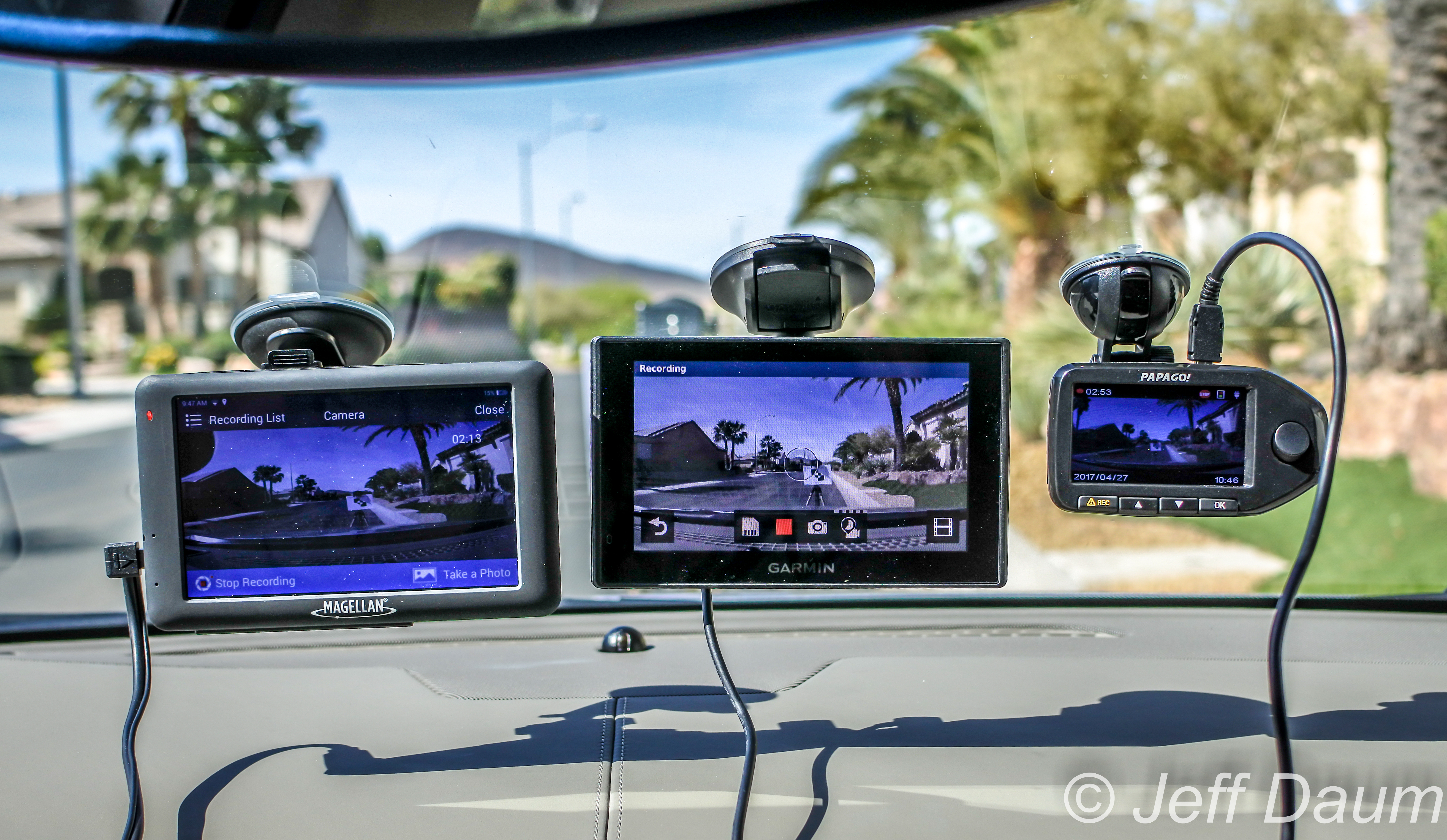
One other thing to note is that the Magellan also captures part of its window attachment, as can be seen in the upper left corner of the image.  While there may be a way to configure the attachment component so this doesn’t happen, it wasn’t intuitively apparent.  Both units were placed on the windshield in a manner that replicated the typical location, especially if you were intending to use the navigation function of the unit while driving.  Here is the set up used:

JWDaum (1 of 4)

Another point to note is that both units picked up reflections from the dash interior.  It would have been possible to reduce or minimize these reflections by moving the attachment point on the windshield, however, again, these were placed where a typical driver would place them, so as to easily view the navigation information and also, to ensure that the unit did not block any critical forward vision.

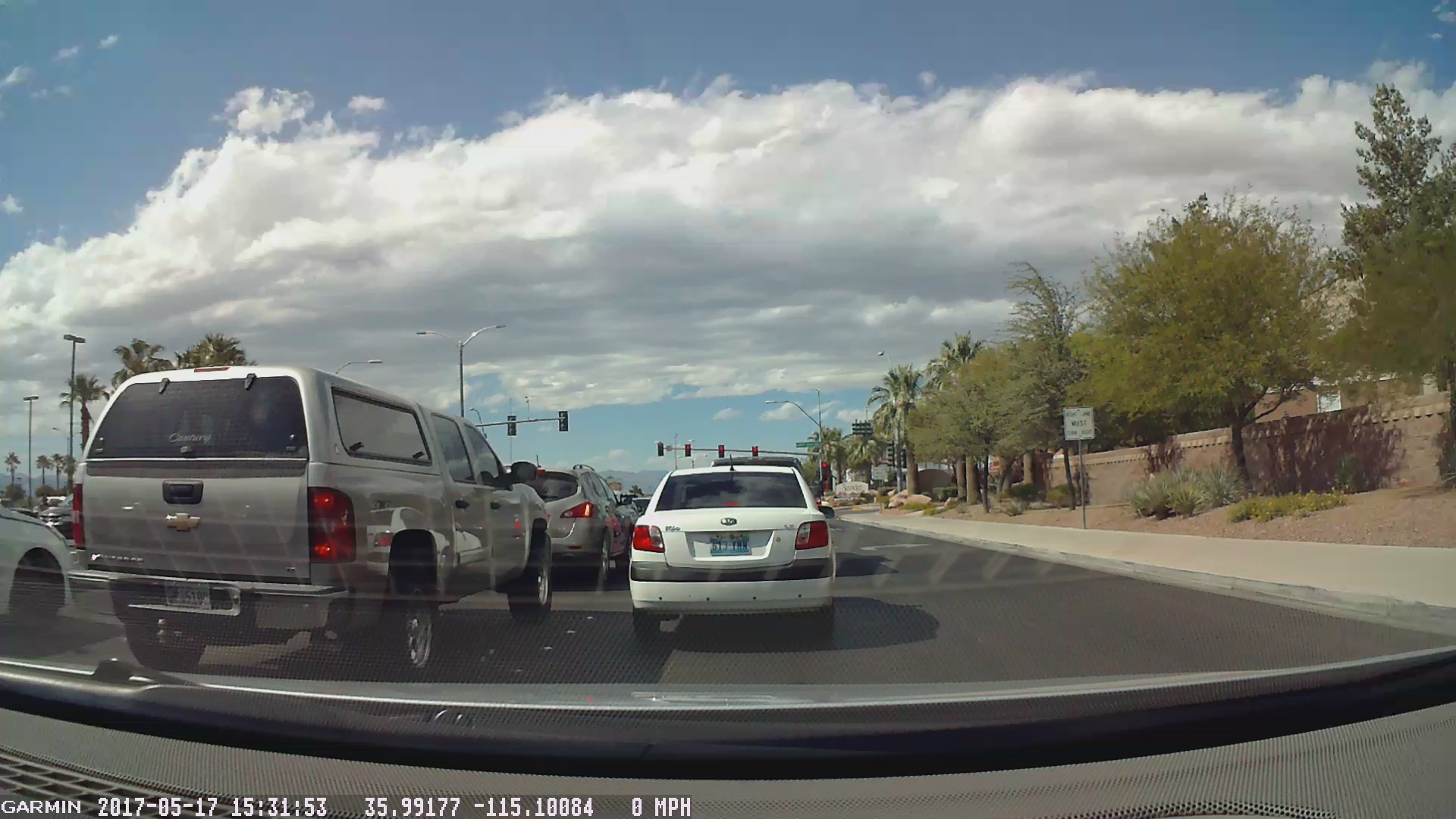
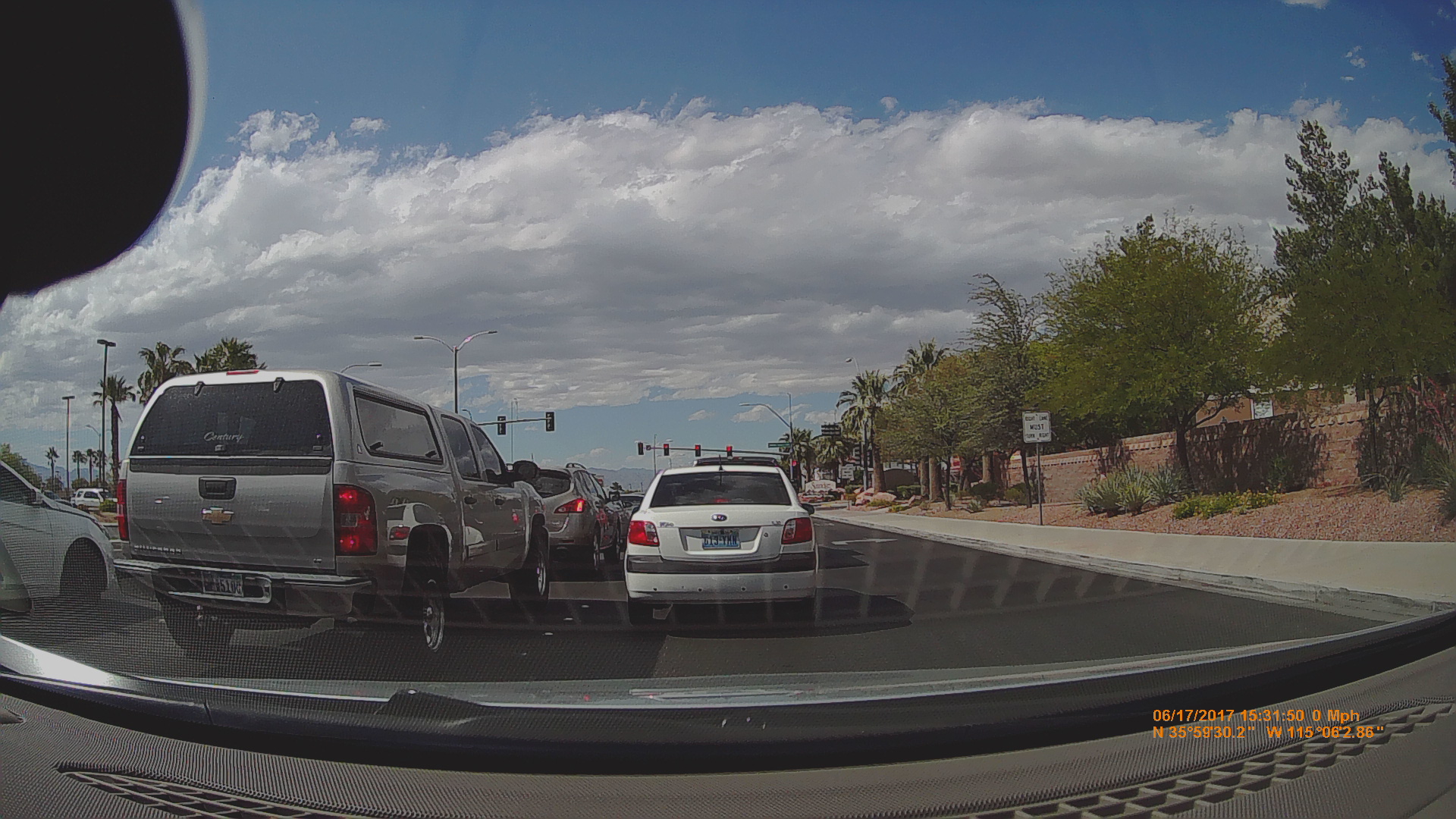
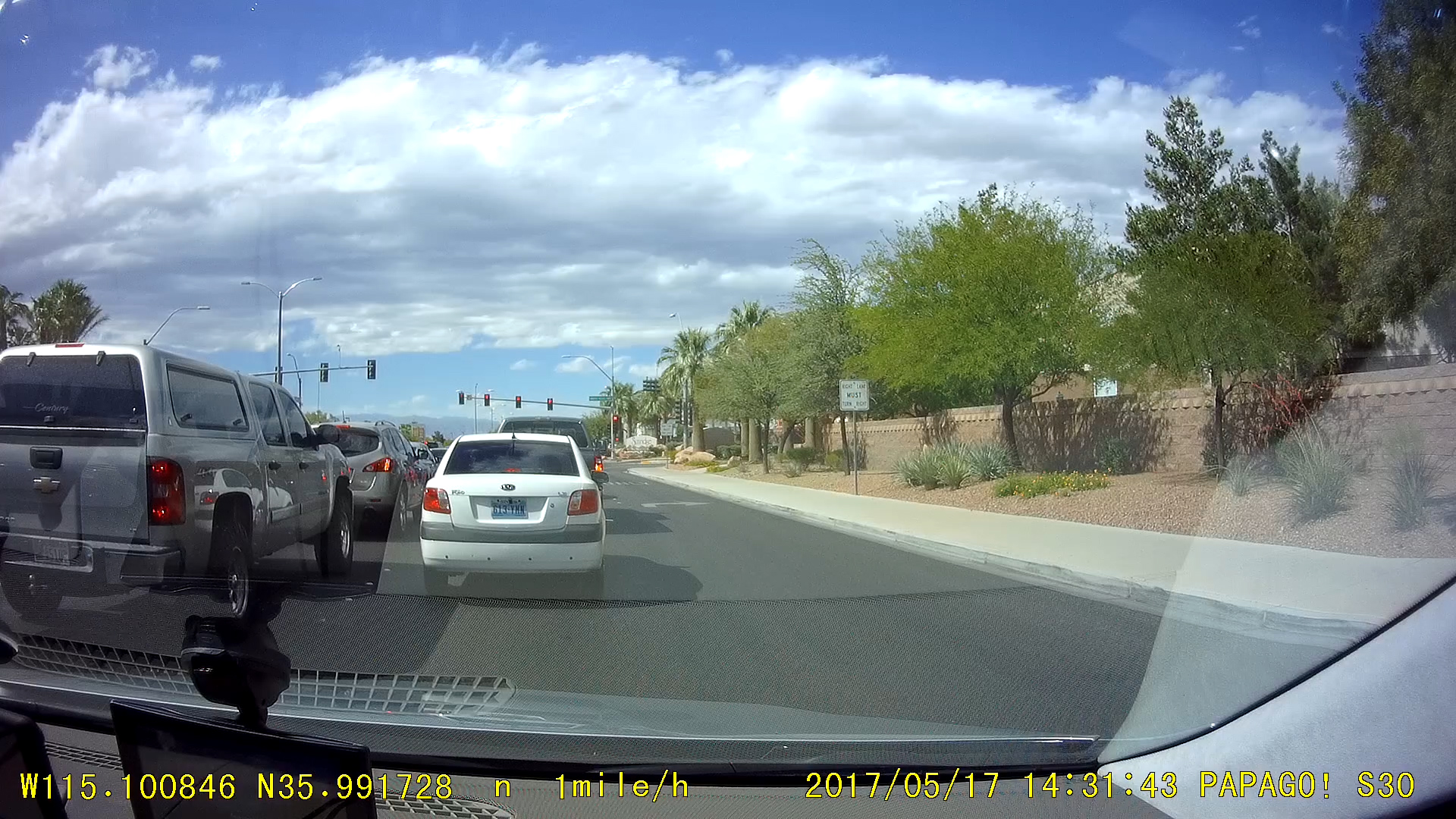
Here is a second example of still shots generated by the respective units (each has a touch button to ‘snap’ a still shot independent of whether the unit is recording video at the time).

From the Garmin:

GRMN0002

From the Magellan

IMG170617-153150F

From the Papago

2017_0517_143138_006-1

The dash reflection is apparent in all units, but not to the point of reducing the value of the documentation.  When I enlarged each of these, you could not only read the license plate of the white car, but also the plate on the silver/gray truck.  As before, the Magellan is slightly sharper than the similar image on the Garmin, but the best image is from the Papago.

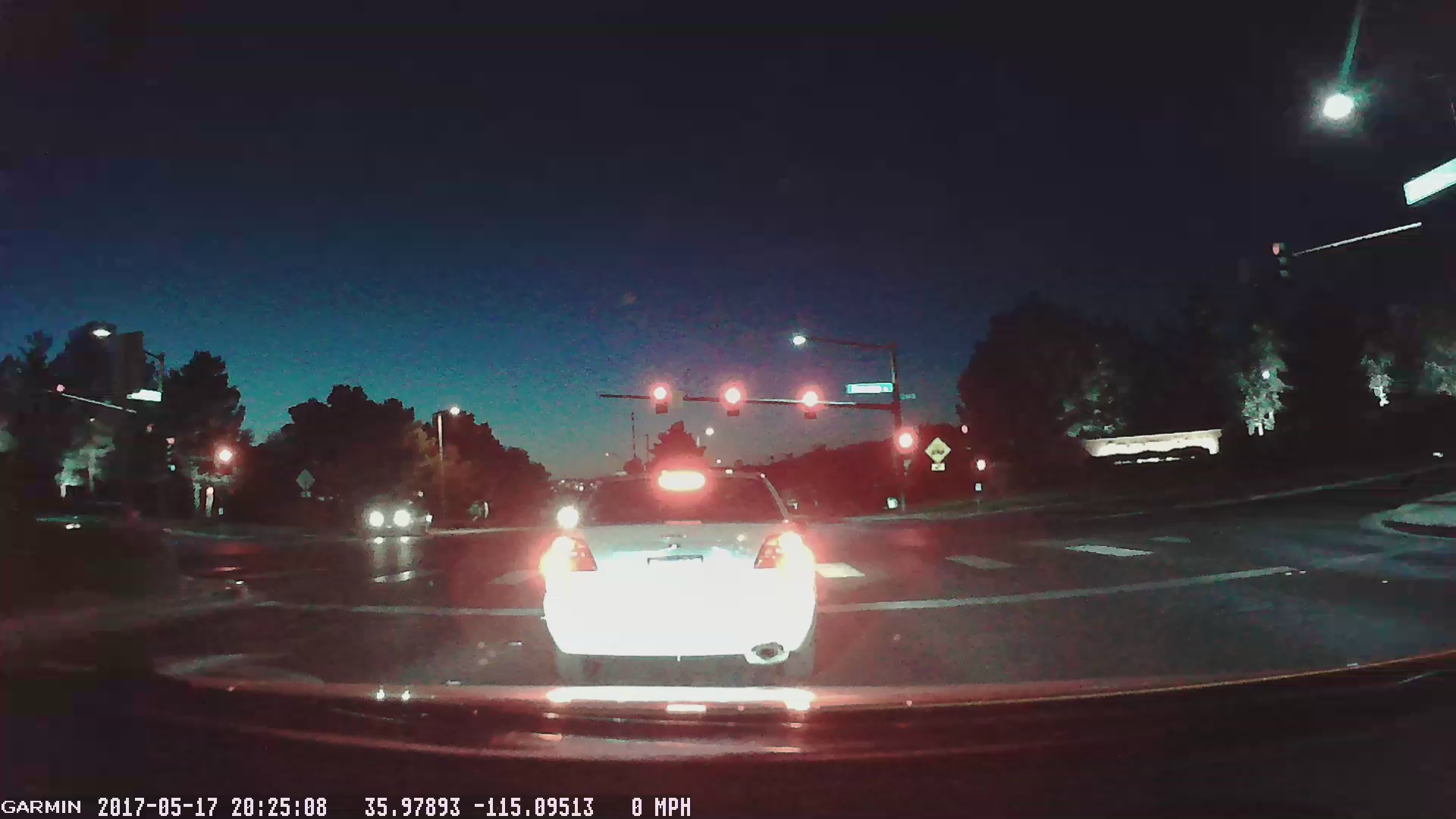
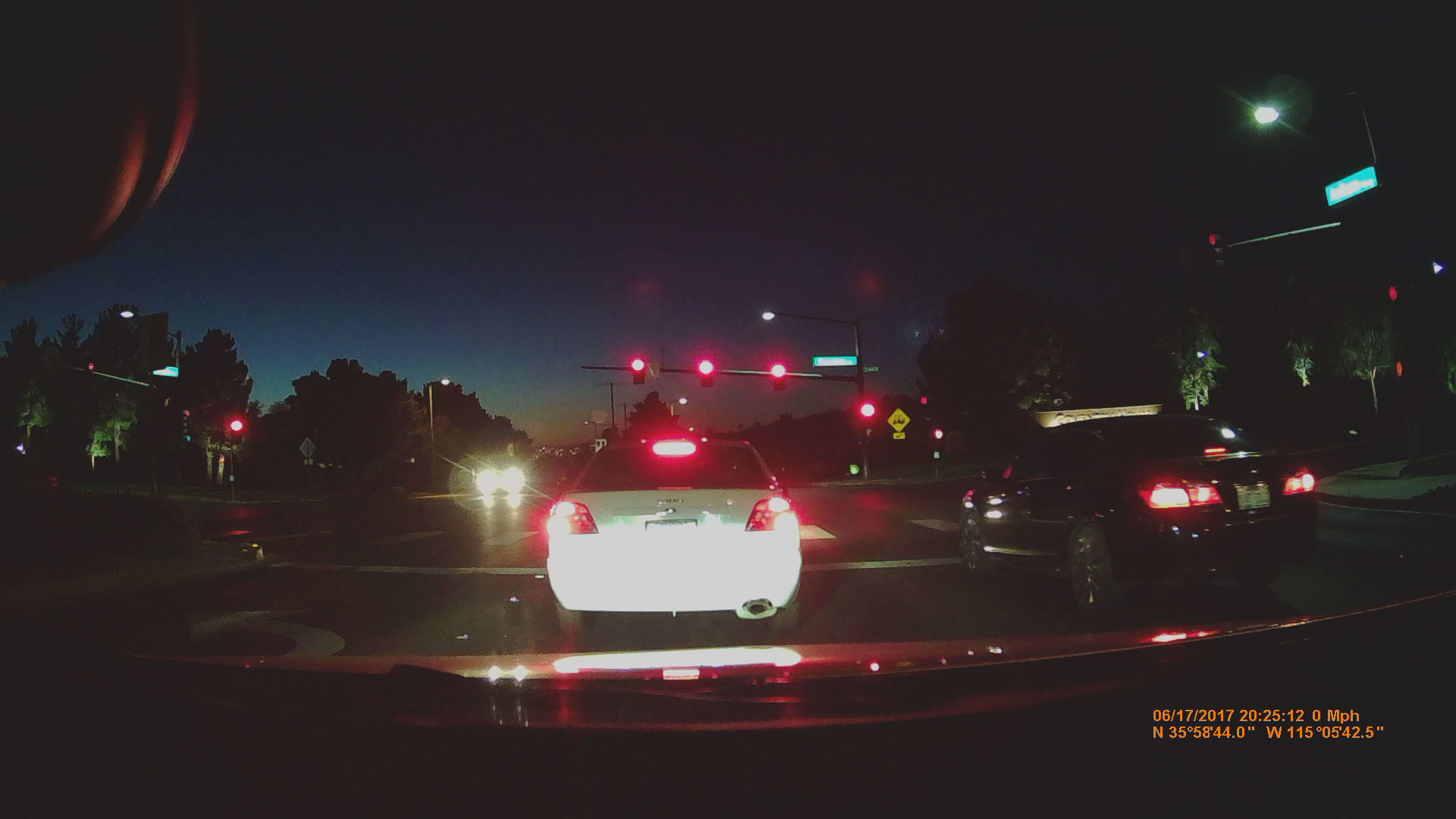
While the day time images would be very good for any incident documentation, that was not the case with the still images captured at night.

Here is the Garmin:

GRMN0014

And the Magellan

IMG170617-202512F

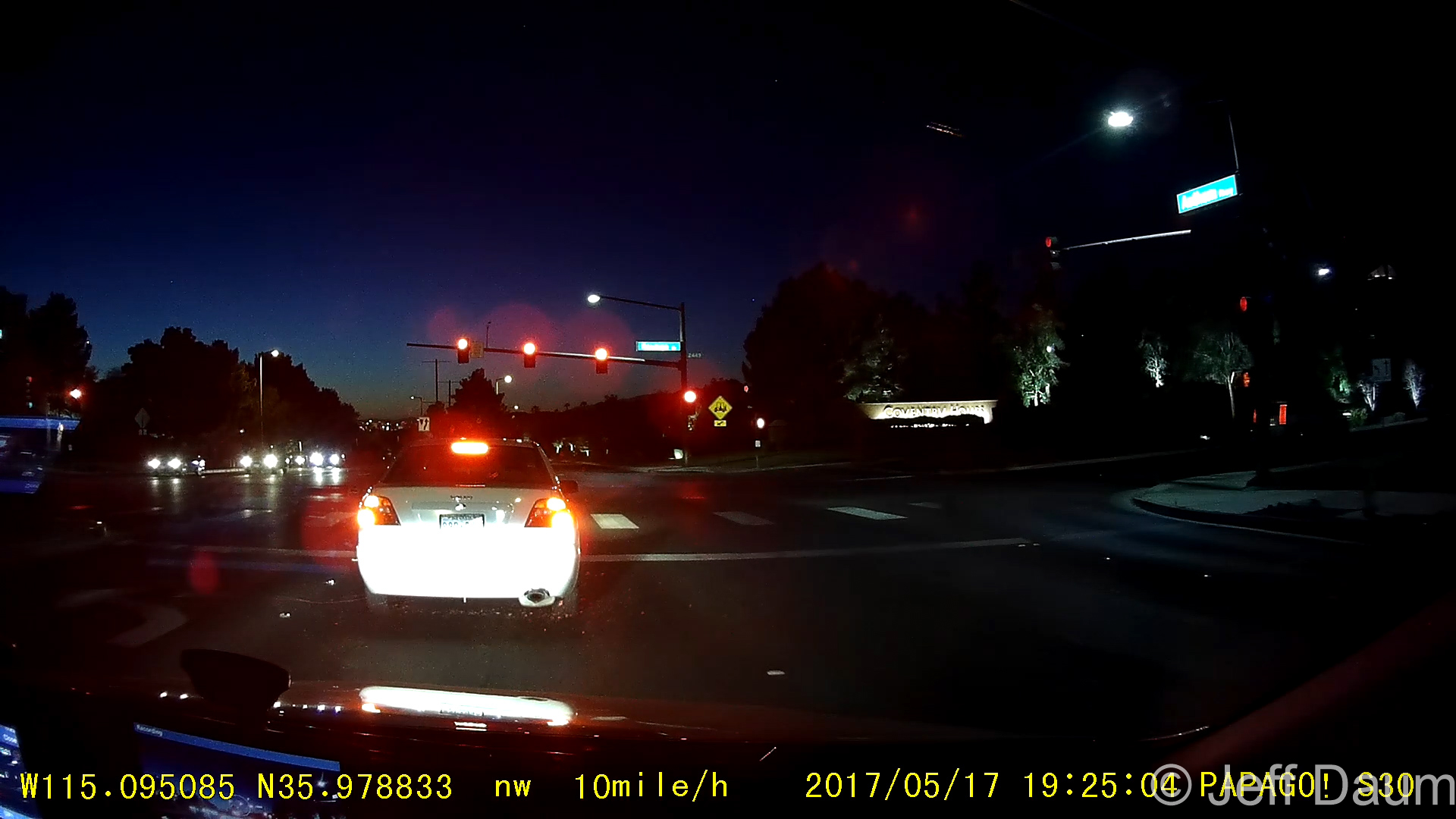
And here is the Papago

JWDaum (2 of 2)

No unit was able to effectively compensate for the high dynamic light range between the ambient light and the reflected headlight, rendering it impossible to read the license plate off of the car immediately in front (possibly some post editing software magic would enable the reading of the license plate).

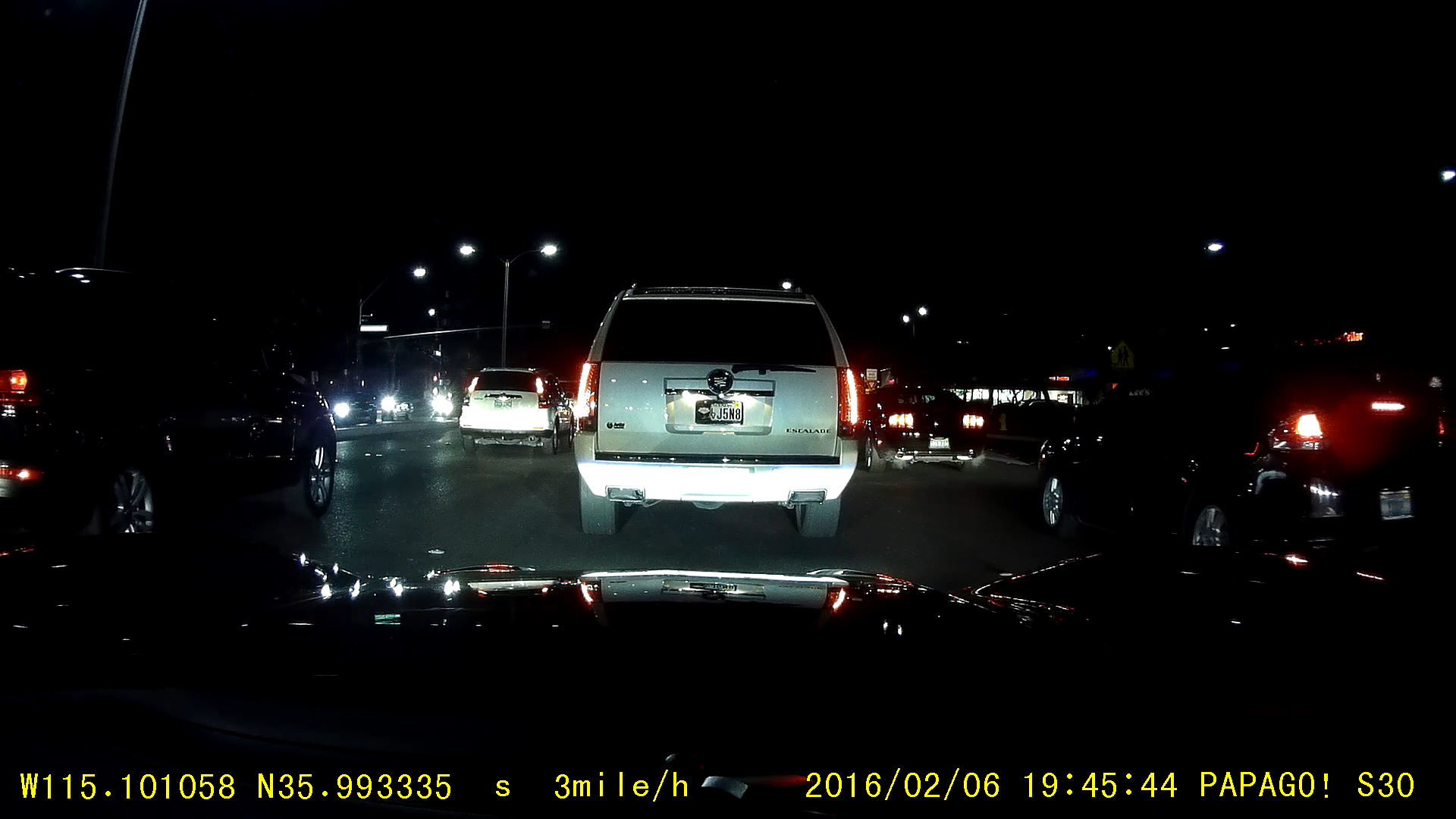
It should be pointed out however, a different vehicle (different type of head lights and different size vehicle) can have a better outcome under night driving situations with these same units.  For example, here is an image from the same Papago S30 in a sports car (the vehicle used in the current tests was a full-sized sedan)

3 S30

You can see that the license is fully legible from this perspective.

Now let’s look at comparative videos.

This first set shows daytime MP4 output and demonstrate how the dash cam could provide documentation in the event of an incident.  Shortly after the respective videos start, you’ll see on the left side of the screen a car start to drift into my lane.  If the car had hit me, or caused me to stop abruptly, the video would document several factors including my speed, the fact I was driving in my lane at the time of the incident, and the car entering into my lane.  This units all have microphones (that you can turn off), that capture potentially supporting evidence like a horn, or turn signal.

First is from the Garmin:


Here is the Magellan:

Here is the Papago:

All three units provide reasonable quality videos sufficient to document an incident, should it be necessary.  There are minor differences in the quality of the three units, and noticeable in the Magellan only, is uncorrected image shake.

This next set shows nighttime comparative videos.  As noted in the still shots, you cannot read most license plates resulting from the high dynamic range contrast of the reflective license plate versus the surrounding images.  However, you can easily make out the type of vehicle, the traffic light colors, etc., so if an incident occurred you would be able to document your vehicle’s position within its lane, speed, and right of way.

First is from the Garmin:

Here is the Magellan:

And here is the Papago:

A few words about the navigation function of the two hybrid dash cams.

Both of these companies have been producing nav based units for years and have it down pretty well by this point.  Each has earned its camp of followers.  The directions, visual guidance including automatic map enlargement at pending turns or divides on highways, ease of finding establishments including entertainment, food, gas stations, as well as emergency information such as police stations and hospitals, have greatly improved with the latest iterations of software.  A real plus of these units (in most cases) is the free lifetime map and software updates.   Additionally, the latest units are offering live traffic updates and automatic rerouting.


JWDaum (3 of 4)

Both offer routing with similar options, on-the-go quick course recalculating, and reasonable good audible call outs of directions.  Similarly, each has updatable points-of-interest (entertainment, food, gas, etc.).  However, one big difference is that the Garmin allows either manual input of address location or voice command input, whereas Magellan only has manual input.  This is an important difference, both from a convenience and safety perspective.  It is much easier to use the voice command (which is pretty good in terms of recognition) in my opinion even when not driving, and critical to have when you are driving.

Conclusions and recommendations

If your car has a built-in navigation system and you are satisfied with it, then there probably isn’t much logic in getting a combination nav and dash cam unit.  However, with the increase in red-light runners, distracted drivers, and the like, I highly recommend adding a dash cam to your vehicles.  If that is your inclination, the Papago units are worth considering.  They have some of the best cameras and reliability of ones I have tested.  They have differing levels of bells and whistles, so you will need to explore and find the one that suits your needs.  Please see details at the end of this review for highlights across the Papago units.

If your vehicle has a OEM nav system that you are less than satisfied with (don’t like having to buy expensive map updates, or its a complex process to input an address, etc.) or lacks one completely, then I’d recommend considering the hybrid Garmin line.  While the Magellan was certainly capable, the fact that it currently does not include the ability to accept voice commands takes it out of contention.

One additional plus of an aftermarket unit that combines nav and a dash cam, is that you can easily transfer it from vehicle to vehicle, if you have more than one, and also take it with you when you travel to use in your rental vehicle.

Final thoughts for future improvements on combo-dash cam/nav and dash cam only units:

I would like to see a larger rechargeable built in battery so that the unit could turn on and record a bump or impact while the vehicle was parked (and powered off).  Most vehicles today have their accessory outlets power down shortly after the vehicle is turned off rendering these units ineffective.  Even if you have an accessory outlet that remains live when your vehicle is powered down, you probably don’t want a dash cam potentially draining down your battery.  A rechargeable independent power supply in the unit would get around this. Since such an occurrence would hopefully be rare, the battery would need to have perhaps a 15 or so minutes reserve for practical purposes.

Many units come with ‘driver assistance safety features’ such as the ability to alert you that the car in front has started moving (for example after stopping at a light or stop sign), a reminder to turn on your head lights at dusk, driver fatigue alarm, forward collision warning, lane departure warning, and in the ability to recognize and warn you of an approaching stop sign.  Personally, I found these more of a distractor than a safety feature and turned them all off, except the stop sign recognition.  It will beep and turn on/show a picture of a stop sign on the rear display as you come up to it (even if you have the display turned off as I did).  However, in the units I tested, it failed to recognize at least half of the stop signs I encountered.  I’d rather see improvements in dynamic range, reduction of dash glare, and making quick attachment and removal (leaving the windshield component in place) a priority, and losing the driver assistance features.

Many of these units come with a hardwired 12-volt accessory plug.  Many vehicles today don’t have multiple accessory plugs (at least up by the driver).  Often drivers are already using the sole accessory outlet to power a radar detector or charger for their phone.  It would make more sense to have these units power off of a USB connection, since cars typically have several of those.

Additional detail on each unit tested:

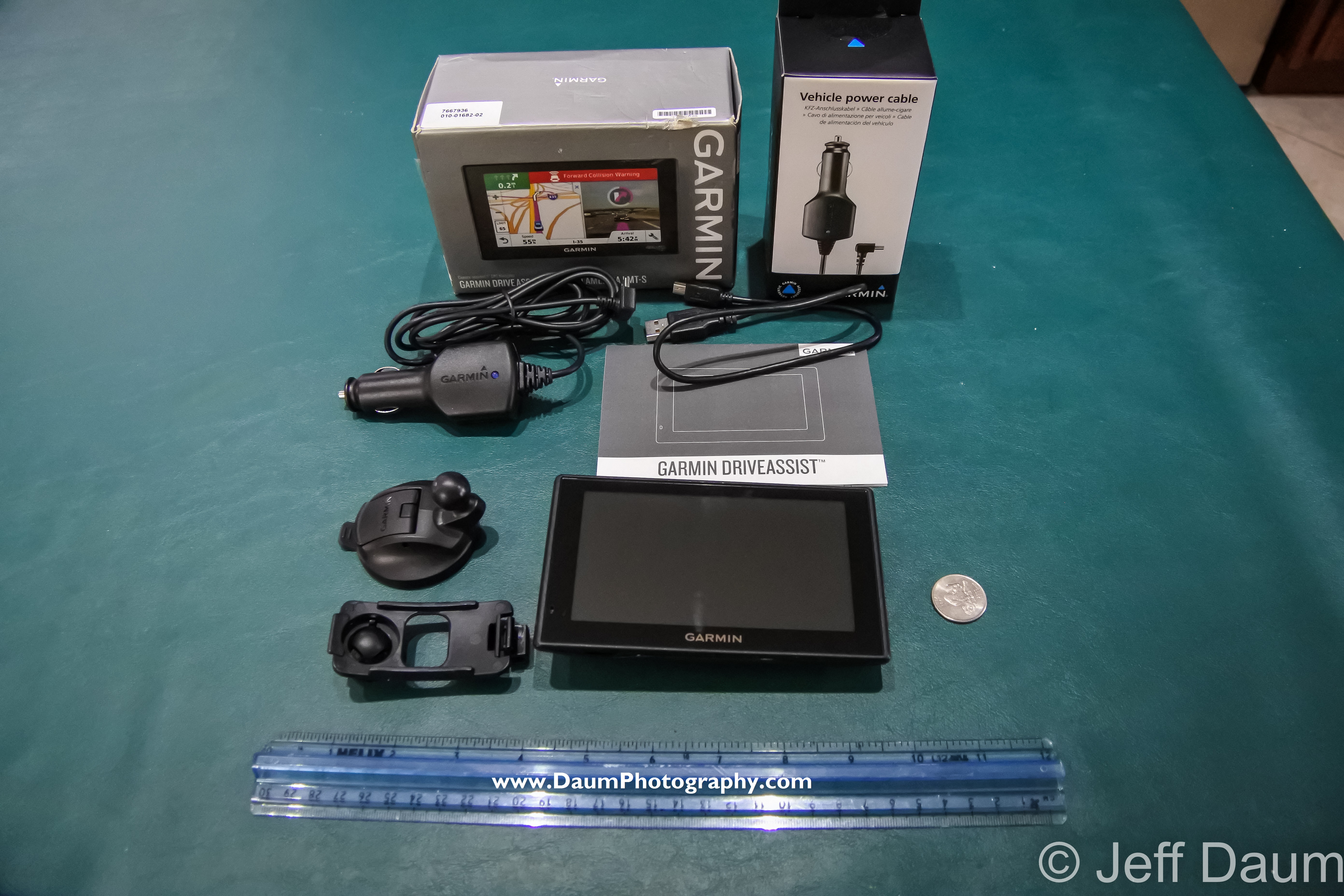
Garmin Drive Assist 51 LMT-S

JWDaum (35 of 7)

Pros:

  • Very easy to set up
  • Voice command works well
  • Easy to read with a quick glance
  • has “live traffic”
  • has WiFi built in for updates
  • can be paired to your Garmin smartwatch
  • Incident Notification: When the unit detects an incident, the device can send an automated text message to a designated contact in 60-seconds. The message is sent from a third-party service, not from your phone, and includes your name and a pre-selected message. If you wish to cancel the notification, you can cancel it within the 60-second window. Incident Notification requires a connection to Smartphone Link, an active mobile data connection, and can be disabled if desired.
  • Travelapse: The Travelapse feature captures video frames at a set interval (one frame for each mile you travel, for example), and creates a fast-motion video of your trip. The device sets the distance interval automatically, based on the length of the route and the space available on the memory card. The unit continues to record regular dash cam video while recording a Travelapse video.
  • The “Where Am I?” feature gives you instant access to important information in case of an emergency. When you touch the vehicle icon on the map screen, the “Where Am I?” feature provides the coordinates (including elevation) of your current position, plus the nearest address and intersections. There are also buttons to help you locate the nearest hospitals, police stations, and gas stations. You can also save the location for future reference.

Cons:

  • When mounted where you would normally mount to have access to routing, the camera catches windshield internal reflections.  Would like to see some form of lens shield to prevent this.
  • Would like a quick release from windshield mount that doesn’t change the unit’s position on the windshield (so you don’t have to re-align camera). Some other Garmin non-dash cam units have a magnetic mount from the unit to the windshield so you can leave the mount and easily pull off the unit without potentially altering the alignment.

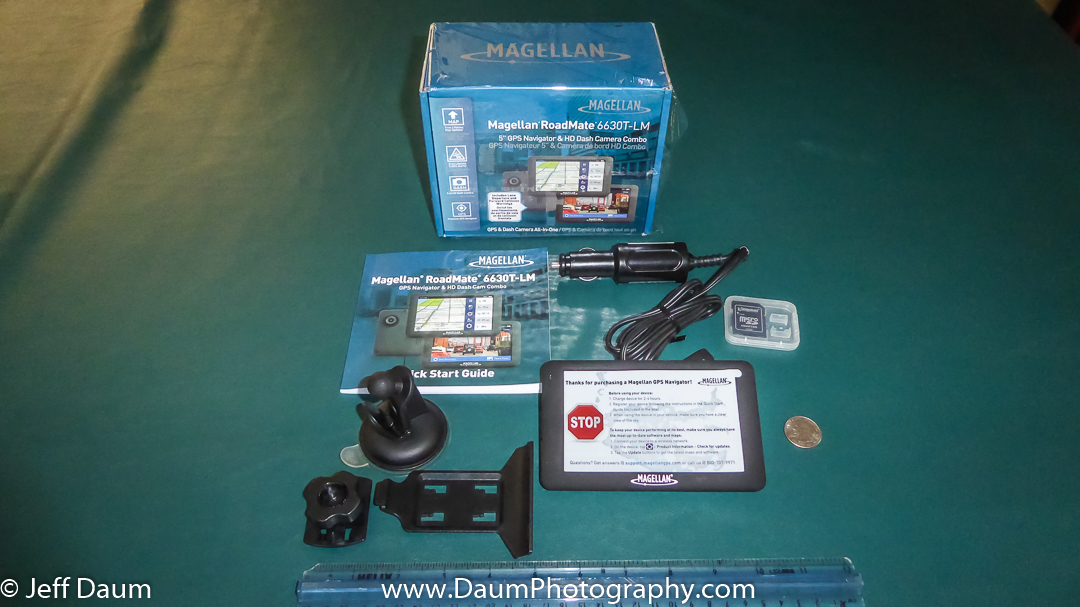
Magellan RoadMate 6630T-L

Copyright JwDaum-1

Pros:

  • The unit comes boxed with a Quick Start Guide, 8gb micro card and reader, the components to attach it to your windshield (effective suction cup), and a 12 volt accessory plug and mated USB power cable.
  • You will want to set the unit up at your home, so that you can log onto your WIFI for the normal updates to the maps and software.
  • Once set up, the unit is pretty intuitive and easy to use. However, there is no voice command for inputting addresses, you have to manually use the touch screen

Cons:

  • No voice command interface.
  • When mounted where you would to be able to use map/routing, the camera catches its own mounting bracket (can be seen in the upper left part of videos) .
  • (minor) The unit has a red led power light on the upper left side of the front. This is OK during the day, but an annoyance during the night.
  • Static cover on unit tells you to charge it for 2-4 hours before using, but unit only comes with a 12 volt accessory plug and mated USB cable. The included Quick Start Guide does not mention that you can do this using a power pack like Go Puck©, or your computer USB (however, using the computer will be a relatively slow charge), or by using a AC adapter (not supplied).  The full downloadable User Manual does mention that you can use an AC adapter.  I placed a call to customer support and quickly got through.  The very professional tech said you can us power packs, computers (again, noting that it will be slower) or AC adaptors in addition to the 12 volt accessory plug supplied with the unit.
  • Voice sounds tinny. Though this unit may have had a cracked board, since it also randomly lost power.
  • Doesn’t appear to have any image stabilization software, note shake in images

Papago

JWDaum (36 of 7)

As noted earlier, Papago has a variety of dash cams with somewhat different options.  All are very good dash cams, so the decision as to which one is best depends on your needs.  Tested and pictured above include the 760, 520, 30G and S30.

All units include lifetime update on software, removable microSD memory cards, a set of driver alerts such as stop sign recognition, shock/impact auto save recording, etc.  Also all units operate properly in temperature ranges from 14 degrees up to 149 degrees.  This upper range is impressive, since many competitive dash cams malfunction in the higher temperature ranges (of a windshield fully exposed to the sun).

Here are the highlights of the 4 units tested:

GoSafe 760: This is one of their more advanced multi-purpose units.  It comes with a forward facing wide140 degrees F2.0 camera in the main unit and a separate rear (or side) facing 120 degrees F2.4 camera.  It also has connections for their optional GPS antenna (for adding GPS coordinates overlay to recorded images) and their optional tire pressure monitoring D10E unit.  This unit would probably be best suited for an older car which doesn’t have built-in tire pressure monitoring, and/or individuals who want to document both forward and rear (or side) views simultaneously.

While this offers an impressive array of options, one thing to consider is all of the options and the additional camera require physical connections to the main unit.  So, if you are using the rear camera, GPS and tire monitoring systems, you will have four sets of cords attaching to the main unit.  Unless you plan on trying to tuck some of these in the header or elsewhere, that is going to be pretty messy in your vehicle.

GoSafe 520: This unit has their widest lens at 146 degrees, F2.  It also offers the highest quality at 2K 21:9 ratio videos.  It does not have built-in GPS, nor offer the option of using their GPS or TPMS accessories like the 760 does.  This unit would be ideal if you want to capture your driving trip, track experience, etc. to share with others.  It also, of course, will provide excellent traffic incident pictures.

GoSafe S30: This unit has 135 degrees capture lens with an F1.9 sensitivity.  It also offers the option of using their GPS and tire pressure monitoring systems.  It offers a very small ‘foot print’ on your windshield and is unobtrusive, unless you opt to attach the GPS and/or TPMS.  Then, similar to 760, you are going to have two or three sets of wire connections to this small unit.

GoSafe 30G: This is one of Papago’s latest units and has a wide 140 degrees F1.9 lens.  It has the GPS built in, but does offer the option of attaching the TPMS.  If your vehicle already has a decent navigation system, and TPMS, then this would be the unit to consider.  It is relatively small, would have just the power cord (unless you added the TPMS) and produces high quality videos, time, date and GPS coordinates stamped.