You’ve been captured! Reolink Elite 4K Floodlight WiFi surveillance camera review

By Jeff Daum, Ph.D., PPA

Technology & Product Analyst

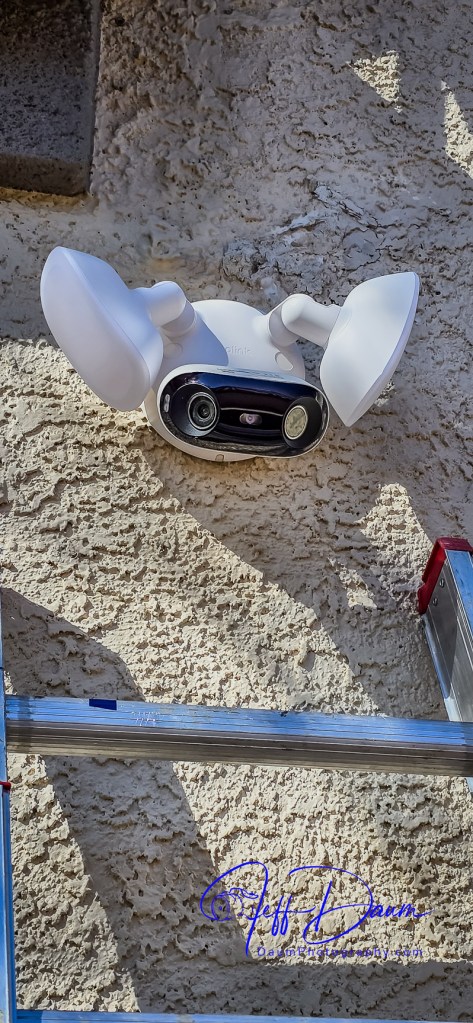
In a word, this Reolink Elite Floodlight WiFi surveillance camera is truly impressive.  Reolink raises the bar for surveillance systems on multiple levels including image quality, ease and flexibility of use and AI-assisted search of recorded videos.  This unit was provided to me by CommunicateMore for testing and review.

Here are the Reolink Elite Floodlight WiFi specifications listed on their website*:

  • Image Sensor 1/2.7″ CMOS  Sensors
  • Resolution 5120×1552(8 Megapixels) @20fps
  • Lens f=2.8mm fixed, F=1.6
  • Field of View Horizontal: 180° Vertical: 59°
  • Infrared Night Vision Up to 30 meters (100ft); LED: 9pcs/850nm
  • (Auto-switching with IR-cut filter)
  • Color Night Vision With Floodlights: 19W 3000 Lumens/3000K~6000K
  • Frame Rate Main stream: 2fps – 20fps(Default: 20fps)
  • Sub stream: 4fps – 20fps(Default: 20fps)
  • Code Rate Main stream: 3072Kbps -8192Kbps(Default: 5120Kbps)
  • Sub stream: 256Kbps – 2048Kbps(Default: 1024Kbps)
  • Audio Two-way audio
  • Tailorable real-time mobile notification options of email, text or both.
  • Unit cost: US$219.99 list

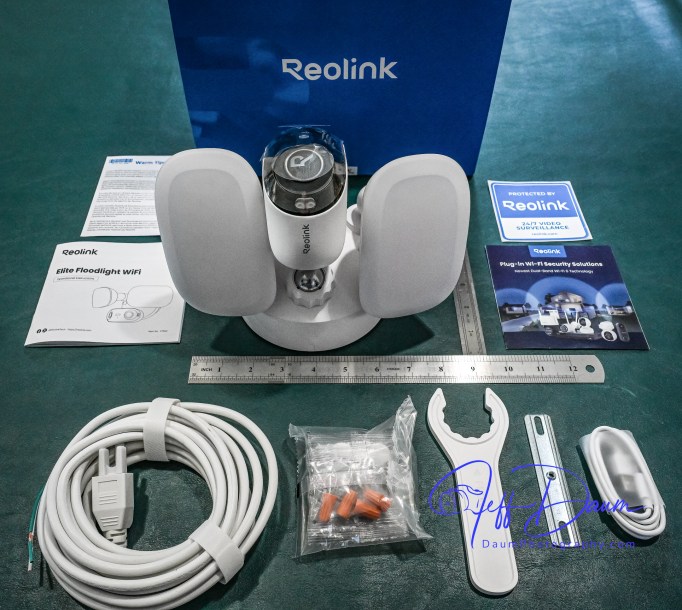
The unit ships with just about everything you need to mount the surveillance camera and get it up and operational.  Included is the camera unit with dual cameras and two LED floodlights, hardware to mount it on the wall or overhang, and a brief manual.  Additionally, each package of the different screws needed are clearly labeled and match the labeling in the brief manual.

Before you mount the unit you need to use your smart phone to download their free app which then guides you through the initialization of the camera and linking it to your WiFi.  At this stage you temporarily power the camera with the supplied USB A to C cord.  However, you will need to provide your own 5-volt 2-amp USB power adaptor (standard with most phones in the past).  Access the USB port on the camera body by removing two Phillips head screws in the port cover (the screws are ‘captured’ so you don’t have to be concerned about losing them).

This initialization process will go smoothly if you make sure you do a couple of necessary things:

  • Ensure you set up the permissions for the Reolink app to access your camera, its Bluetooth, precise location, etc.
  • Notice the little check box on your phone as it is stepping you through the process that says ‘you heard the voice prompt’ from the unit.

Once you get the initialization set up, you disconnect the USB cord.  If you are going to use the unit’s internal storage, you will need to install a micro-SD card at this point.  It supports up to a 512GB microSD card with FAT32 format and Class 10 read and write speed. You will find the microSD slot near the same area that you inserted the USB cord.

You don’t have to use internal storage, but I recommend it even if only as a backup.  Reolink offers the option of storing recorded videos to the microSD card, your own NAS or their NVR unit.

Next you screw the port cover back on and are ready to mount the unit.  Since it is powered by AC 100V~240V, 50~60Hz you will need to have a junction box available where you plan on placing it or run power and a new box to the location.  Wiring is straight forward, just the hot, neutral and ground connections.  The mounting bracket Reolink supplies has a level built into it that makes it easy to correctly align the three screw holes as you mount it to the wall.

The camera and floodlights unit then screws on the mounting bracket.  Note: There is a small loop incorporated into the back of the camera unit that allows you to temporarily support/hang it while you connect the three wires with the supplied wire nuts.

Once you have the unit mounted and have placed the supplied hole plugs over the screws, you are ready to turn on the power to the camera.

In my case the unit came online in the app on my phone almost immediately.  Next, using the live stream in their app, you position the camera head to deliver the best coverage.  They provide a plastic wrench to tighten the camera support once you have it positioned.

Keep your ladder handy if you mount your unit high on a wall, since you will need to wait until it is dark to position the two floodlights best for your situation.

Reolink’s smart phone app is very easy to use and well designed.  It opens to a live stream of the camera’s 180 view.  The app is intuitive with icons to trigger the 105dB siren, floodlights, two-way audio, snap a picture or start a recording, talk over its built-in speaker, playback recorded events and access your settings.

They also have free versions of the app available for use on a PC or Mac that are equally easy to use.

The key function that sets Reolink’s app and this Elite 4K Floodlight WiFi surveillance camera apart from competition is the ease you can review recorded videos.  Instead of having to wade through potentially hours of video to find what you are looking for Reolink uses AI to do it for you!

When you click on Playback on the phone, it loads the videos by date and then there is an icon that allows you to sort/search by event type.  For example, you can choose to see all videos where a person entered the field of view, or a vehicle, or animal or combination of these.  When you select one or more of these filters, it then quickly sorts through the videos and brings up only those matching your selection.  If you used the settings function to define a specific line or zone in the viewing area, you could also select to see videos where someone has crossed the line or entered the zone.  It can even identify and sort when someone is loitering in the viewing area.

When you are looking at saved videos, the app allows you to play the video at normal speed or as slow as ¼ speed or in increments up to 16xs speed.  As mentioned, you can at any point snap a picture of what you are viewing, and/or download the current video.

The Reolink apps on PC or Mac are very similar to the smart phone app in functionality and ease of use.

I found this AI assisted search to be excellent and correct most of the time.  It really saves so much time and effort searching through recordings to find an event.

This brings me to the quality of the image.  Whether you are looking at the live feed or the recorded image, it is outstanding in both day and night versions.  The image is sharp, the color excellent during the day and very good at night even with the floodlights set to lower lumen output (I did set the color temperature to 6000K and reduced the lumens to about half power).

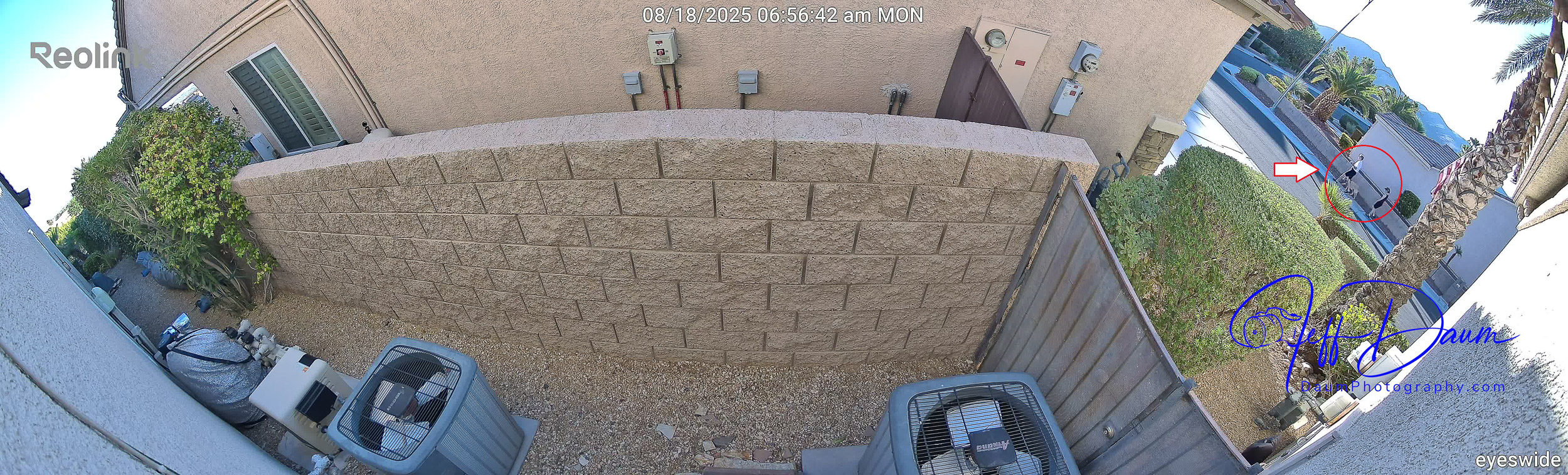
Here are some samples of daytime images and nighttime images directly from the live stream.  The detail holds up even if you considerably enlarge (crop) an image. Note, these are uncorrected images directly from the Reolink unit. Because of the native quality, they could if necessary be easily enhanced using post production editing.

These are day and night images:

These sets show enlargements of the red circled area in the first image:

Similarly, the videos are smooth and images crisp. For a short day clip see https://youtu.be/L3aVJGOvWz0

and for a short night clip see https://youtu.be/Z7__wVtNgxs

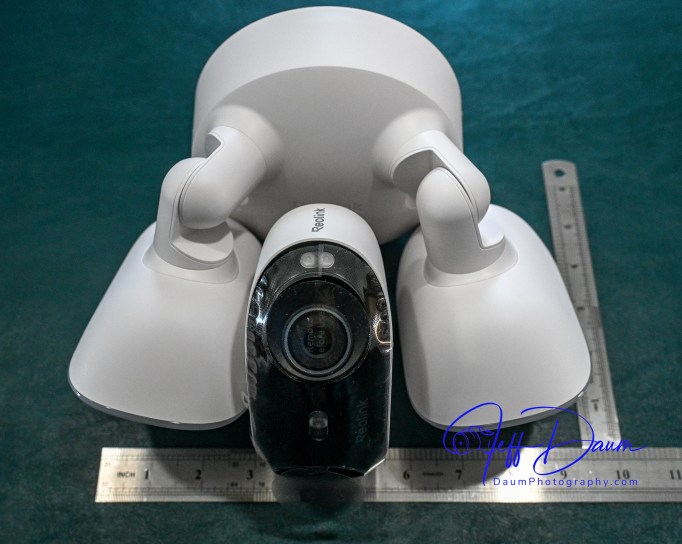
You can see in these samples that the Reolink software automatically stitches the simultaneous images from the two cameras in the unit together to provide a panoramic picture.

In my set up because I have the unit both mounted high and pointed downward so I can see both ends of the side yard as well as wall of my house, you do end up getting normal curvature distortion from the center of the image to both sides.  This is mild and does not impact the sharpness of the image.  If you end up mounting the unit lower or don’t need to point it downward as much, you will have little to no curvature distortion.

The type of recording you want to save is set in options, along with where you want to store them.  For this review I went with a 512GB MicroSD card and allowed it to save recordings of all forms of activity.  It appears that it will store approximately a month’s worth of recordings on my setting before recording over the oldest files.

The Reolink Elite 4K Floodlight WiFi surveillance camera and its free apps do not disappoint.  The high quality180 degree view along with the AI search set this system apart from competition.  It is easy to tailor it for your specific needs and is value-priced considering everything it delivers.

It receives five out of five thumbs up!

*Reolink website https://reolink.com/us/

Thanks for visiting and reading. If you have a question or like to comment, please feel free to enter it below!

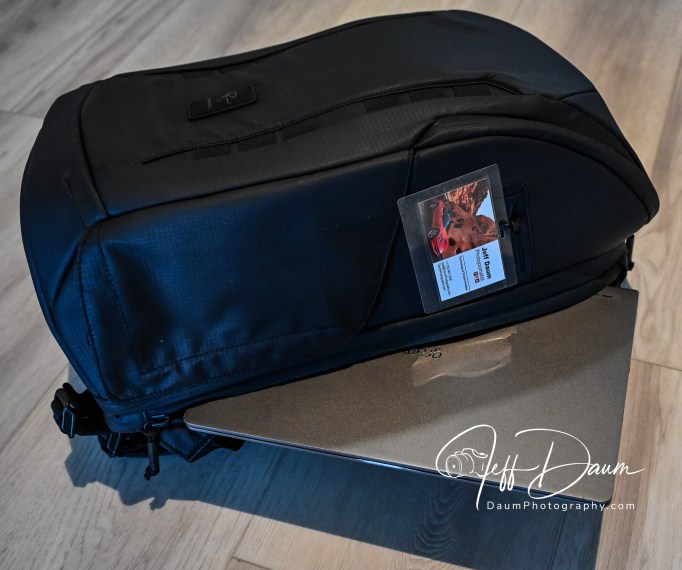
McKinnon 25L Camera Pack: a crazy versatile backpack!

By Jeff Daum, Ph.D, PPA, Technology & Product Analyst

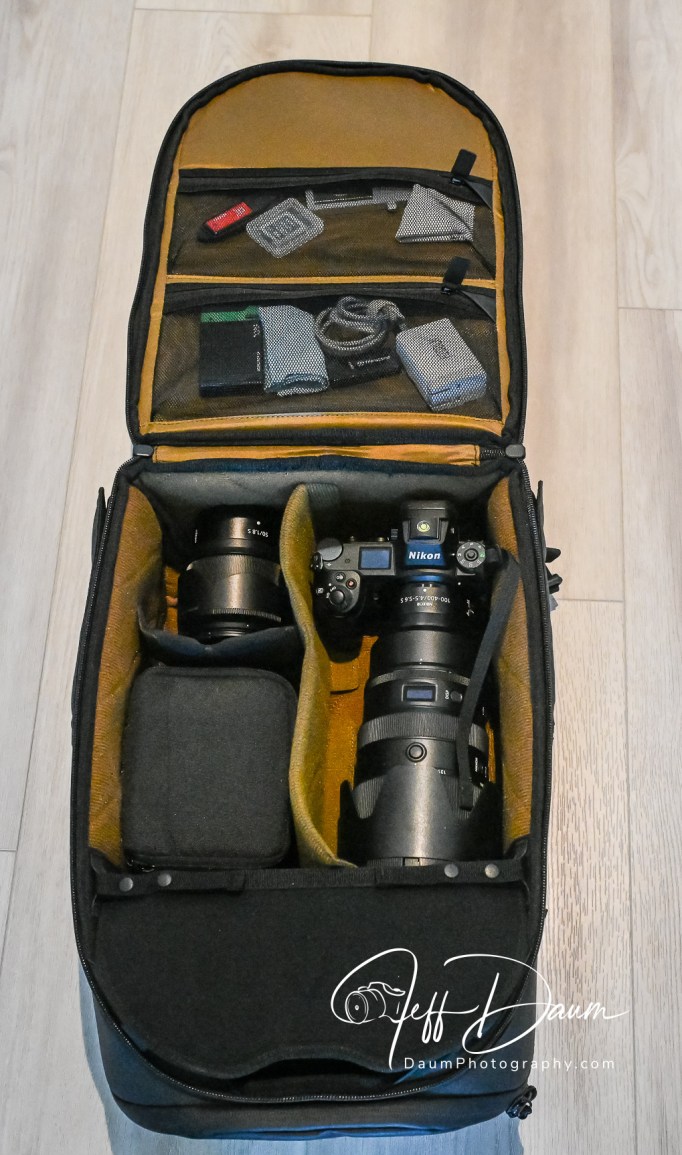
I have owned many backpacks designed to carry my camera equipment but have to say that none have proved to be as customizable and convenient as the McKinnon 25L Camera Pack.1

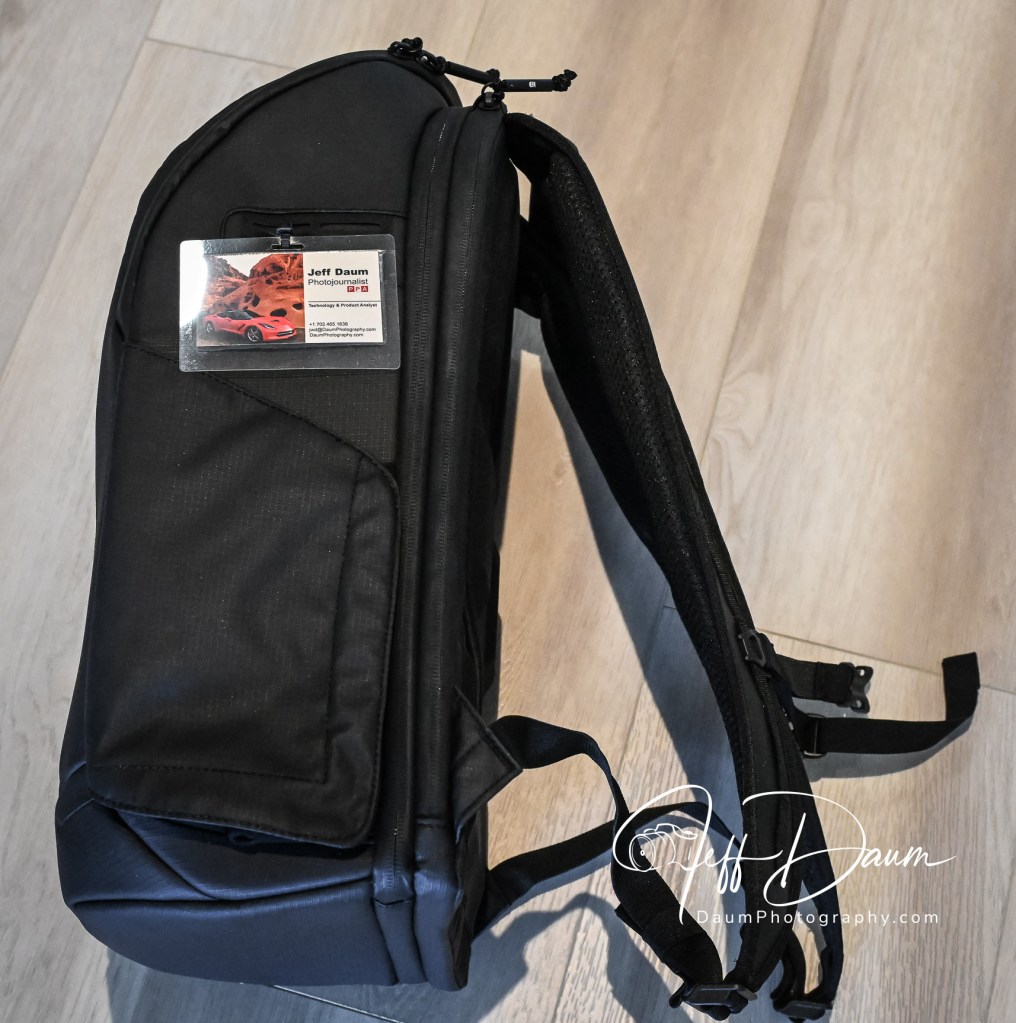
As soon as you take it out of its wrapper you are impressed with the quality of materials used and its fit-and-finish. The case is a combination of Polyester, Nylon and Polyurethane foam and has a water-resistant exterior.

Empty it weighs 3 pounds 3.4 ounces (1455 grams) and measures approximately 20 inches H x 12 inches W x 7.5 inches D (508 mm x 304.8 mm x 190.5 mm).  It has an easy-to-grip carry handle at the top of the back, along with heavily padded shoulder straps.  The straps are adjustable and include an adjustable cinch strap that can be used between the two shoulder straps.

The back side of the McKinnon is heavily padded to ensure the backpack is comfortable on your back yet allows for air circulation.  The center padded section can also serve as a strap to slip over another suitcase handle when you are not wearing the backpack.  Each side of the bag has a nice sized drink or item holder pocket.  The pocket is held flat until you use it by a magnetic flap.  There are also attachment slots near the top of the sides for optional gear straps to secure a tripod or monopod on the side.

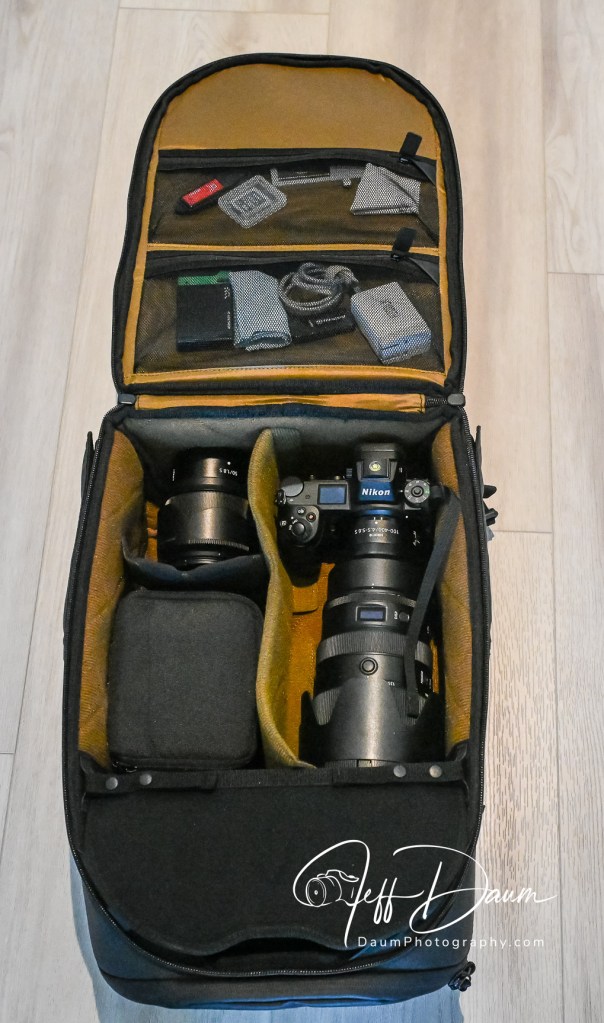
At the back of the backpack is a zippered laptop sleeve.  The zipper runs from the left side (looking from the back) of the top down the full height of the backpack. The laptop sleeve is the full width of the backpack. The next zippered compartment (from the back) fully unzips the entire back so that the backpack interior is completely accessible.  At that point you’ll see two mesh zippered compartments on the interior of the heavily padded back that can hold filters, paper, pens etc.

You will also see the Nomatic ladder system. That allows you to reconfigure the interior of the backpack.  The ladder easily divides the interior to have the top section, which is accessible from the outside top of the backpack separated off from the rest of the interior, to be either one third or two thirds of the usable storage space.  You can also fully remove the ladder system so that you have one large interior compartment.

If you leave the ladder system in you have access to the separated top section from the inside by a flap that is held magnetically closed.  That same section is accessible by a zippered flap on the front top of the backpack.  On either side of this top section are two small mesh pockets and there is also a larger zippered pocket in the top flap.

The front of the backpack is minimalist and has surprising rigidity.  The case can stand upright on its flat base.

Nomatic sells optional add-ons for the McKinnon 25L Camera Pack that enables a variety of internal configurations for your equipment.  These include a Divider Kit to create sections horizontally and vertically, Small and Large Cube inserts, Accessory Straps, Waist Straps, Memory Card Case and a Battery Case.  All except the straps, attach using Velcro and are easily positioned and removed as needed.  You can see these at their site https://www.nomatic.com/collections/all-camera/products/mckinnon-camera-backpack-25l .

Field Test

My initial impressions are that the McKinnon 25L Camera Pack is well thought out and highly practical for most photographers.  I set out with it fairly loaded at more than 20 pounds of equipment including two Nikon Z7s, one with a Nikkor 28-120 mm zoom attached and the other with a Nikkor 100-400 mm zoom attached, a Nikkor 50 mm lens, an LG laptop and miscellaneous chargers and cords.

It felt comfortable on my shoulders throughout the day.  The access to the cameras was easy.  I especially liked having my prime camera in the upper section accessible through the top flap.

Summary

If you are looking for a highly customizable camera backpack, the McKinnon 25L Camera Pack should be at the top of your list.  I give it five out of a maximum of five Mules!

  1. Product provided for review by Kyle Abarca, Nomatic Community Marketing Manager ↩︎

Thanks for visiting and reading. If you have a question or like to comment, please feel free to enter it below!

Put a ring on your vitals! A review of the Ultrahuman Ring AIR® -Smart Wearable Tech

By Jeff Daum, Ph.D, PPA, Technology & Product Analyst

Smart rings are becoming popular with several companies offering competing products including Utrahuman, Oura, Samsung, RingConn and Amazfit.  If you are not familiar with smart rings, think about taking most of the technology you find in smart watches and shrinking it down to fit in a normal sized ring.  Amazing, right?!

Of course, you might wonder why get a smart ring if you already have a smart watch?

The short answer is convenience and wearability.  Many smart watch owners don’t like wearing the watch while they sleep or go for a swim.  Smart rings nicely fill that void.  Also, smart watches tend to need charging every day or two, while smart rings can go four to six days before needing a charge.

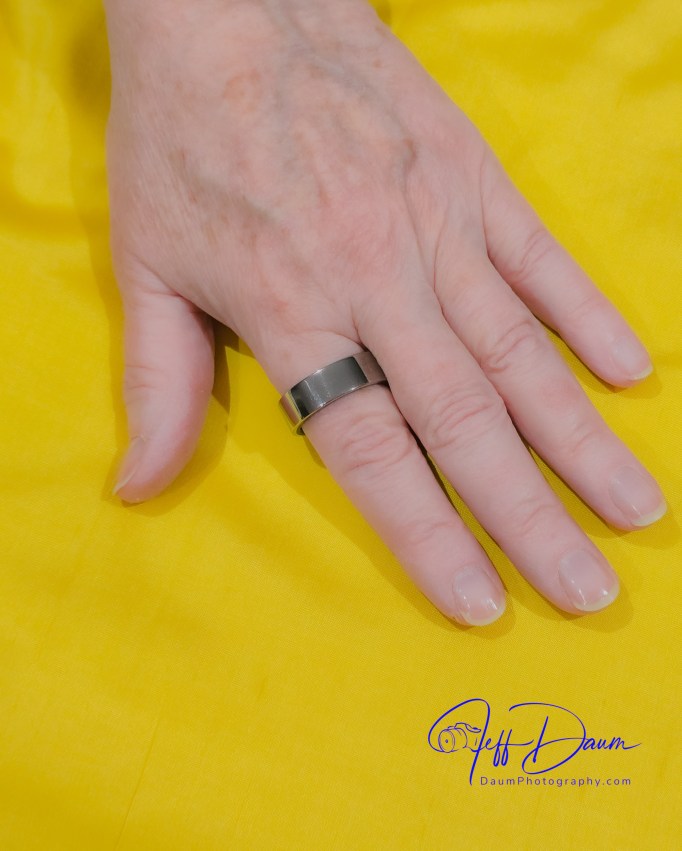
This review focuses on the Ultrahuman Ring AIR.  It weighs only between 2.4 and 3.6 grams (0.08 to 0.12 ounces) depending on the size you order! They recommend you wear the Ultrahuman Ring AIR® on either your index, middle or ring fingers, and it appears that many users opt to wear it on their index finger.  When you place an order they offer to ship you a free ring fitting kit to ensure you select the correct size prior to finalizing your order.

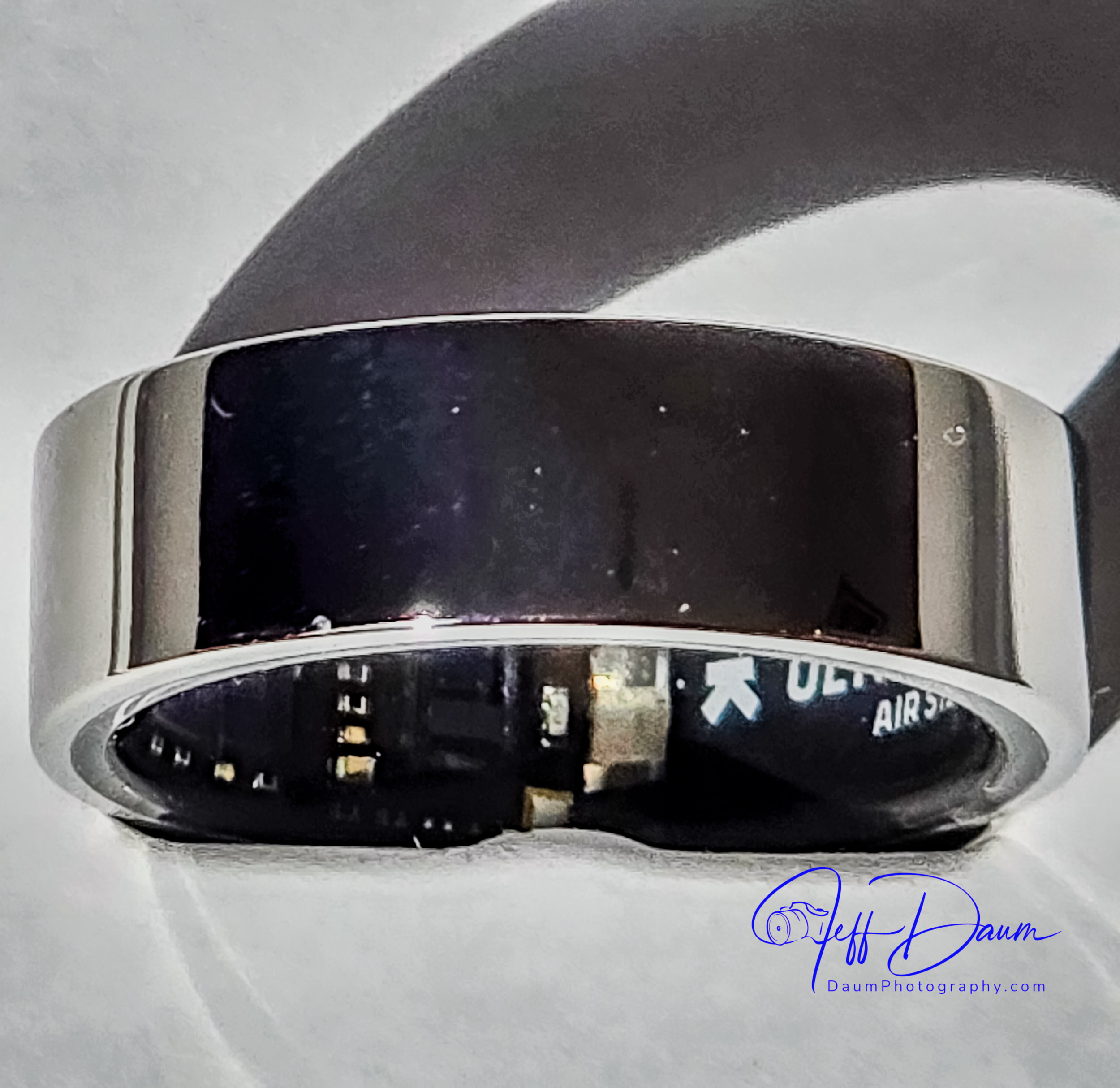
The Ultrahuman Ring AIR currently comes in five colors: Raw Titanium, Aster Black (gloss black), Matte Grey, Bionic Gold and Space Silver.  All color versions have an outer shell made from high grade Titanium reinforced with a Tungsten Carbide Carbon coating.  The inside of the ring is coated with a transparent medical-grade hypoallergenic epoxy resin covering all its electronics.

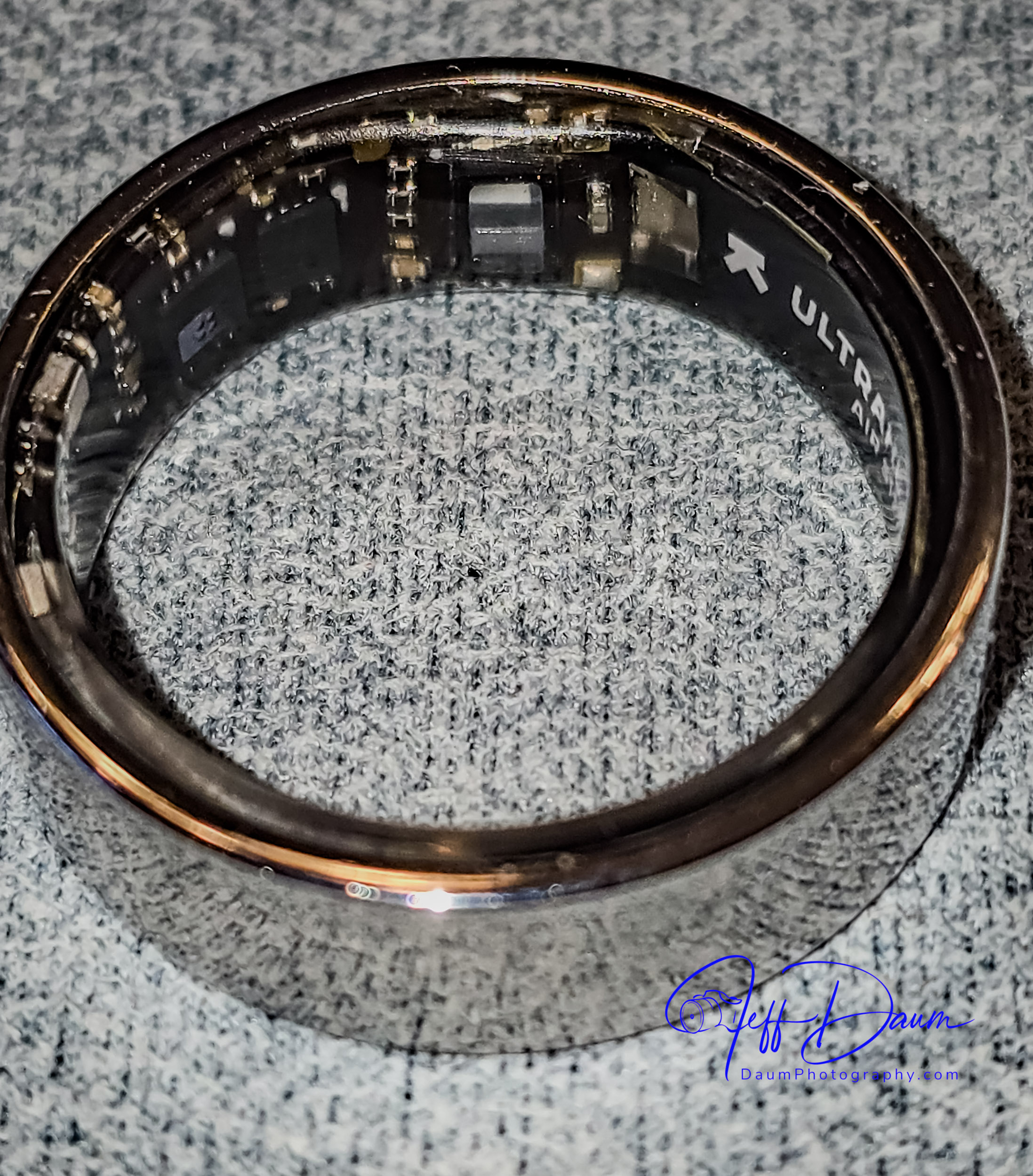
The ring itself is elegantly simple, what I would call almost a Bauhaus design.  There are no displays, design or LEDs on the outside, but you can see some of the circuitry on the inside through the epoxy resin and occasionally a LED lighting up.

The ring contains several sensors including Infrared Photoplethysmography (PPG) [now that is a mouthful: PPG is used to detect blood volume changes] sensor, a non-contact medical-grade skin temperature sensor, 6-axis motion sensors, Red LEDs (heart rate monitoring and oxygen saturation), Green LEDs (heart rate monitoring) and Infrared LEDs (heart rate monitoring).  Once you download the free Ultrahuman app these sensors communicate with your iPhone or Android automatically through Bluetooth Low Energy (BLE5).

The ring uses a permanent rechargeable LiPo battery that can last up to six days and recharges on their proprietary ring charge stand in two to three hours.

The ring is rated waterproof up to 100 meters (about 328 feet) for up to 12 hours.

Currently the rings are manufactured in India, and delivery is relatively fast from the time of the order.  The Ultrahuman Ring AIR costs US$349 including delivery.

All tracking and data (mentioned above) are provided as part of the purchase price with no monthly or subscription fees.  This sets Ultrahuman apart from many competitors who charge post-purchase subscription fees for the same types of information.

There are some third-party apps that they call PowerPlugs which can be added to Ultrahuman’s app.  Some are free like Cycle & Ovulation, Vitamin D and Smart Alarm while others charge a monthly fee like Cardio Adaptability.  Ultrahuman periodically adds both free and third-party subscription-based apps.

Here is what you get with your order

Ultrahuman has one of the best post-order communication processes I have experienced.  After acknowledging and confirming my order, I received daily progress updates and then shipping status updates.  From order acknowledgment to delivery was under a week.

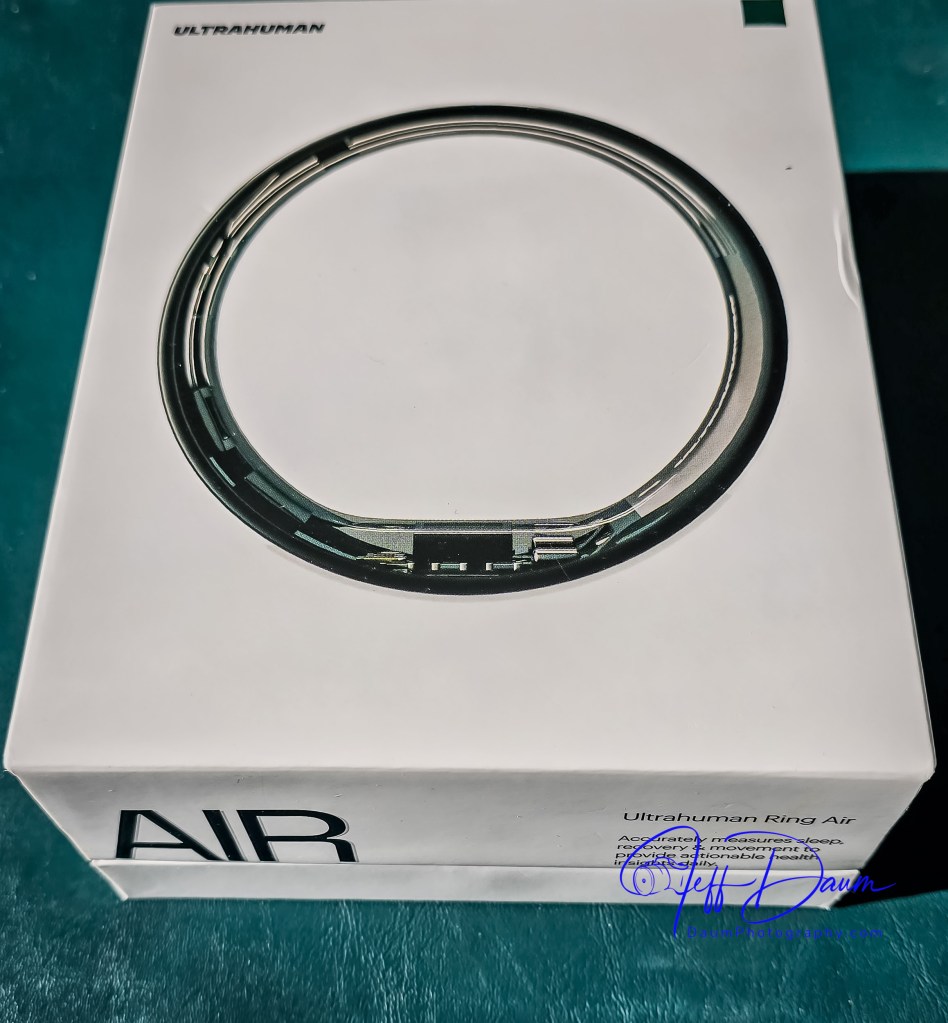
The Ultrahuman Ring AIR arrives nicely protected in a box that includes the ring, a proprietary ring charging base with a USB C to C cable, a How to Charge booklet, a User Manual, a Getting Started Guide and a humorous Hello Cyborg card (a nod to a Human Being whose powers are enhanced by mechanical parts and/or computer implants).

After downloading the Ultrahuman app and charging my ring I went through the very easy pairing process.

Initial Experience

I have worn the Ultrahuman Ring AIR continuously except for one charging period, for a little more than a week at this point.  The first impression was how smooth and comfortable the extremely lightweight ring felt.  I choose to fit and wear the ring on my index finger and virtually never notice that it is there (unless I look at my hand 😊 ).  The finish and quality match high-end jewelry.

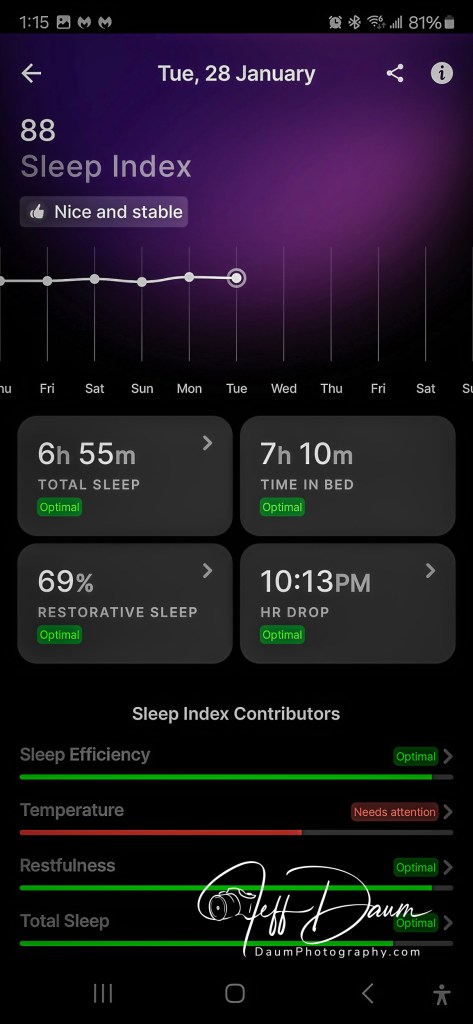
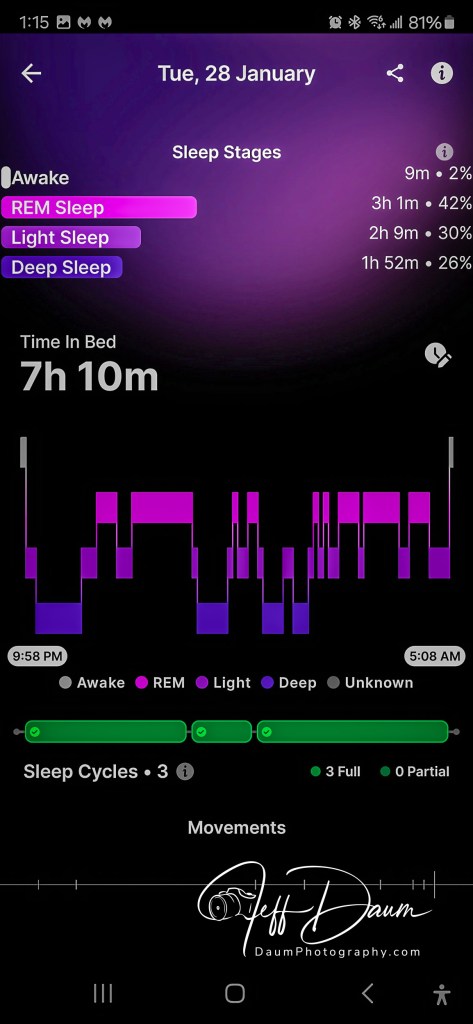
I rarely used the sleep data from my smartwatch, primarily because I do not like sleeping with it on my wrist.  Conversely, I find I check the Ultrahuman app for my prior night’s sleep data every morning.  As shown on the following sleep screen shots, there is a good bit of information available.  In many cases there is a “>” or “i” icon next to the data that leads to more details.

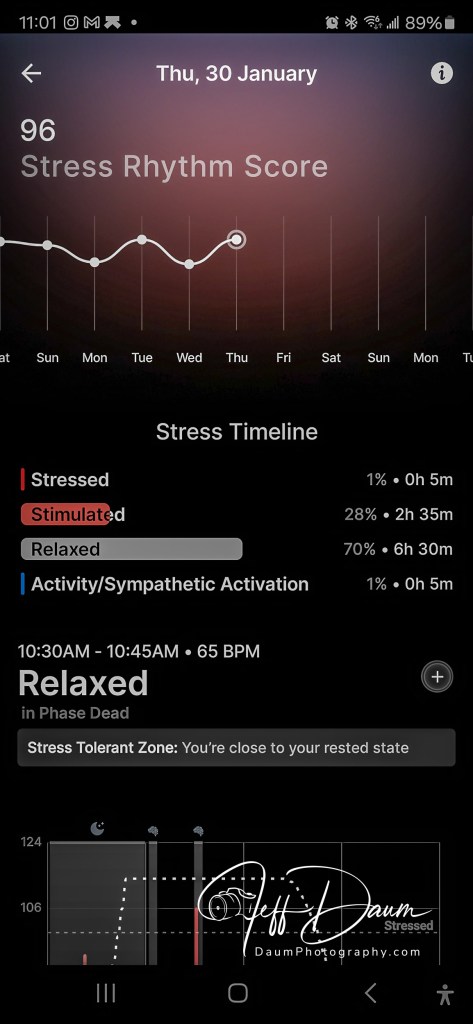
There are a lot of data and charts available to you in the Ultrahuman app, for example, here is the opening information, skin temperature, stress, heartbeat and relaxation views.

The ring automatically recorded my daily walks but seemed to miss most of my daily morning exercise routine.  The 35-to-40-minutes routine is a mix of stretches, isometric and weights exercises done as soon as I get out of bed.  Only one time did the app ask if I just exercised and captured related data. 

Preliminary Thoughts

I find the amount and scope of data generated by the Ultrahuman Ring AIR quite amazing and worth exploring.  I believe over time it can prove useful in refining some daily activities.

I would also like the ring’s ability to autodetect workouts to be enhanced and if that is not feasible, at least an easy way to trigger related data collection at the start of a workout session.

While several people have commented on seeing the Ring AIR on my hand and liked the look, personally I would prefer some visual texture options similar to what Ultrahuman is introducing with their Rare luxury rings.  Or possibly, some interchangeable very thin ring surface graphic design covers.  Aesthetically I think it would make the Ring AIR fit in better when one is more formally dressed.

All in all, while I am not sure I now feel like a cyborg I have been pleasantly surprised with the comfort of the Ring AIR as well as the detailed data the app provides.  Here is a link to their site https://www.ultrahuman.com/

Thanks for visiting and reading. What are your thoughts on the Ultrahuman Ring AIR? If you have a question or comment, please feel free to enter it below!

Is it a car, a UFO or…? First look at the Aptera: The Future of Electric Solar Vehicles

By Jeff Daum, Ph.D., PPA

This is an initial look at the Aptera all electric solar vehicle presented at the 2025 CES (Consumer Electronics Show) in Las Vegas, Nevada. 

Let me begin with a full transparency statement: I was so impressed with the Aptera, its cutting-edge technology and dual CEO team direction and commitment, that I have placed and received confirmation of a pre-order future variant all-wheel drive Aptera.

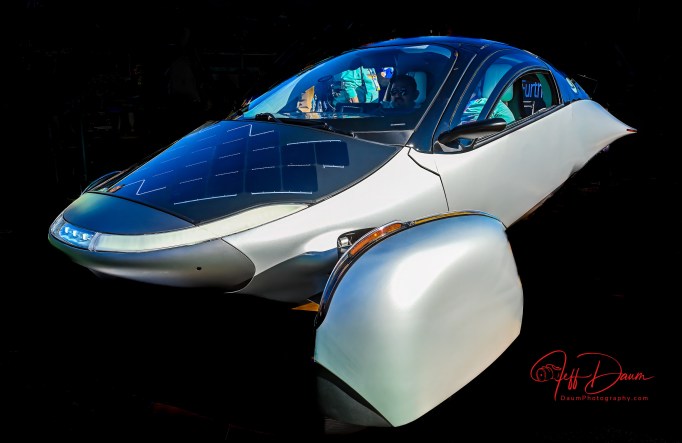
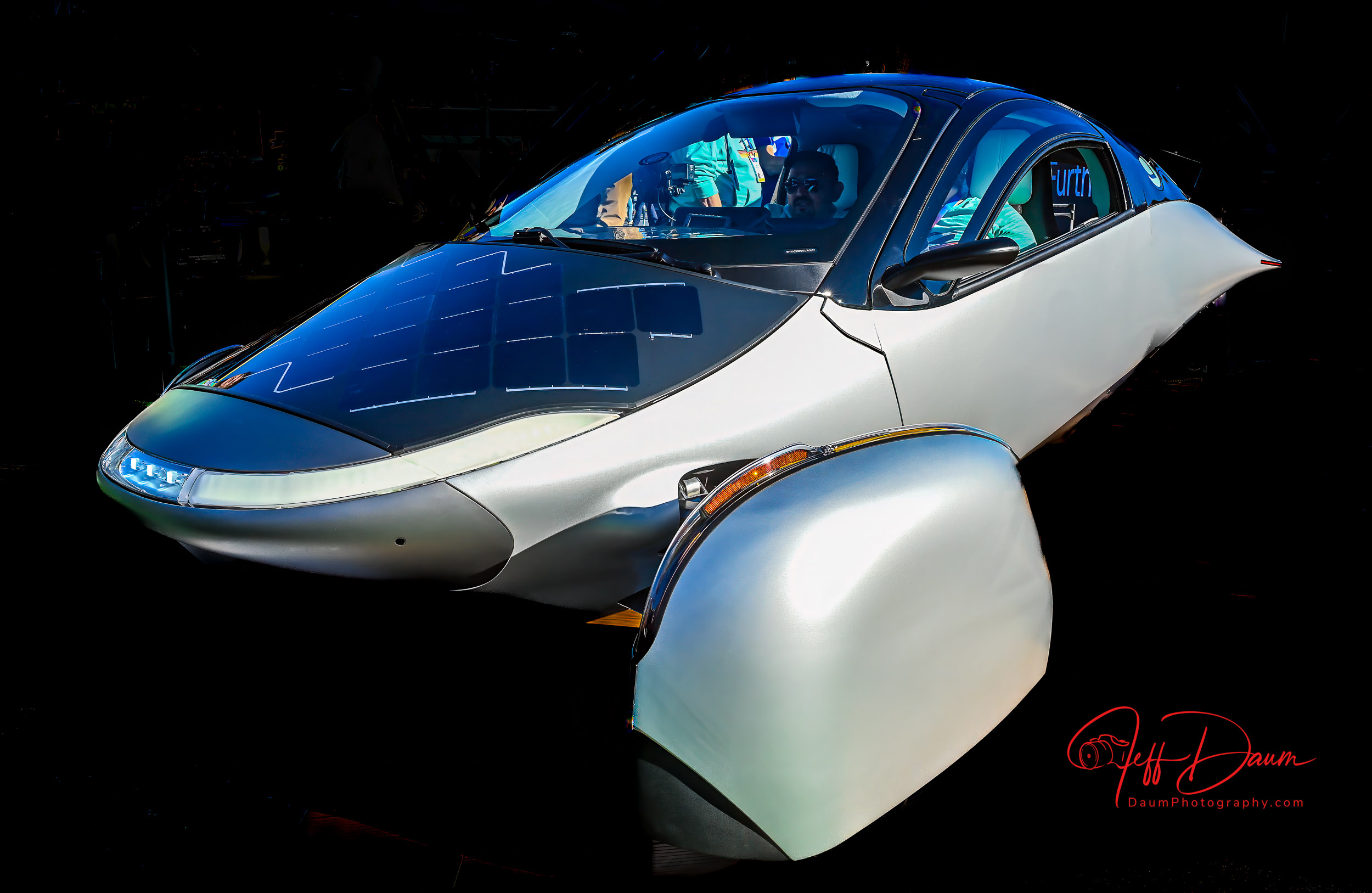
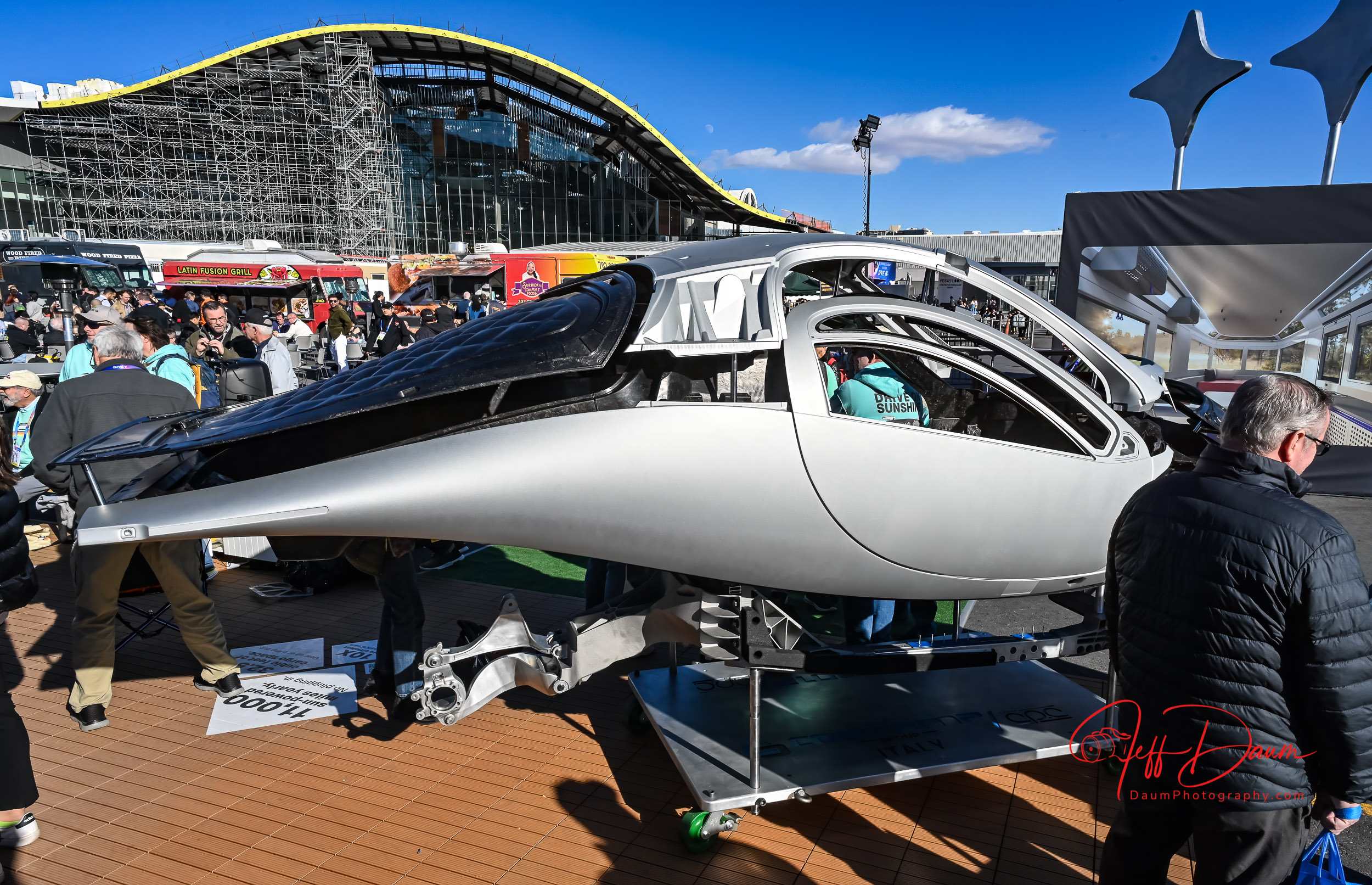
The first thing that you notice is its unique aerodynamic shape.  In fact, because of this shape it has the lowest coefficient of drag of any road vehicle at approximately 0.15!  The body was designed in concert with Pininfarina and is out of carbon fiber.  It is manufactured in Italy and shipped to Aptera Motors facilities in Carlsbad, California.

Probably the next thing you will notice is that Aptera has two front wheels and one rear wheel- an autocycle.  It is classified by the DMV as a motorcycle, specifically a Trike with full enclosure.  This means that it is registered as a motorcycle but you will not need a motorcycle driver’s license nor need a helmet.

Like most sports cars, the interior includes side-by-side two passenger seating.  It has all the normal accouterments: safety belts, frontal driver and passenger air bags, a steering wheel, accelerator and brake pedals, ac and heat, etc.  In front of the steering wheel is a horizontal screen that continually shows full views of the right and left side of the Aptera virtually eliminating any blind spots.  To the right of the steering wheel is the infotainment and information display.  The electronic rearview mirror shows the unobstructed view behind the Aptera (from a camera on the roof).  There is also a backup camera located adjacent to the license plate.  The plate holder slides to the side, revealing the NACS charging receptor.

Aptera has bespoke solar cells on the hood, dash and roof capable of generating 700 watts of electricity.  Each cell is incredibly thin, lightweight and glass covered yet capable of being bent to conform to the respective body shape.  According to their website details, an individual cell could be cracked yet continue to generate power because of its unique wiring. 

According to Aptera’s website, “the Launch Edition uses 21700 NMC 811 cylindrical lithium-ion cells, known for their high energy density and long life. The 44 kWh battery pack contains 2,304 cells, delivering 400 miles of range.” [ https://aptera.us/article/what-batteries-are-inside-aptera/ ]

I had the pleasure of talking with Chris Anthony, Founder and CEO Aptera Motors.

Chris image courtesy of Aptera

  Chris’ partner, Steve Fabro, also carries the title of Founder and CEO.

Steve, image courtesy of Aptera

I started off asking Chris about Aptera’s design elements to ensure safety, Here are highlights from this interview:

  • Regarding Aptera’s safety: Able to do things with carbon fiber that steel and aluminum vehicles can’t do.  Able to add protection such as great frontal impact strategies, offset frontal, side impact.  Crash energy is diverted from the passenger area downwards to the well protected battery and frame.  Aptera has front and rear crumple zones. Aptera has front and rear crumple zones and a carbon fiber roll bar.
  • Suspension dynamics: even though it is a three-wheel vehicle, because the heavy battery is mounted so low, it has almost the exact same suspension dynamics as a VW Golf.
  • Done lots of track testing and skid pad stuff, curb strike angles at forty-five miles per hour, pothole tests every which way you can think of with the vehicle, and because the battery weight is so low it is extremely stable.
  • We will be running Crash Tests shortly.
  • It has better ground clearance than a Honda Civic with six inches to the belly and five and one-quarter inches to the wheel pans, and ingress and egress a couple of degrees better than the Honda Civic.
  • Regarding stability, especially with the large area by the rear wheel, it has a low-profile mid-section.   We have simulated cross winds up to 115 mph and it performs better than other vehicles because flat sided vehicles are much more susceptible to the winds.  There is no float created because it is basically a downforce vehicle that creates a bit of downforce, though we attempted to keep it as neutral as possible.
  • The tires are 195-55 R16 low rolling resistance, specially formulated for them by Hankook Tires.
  • The ABS and airbags (passenger and driver frontal airbags) are currently undergoing calibration.
  • It has DC Fast Charge, Level 2 and regular 110 outlet capability.  The 110-volt outlet will provide 150 miles charge overnight.  The Aptera uses one quarter the energy of the average EV, meaning we charge four times faster.  A DC Fast Charger will put 500 miles an hour into it, a Level 2 will put 60 miles per hour and a regular outlet will put 13 miles an hour into it.
  • Currently we have more than 50,000 preorders from across 115 countries, had the largest Crowd Funding in the industry with 20,000 individual investors, and now working on an IPO and hope to have production vehicles in people’s hands by the end of the year.
  • No dealerships, but have distribution centers around the world, and working with some Tribal communities in states that don’t like the lack of dealerships similar to what Tesla does.
  • In sum, the Aptiva is much more akin to a formula one car than anything else on the road. It is the penultimate in aerodynamic efficiency and has a carbon fiber chassis through and through.  It is an interesting mix to try an be the most efficient vehicle in the world but also have really extreme performance, when you look at the how the vehicle is constructed and how we achieve 100-watt hours per mile and still keep safety paramount, and get all the solar power out of it we need. The Aptera is the most efficient vehicle in the world but still sporty and very nimble.

Some addition information from the Aptera website https://aptera.us/  :

  • the core of our design is a safety cell crafted from Carbon Fiber Sheet Molding Compound (CF-SMC), which is both ultra-lightweight and stronger than steel, paired with metallic subframes that absorb impact energy.
  • Aptera’s body features a specialized composite structure known as Body in Carbon (BinC), primarily constructed from Carbon Fiber Sheet Molding Compound (CF-SMC) and Glass Sheet Molding Compound (SMC). CF-SMC is a lightweight material that utilizes a random arrangement of short fibers, allowing for the creation of intricately shaped parts with significantly higher stiffness and strength compared to standard SMC.
  • Aptera features an unequal-length dual wishbone suspension in the front and a double trailing link suspension in the rear. This advanced suspension system provides a balanced combination of stability, control, and ride comfort, allowing for smooth handling across diverse terrains.
  • The largest single component is the carbon fiber tub.
  • Use of SMC side panels on the body that won’t dent when hit.
  • Front wheel covers rotate up to allow access to tire valve stem and rear tire has a small access hole for the same purpose.
  • At Aptera, we’re redefining the repair experience by making it accessible, straightforward, and affordable. Whether you’re repairing your vehicle yourself or working with a local shop, Aptera will provide detailed documentation and make spare parts easy to order. Unlike typical processes where maintenance information and parts access can be limited, we believe in empowering owners with everything they need to keep their vehicles in top condition.
  • The Launch Edition’s dimensions are optimized for aerodynamics and stability. The vehicle measures 15 feet (4.56 m) in length, 7.3 feet (2.22 meters) in width, and stands 4.6 feet (1.4 meters) high, with a wheelbase of 9.2 feet (2.82 meters).
  • Aptera has integrated the Vitesco Technologies’ EMR3 drivetrain—a high-voltage axle drive that combines a permanent-magnet synchronous e-motor, inverter, and reducer in one compact unit. 

Final thoughts:

I had a chance to sit in the Production Intent Aptera and found the seats very comfortable.  The interior is airy with great outward visibility.  The ‘double knock’ to open the door or trunk is a fun twist- there are no outside door handles.  The trunk is quite spacious, easily carrying two regular golf bags or even, apparently, with the seats folded forward, room to lie down if you take the Aptera camping.  There is also a small compartment under the regular rear floor that can be used to store charging cables or other supplies.

I am particularly impressed with Chris and Steve’s vision and approach.  They are continually striving to use their own and their team’s knowledge, seek and use outstanding third party input and resources, and harness AI to refine the Aptera to be highly efficient, practical and fun.  The use of Open-Source Software and Right To Repair sets the Aptera apart.

This is hopefully Part 1 of a multipart Aptera review.  Stay tuned for Part 2: a factory visit and first drive…

Thanks for visiting and reading. What are your thoughts on the Aptera? If you have a question or comment, please feel free to enter it below!

The Innovative Neakasa Magic 1 Vacuum Steamer

By Jeff Daum, Ph.D., PPA

The Neakasa Team provided me a sample of their new Neakasa Magic 1 Vacuum Steamer to review.  Typically, portable clothes steamers are not something that most people get excited about. 🙂 This Magic 1 is truly different.

A Closer Look at the Neakasa Magic 1 Vacuum Steamer

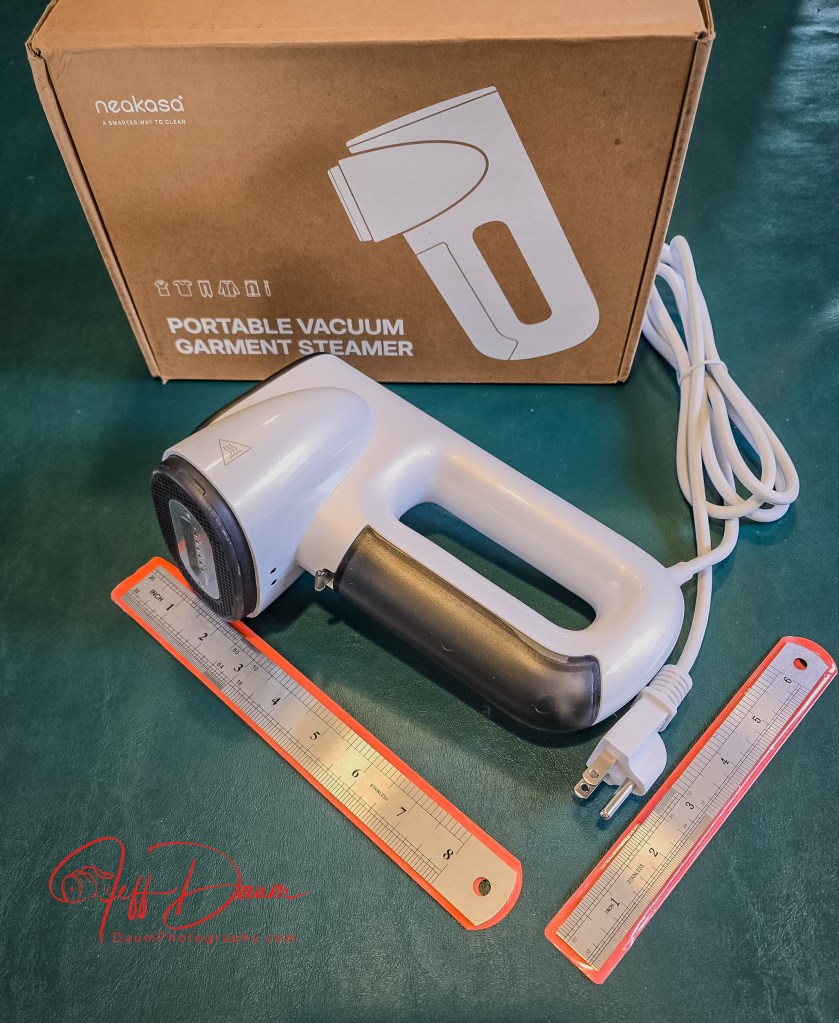
The Magic 1 is about the size of many portable steamers at approximately eight inches in length.  It weighs two pounds (915 g) dry.  The non detachable power cord is almost six feet long.

It comes with a “5 Tips to ensure a smooth first use” guide as well as parts/buttons explanation.  Water goes into a removable container located in the front of the handle and holds approximately 3 ounces (100 ml).  They recommend distilled or purified water.

The innovative difference that sets the Neakasa Magic 1 Vacuum Steamer apart is the built-in vacuum function.  You can turn this on or off instantly.  In essence, what this does is sucks the fabric to the face of the Magic 1 while it steams it.  This, in theory, should enhance the steam’s ability to smooth out wrinkles.

Preliminary Use

After filling the Magic 1 with water, it came up to operating temperature within about 30 seconds.  I decided to try it out on several different types of fabric, using the vacuum function turned on.

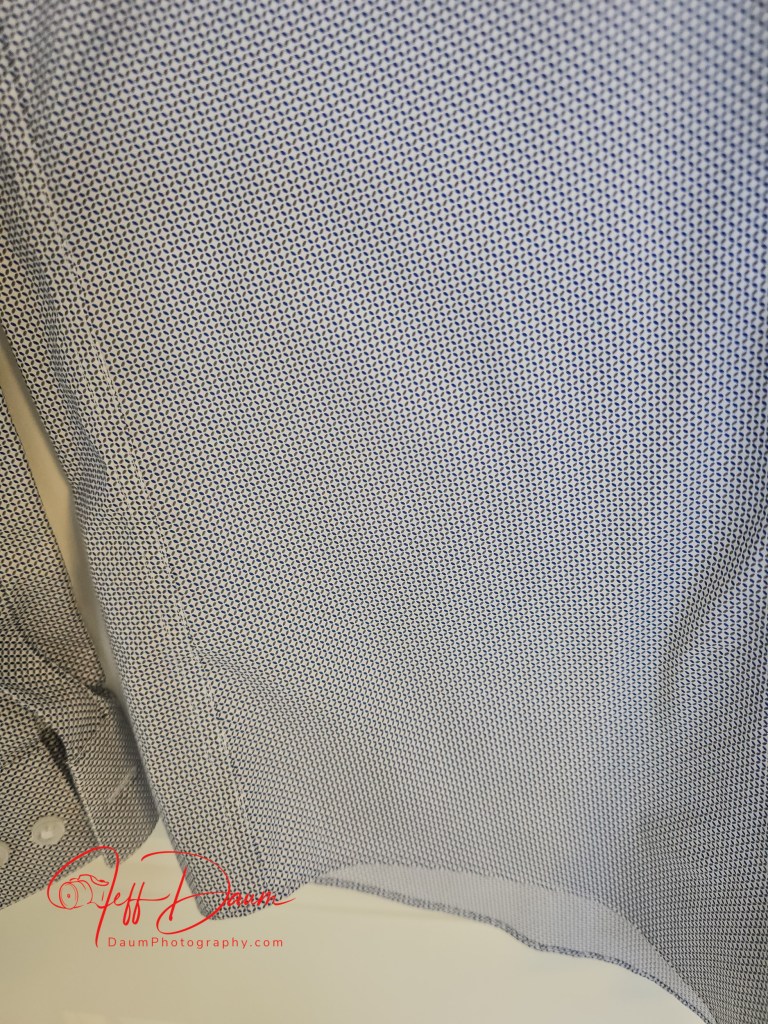
First was a cotton shirt.  Here are before and after images:

As can be seen, the Magic 1 did a commendable job in eliminating wrinkles.  It was very easy to do.  I followed their suggestion to let the garment hang naturally while moving the Magic 1 top to bottom.

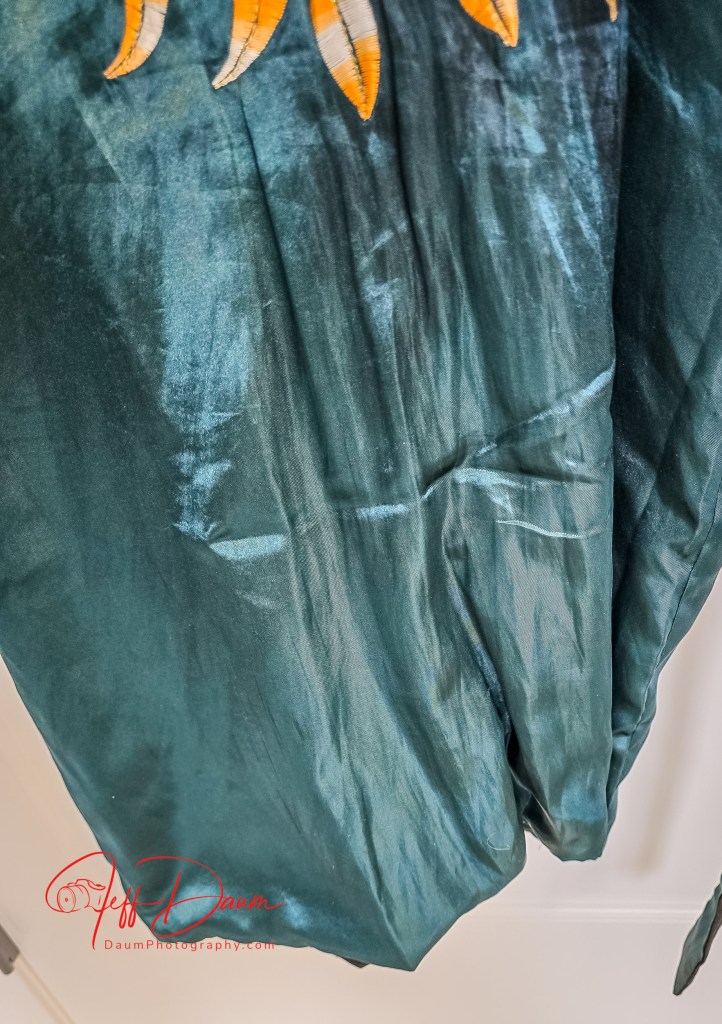
Next I tried it out on silk.

It glided smoothly across the silk and quickly reduced the wrinkles.  Because the fabric was so light weight I found it worked better if I held the fabric flatter (in the horizontal plane) with one hand while moving the Magic 1 top to bottom.

A pair of jeans

This heavier fabric required more pressure to somewhat eliminate creases, though the vacuum had no problem keeping it on the steamer face.

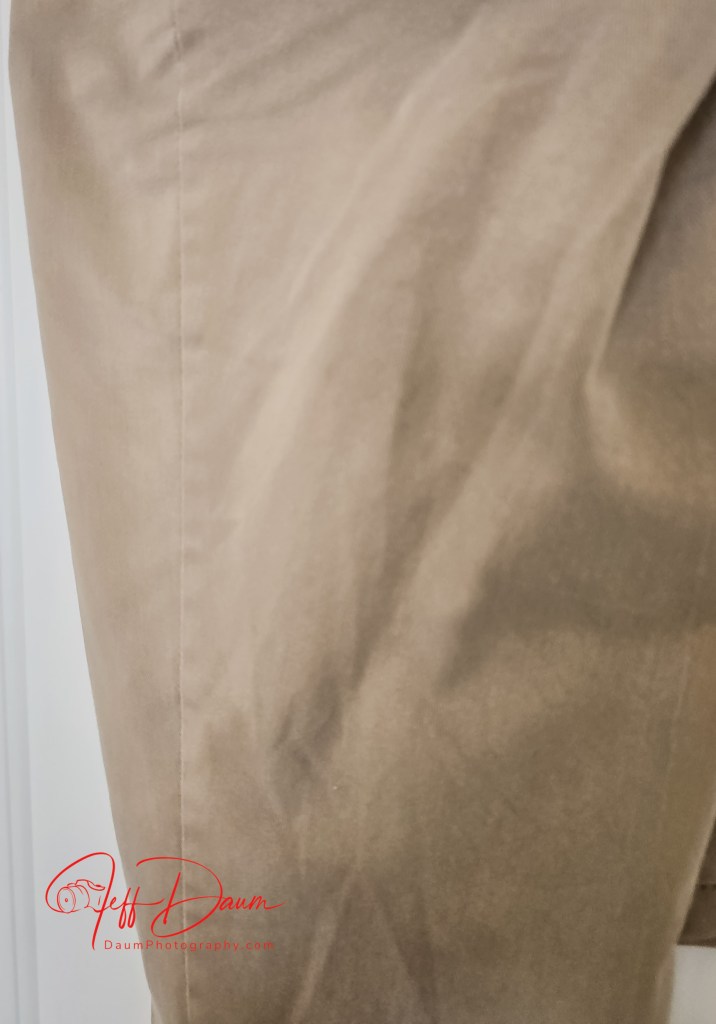
Khakis was my last test.

The Magic 1 did a very good job eliminating wrinkles on these pants.

Preliminary Conclusions

The Neakasa Magic 1 Vacuum Steamer does set itself apart from typical handheld steamers. It is easy to use and a comfortable weight.  It quickly comes up to steaming temperature and the vacuum smoothly suctions all types of fabric to the steam face.

This vacuum function results in more effective and easier ‘de-wrinkling’ as compared to using a typical handheld steamer.  Another bonus according to the manufacturer, is that the vacuum function removes 99.9% of bacteria and dust mites.

My only suggestions for future iterations are very minor: to increase the water capacity and increase the power cord to eight or ten feet.

Thanks for visiting and reading. If you have a question or comment, please feel free to enter it below!

BlackVue DR770X Dashcam Review: Security Redefined

By Jeff Daum, Ph.D., PPA

BlackVue represents some of the best dashcam systems on the market.  You can see my reviews of previous models at for the DR970X https://insight.daumphotography.com/2024/02/02/blackvue-dr970x-2ch-plus-and-dr970x-2ch-lte-plus-dash-cameras-field-test/ and https://insight.daumphotography.com/2020/07/11/product-review-blackvue-dr900s-2ch-field-test/ for the DR900S.  This review focuses on BlackVue’s new DR770X Box-3 channel Pro version.  It is primarily designed for the individual who wants up to three cameras- a front facing, rear facing and interior facing dashcams, and a system that is designed to provide protection from someone else getting to the recording memory card or attempting to physically remove the connections to each of the dashcams.  You might want this added security, for example, in a ride share or taxi vehicle.  Of course, the DR770X can be used in your own vehicle even if you don’t need the added security of a tamper proof set up.

The first thing you’ll notice is that the front facing DR770X is physically a lot smaller than most other BlackVue dashcams.  Specifically, the DR770X is approximately 3 inches (76mm) long compared to their DR970X and DR900S at approximately 4.7 inches (118.5mm) long or the even longer DR970X-2CH LTE Plus at approximately 5.4 inches(137.6mm).

The lockable main box comes with a large Velcro pad on the back so that it can be positioned out of sight but convenient to remove to gain access to the microSD card.

While BlackVue’s marketing states the DR770X has a faster lens at f/1.7, it depends on what other dashcam they use in the comparison: The DR970X Plus also has a f/1.7, but the DR970X’s is f/2.8.

The DR770X has a narrower coverage area with Diagonal 139°, Horizontal 116°, Vertical 61° for the front camera and Diagonal 115°, Horizontal 95°, Vertical 49° for the rear facing camera.  The DR970X has front: Diagonal 155°, Horizontal 130°, Vertical 70° and rear: Diagonal 139°, Horizontal 116°, Vertical 61° while the DR900S had front: Diagonal 162°, Horizontal 136°, Vertical 77° and rear: Diagonal 139°, Horizontal 116°, Vertical 61°.

The DR770X is a 4K dashcam with Sony STARVIS, the DR970X and DR900S an 8-megapixel CMOS Sensor.

The DR770X Pro has an increase in the event buffer recording time to 10 seconds up from 5 seconds compared to prior models.  Events are when the system senses a bump, hard turn, crash, etc., and automatically mark the recording as such preventing it from being overwritten when the MircoSD card is full.

Note: prior to setting up your DR770X system in your vehicle, I suggest you jot down the unique password that is on the camera behind the tamper proof end cover.  You will need this if the auto-find in their app doesn’t locate and load your cameras on your initial set up.

All three models incorporate a built-in microphone in the front facing camera that can be set to always record interior sounds (voices, turn signals, music, etc.) or be turned off.  They also include a speaker that lets you know the system is functioning when it turns on.

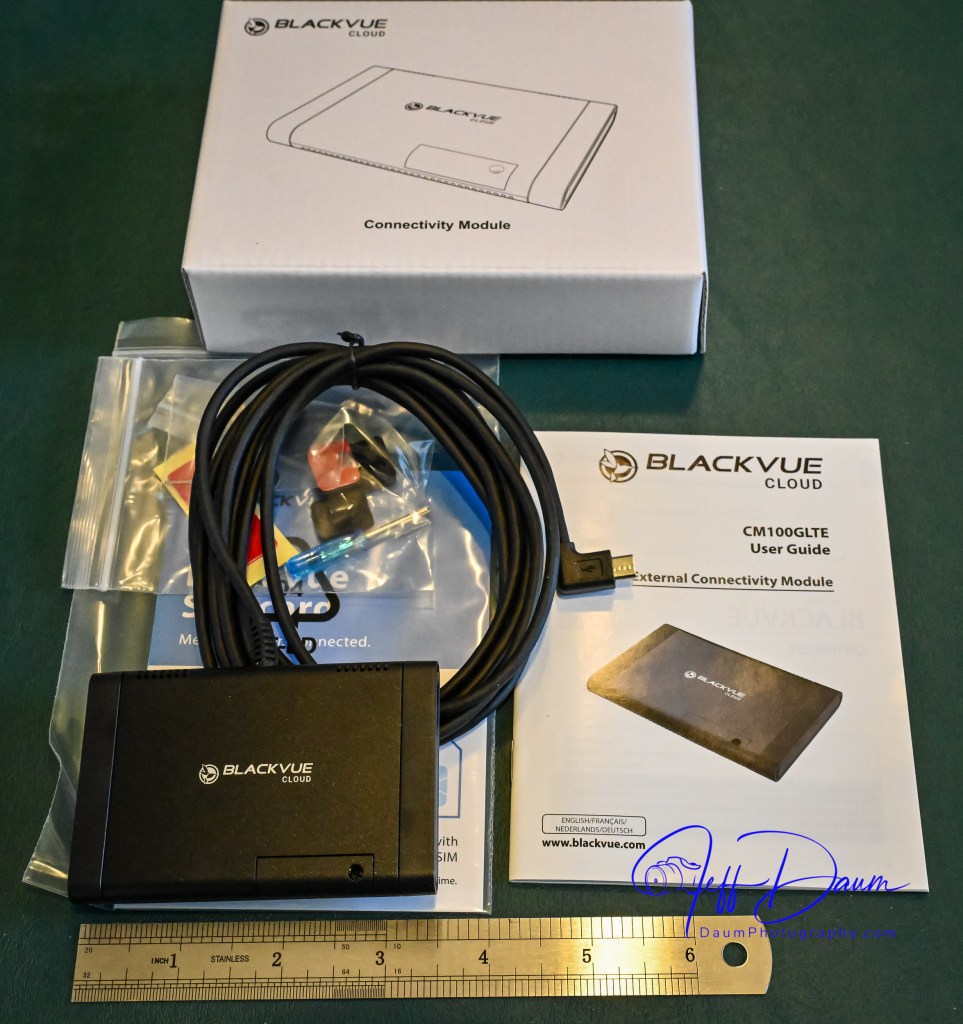
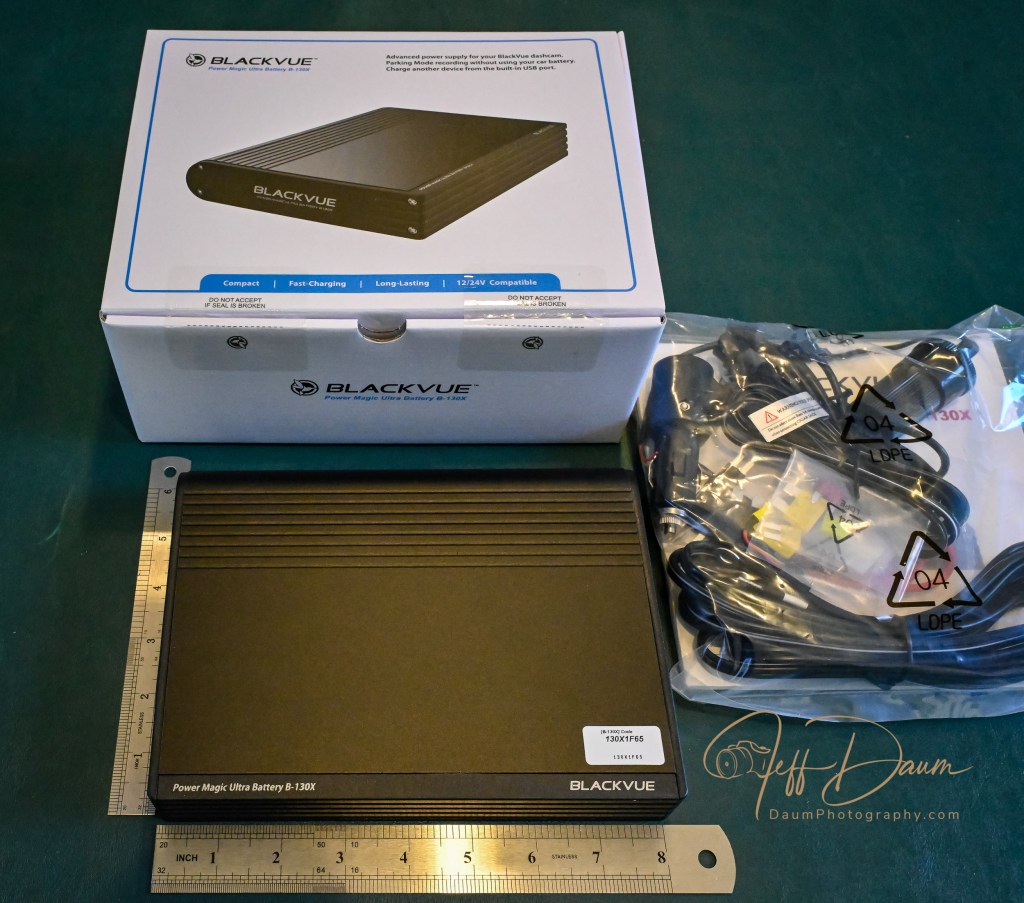
At the same time I tested the DR770X Box-3 channel Pro, I tested BlackVue’s LTE BlackVue cloud Connectivity Module and their B-130X Power Magic Ultra Battery system.

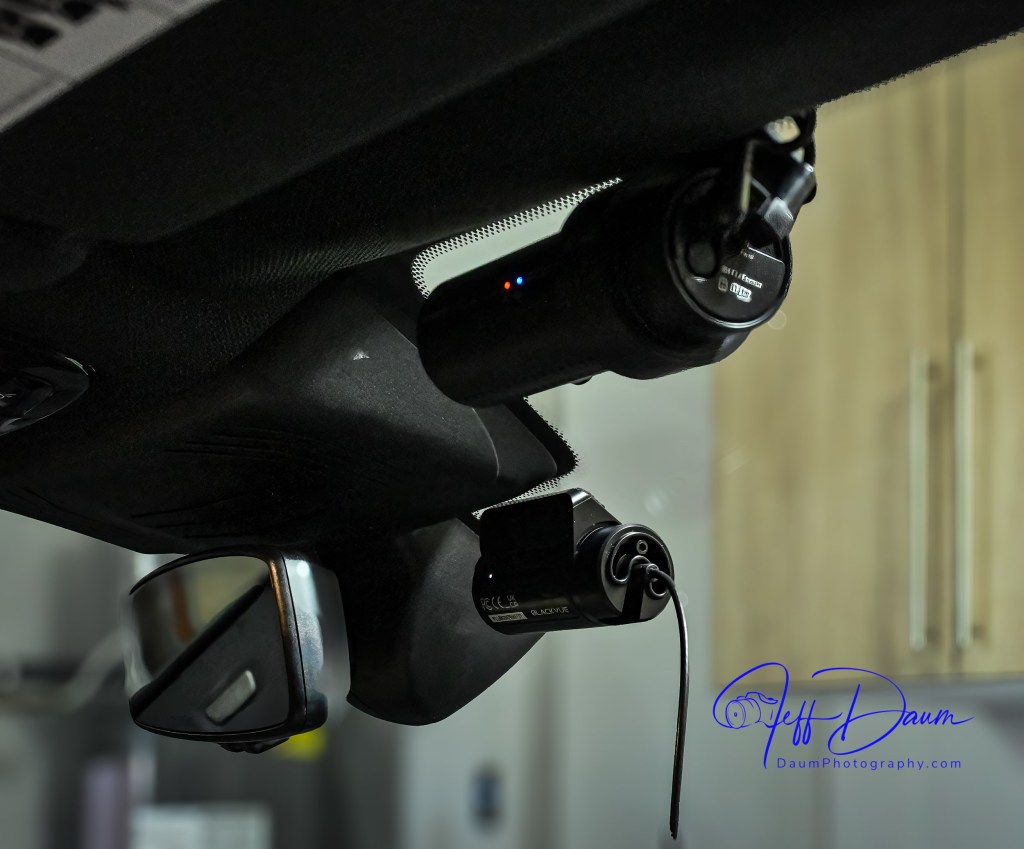
The DR770X dashcams were tested by mounting them in nearly the same perspective on the front and rear windshields as the DR900S, as can be seen in these images.

The main lockable box and B-130X Power Magic Ultra Battery were temporarily placed on the floor, with the GPS module or the LTE BlackVue cloud Connectivity Module antenna temporarily mounted near the top of the windshield.

Field Test

In this as well as all my tests, the images here are unmodified and based on the factory settings, which can be fine-tuned if one wants to.

Here is a look at the front facing cameras during the day.  In this comparison the DR900 images are slightly darker than the DR770.  The DR900 has a wider perspective, meaning you would see vehicles on either side earlier than with the DR770.  Both systems capture solid images along with documenting your position and speed (though you can turn that off in the set-up).  When I looked at enlarged images, the DR900 captures a bit more detail than the DR770.

[Note: a higher resolution video can be seen by clicking on “Watch on YouTube” in the lower left section of each video]

Here is a comparison of the rear facing cameras, with similar conclusions as the front facing cameras. Again, the DR770 has a smaller angle of coverage with its rear facing camera than the DR900S.

Turning to night captures, the front facing DR900 appears sharper with less flare around bright lights than the DR770. 

Looking at the night rear facing cameras, the DR900 has more flare around bright lights than the DR770, but still a bit more detail on examination.

The interior facing camera of the DR770 provides similar quality during the day to the front facing camera, but with a much wider range of 180 degrees.  It captures everything from the driver door to the passenger door and back seat.  This camera includes Infrared LEDs and sensors that automatically come on in low light, providing clear images in total darkness.

The free BlackVue app provides easy access to check on the B-130X remaining power.  If you have the optional LTE Connectivity module connected, the app also allows you to see what your dashcams are seeing, stored recordings, etc.  Even if you do not have the Connectivity module, the app will allow you via WiFi to see what your cameras are seeing and to modify their and the system’s settings.

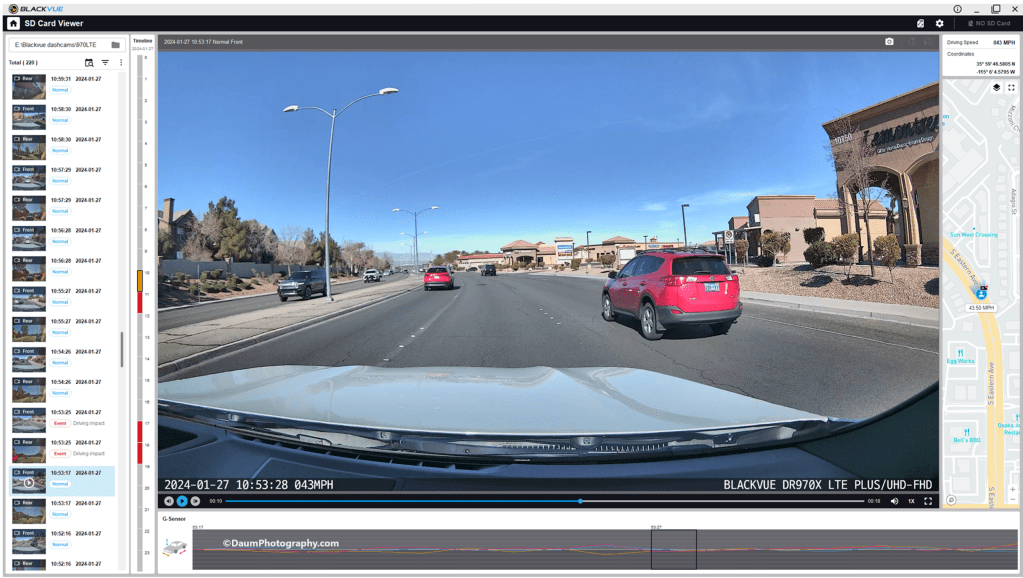
There is also a free BlackVue app for your computer that is very useful.  While you can remove the MicroSD card and view the recordings on your computer without the app, the app offers several real advantages.  When you use the app to view your recordings, it enables you to see all cameras (front, rear and interior) simultaneously as well as providing a sidebar with a dynamic map and GPS position.  Another nice function of the app is it will automatically join the individual recordings one after another, simplifying the viewing.

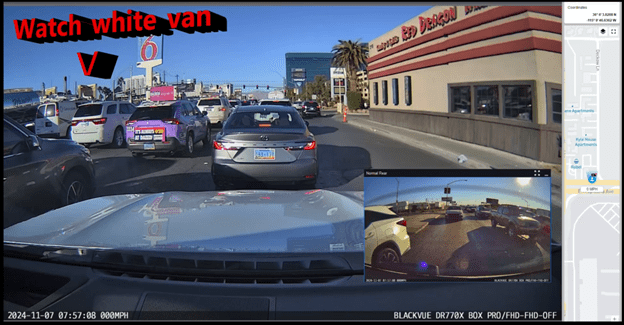
Here is a screen shot of what the BlackVue computer app looks like with the DR770X.  On the right side of the screen, you see a narrow column with a dynamic map showing my vehicle’s position with street names, my speed, and actual GPS coordinates. On the bottom of the screen, you will see a line with date, time, vehicle speed, and the BlackVue camera(s) on the recording.  In the main part of the screen, you see a picture in a picture that has the rear facing camera and the rest is the front facing camera.  You can adjust what is included in the screen.

When you look at the following example from the app, you can see how the map is dynamic, and somewhat amusing, the white van will attempt to cross three lanes nearly perpendicular to the flow of traffic!

Preliminary Field Test Conclusions

Set up of the DR770X was straight forward, especially since this system uses the included wireless button to pair the cameras with the BlackVue phone app.  Once you power up everything, you simply press the wireless button which pairs with the app, and then you use it to confirm the DR770X cameras you installed.  Once that is done, you are all set.  You can use the system immediately or use the app to modify software defaults.

As in prior comparisons, BlackVue continues to produce top line dashcams with the most important features built in.  Of course, quality does come at a price with the DR770X 3CH Pro including a 64GB microSD card retailing at US$474.99.

The Power Magic Ultra Battery B-130X retails at US$359.99. The LTE module retails at US$159.99.

BlackVue customer service has been excellent in responding to any set up questions and/or issues.

The BlackVue DR900S has been in my vehicle for nearly 5 years now and has performed flawlessly in all temperatures from freezing to extreme desert heat. I have no reason to think the new DR770X Box-3CH Pro series won’t perform equally well and it adds the ability to have the IR interior camera along with added security of the locking main box and tamperproof camera mountings.

BlackVue states that you should use their microSD cards for optimal performance. I experimented early on with several non-BlackVue microSD cards (all were name brand high-quality professional level cards, designed specifically for handling the frequent record events typical of security cameras designed for video recording), and while they would work for a period, inevitably they would stop working or have glitches.  Once I went back to BlackVue’s own card I never had it stop working or fail.

These cameras offer pricing plans for saving files to the cloud as well as in the case of the option LTE connectivity module, a built-in SIM card to simplify the recording directly to the cloud.  As noted, it is easy to either download the video files or temporarily remove the microSD card and transfer the files to your computer.

The fit and finish of the new DR770X is excellent and all the components included are high quality.

If you are highly concerned about your vehicle when it is parked and unattended, you should consider purchasing the optional Blackvue Power Magic Ultra Battery.  I was impressed with how it elegantly solves the OEM battery management software issue.  I am adding it to my cars.

A final thought worth repeating from my earlier reviews: Many of my readers have asked ‘Do you really need a dashcam, and if so which one?”  Hopefully this review is helpful in reaching a decision.  For me personally I always want to have documentation of what is going on around my vehicle when I am driving, so all my cars have dashcams and when I rent a car, I put in a portable dashcam before I leave the lot.  I also find it is nice to have videos of scenic drives and the ones from BlackVue are perfect for this.

Thanks for visiting and reading. If you have a question, please feel free to ask below!

Beatbot AquaSense Pro: Clean your pool with a robot every bit as smart as R2-D2!

by Jeff Daum, Ph.D., PPA, Technology & Product Analyst

This is a review of a AI powered pool cleaning robot. Come dive in with me 🙂

Unboxing and Technical Information

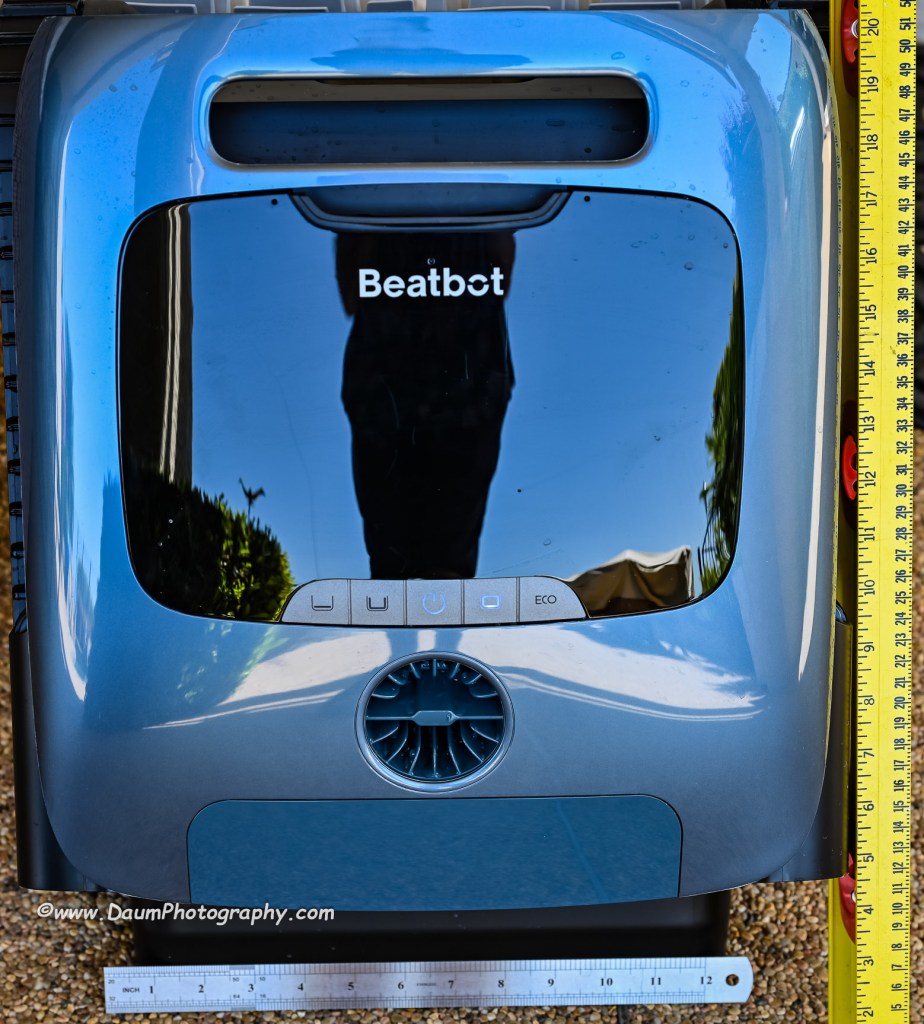
Before answering these questions, let me talk about the unit itself.  It came well packed and protected in a single box.  The Beatbot AquaSense Pro (dry) weight is about 11 kg or around 24 pounds and it measures 451mm x 403mm x 263mm or 17.75 inches x 15.9 inches x 10.4 inches. 

Included in the packing box is a multi-language Quick User Guide (with unfortunately hard to read small gray text on a black background) that runs 2 pages per language, a very legible User Manual that runs 32 pages per language, a compact charging station with attached power cord, and a retrieval hook (not normally needed).

Quick User Guide

It is a very nicely finished product and appears well made.  It has a built-in carrying handle, a push to open cover over the dual filter baskets, a separate cover for the option water clarifying agent kit. LED status light bar, and mode switched/LED indicators.  It comes fully assembled with rubber track wheels and roller brushes.

Highlights from their website:

o        List $2,199 (though they may have a sale on their site)

o        World’s 1st 5-in-1 Cleaning: Clarification/Surface/Waterline/Floor/Walls Powered by 9 Motors.

o        Best Intelligent Path Optimization Powered by Quad-Core 1.8GHz Processor.

o        Industry-Exclusive Intelligent Return to Water Surface and Surface Parking.

o        Powerful Wall Cleaning with Brushless Main-Pump Motor up to 5500 GPH Suction.

o        Effortless Cleaning Control with the Beatbot APP and OTA Software Upgrades.

o        Award-Winning and Eco-Friendly Cordless Submarine Propulsion Design.

o        Superior Cleaning Efficiency and Coverage with 2×2 Independent Roller Brushes.

o        Extreme Safety and Reliability with 15 Certifications, including ETL, CEC, and IP68.

o        Ultimate Convenience with Cordless Charging Dock for Plug-Free Operations.

o        9.5 Hours Surface Cleaning and 5 Hours Floor Cleaning with 10400mAh Battery.

The Quick User Guide suggests that you put the Beatbot AquaSense Pro on the charger stand (plugged in) and allow it to fully charge up.  The charger stand does require easy no tools assembly of the two supporting leg brackets prior to use.

Also, included in the Quick User Guide is a QR code to scan with your smartphone to download the Beatbot app.  Once you download it, you’ll need to follow its setup instructions.  The app is very easy to use and provides you information such as state of charge, the cleaning mode selected (or you want to select) and when the robot is done cleaning your pool and ready to be lifted out.  It will also provide reminder messages such as to clean the filter baskets.

When you are ready to have Beatbot AquaSense Pro clean your pool there are a couple of things to do before putting it in the water.  The manual tells you to (1) turn off your pool (pop-up cleaner, water input from the pool pump) (2) remove any objects including people floating in the pool that can interfere with the multiple sensors, and (3) to place the robot on a level surface by the pool for 5 seconds to allow it to calibrate.  Then you are ready to ease it into your pool.  It will turn itself on shortly after it senses the water and begins the cleaning process depending on the mode you selected. 

You have a choice of five cleaning modes: a Quick mode which cleans only the pool floor once, a Standard mode which cleans the floor, walls and water line once, a Pro mode with cleans the floor, walls, waterline and surface one time, ECO mode cleans the floor every other day (it remains on the pool floor until it cleans it again in two days), and Custom mode.

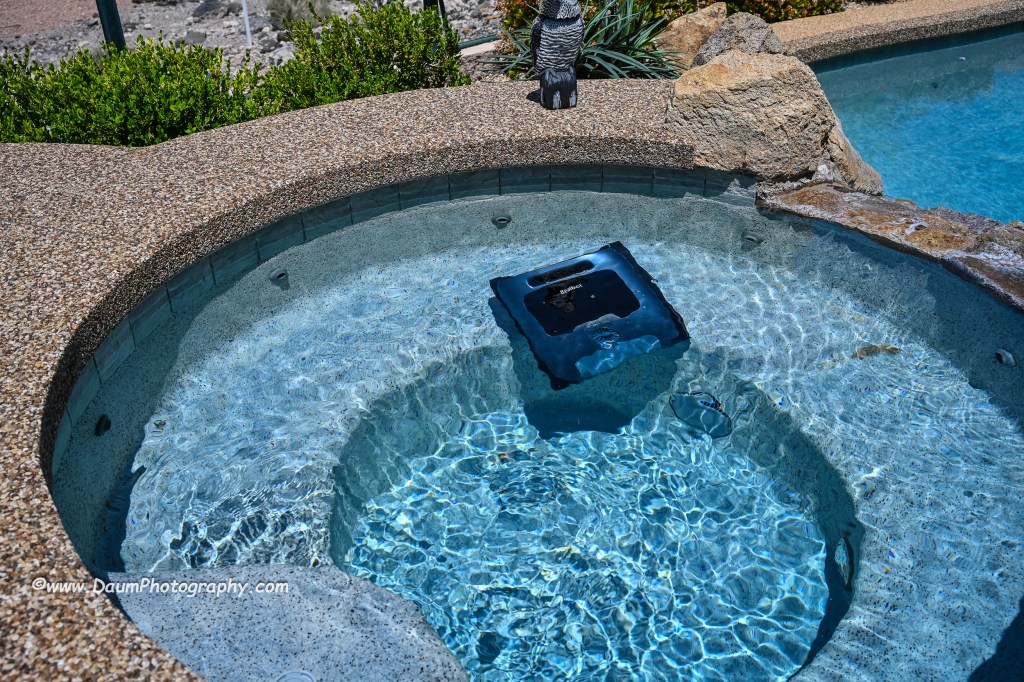
After the robot is finished cleaning, it will bring itself to the edge of the pool and hover there (unless you selected ECO mode) and send you a message via the app.  If you don’t retrieve it for an extended period, it will drop to the pool floor and you will need to use the retrieval hook to bring it back up.  The manual recommends that you slowly remove the Beatbot AquaSense Pro from your pool to allow it to self-drain as you pull it up.  Then you pop open the filter baskets cover and remove them for cleaning using a hose.  When that is done, you can put it onto the charger stand or in my case, move it into our hot tub for it to clean.  It easily cleaned both my pool and the hot tub on a single charge with battery power remaining once done.  It took about 3 to 3 ½ hours for the pool and under 1 ½ to 2 hours for the hot tub on different runs completed during my initial testing. It is virtually silent while cleaning unless it was at the surface where you could hear the water being expelled at a relatively low db level.

Preliminary Results

So, let’s turn to my initial set of questions: How did it handle my free form pool?  In a word- easily!  It had no problem with the fact that it was irregular in shape with curved walls.  The only impact was that the app when the cleaning was finished stated it automatically switched to DeepSense Mode for better cleaning and did not provide a clear graphic of the path it took to do it.  Did it do a good job cleaning?  We live in a dry desert climate so often there are blowing sand and dirt that get into the pool.  I was truly amazed at the amount of sand the Beatbot AquaSense Pro vacuumed up and how noticeably cleaner the bottom of the pool looked compared to just the normal pool filtration system and having the pool manually cleaned once a week. 

Similarly, it did a great job capturing leaves and debris both on the pool bottom and floating on the pool surface. 

Do I think this is something a pool owner would really want or is it just a neat robot?  I think the list price of $2,199 will deter many potential buyers until they see it in action or know someone who has one.  If you pay someone to clean your pool frequently, the Beatbot AquaSense Pro will pay for itself in your first year of ownership.  If you clean your pool yourself, you need to weigh your time and the quality of the job you do versus the ease of having Beatbot AquaSense Pro doing it for you.

If you would like to see a short video of the Beatbot AquaSense Pro in action, click on this link https://youtu.be/k1gVOMtEDKk

Summary

I am extremely impressed with Beatbot AquaSense Pro design and execution.  Lots of pool vacuums and some robots can do a good job on the floor of a pool, but to be able to climb the walls, stairs and landings, and scrub the waterline truly separates Beatbot AquaSense Pro from the field.  It is so easy to use and clean and the results are sparkling, both in the pool and hot tub.  The app is well designed and works every time.  I did not get the optional Clarifying Agent Kit so I can’t speak to its effectiveness.  Since the app has not given any information on water quality, I presume that is dependent on having the Kit installed.  The only hitch experienced so far is that the MemoryPark™ smart return doesn’t always bring the unit back to the starting point, but it always hovers near the wall, so it is easy to retrieve.

Conclusion, I rate Beatbot AquaSense Pro 5 out of a possible 5 waves!

Thanks for visiting and reading. If you have a question, please feel free to ask below! 

The Mirai Speaker: Curving Sound To Enhance Dialog

By Jeff Daum, Ph.D., PPA

While I was at CES 2024 (Consumer Electronics Show) in Las Vegas, Nevada last month I attended the JETRO (Japan External Trade Organization) session.  One of the demonstrations was both at the same time incredibly simple yet producing an almost unbelievable outcome.  It was put on by Sound Fun Corporation of Japan demonstrating the technology behind their new Mirai Speaker.  In essence they developed and patented the AudibleWave™ Technology used in the Mirai that helps produce clear dialog from televisions.  Based on some initial research by a university professor that found elderly individuals could hear music more easily when it was played through an old style gramophone, they spent years perfecting how to curve sound when projected from speakers so that it can be more easily heard and understood.  The demonstration was done using just his unamplified voice either behind a straight piece of plastic sheet or curving the same sheet, so it bowed out in the center towards us.  When he spoke through the straight sheet it was hard to clearly hear him, however, when he curved the sheet, you could easily hear and understand what he was saying.

Here is a similar demonstration from Sound Fun’s website.

Courtesy Sound Fun Corporation

This was intriguing to say the least.  So, when their team offered a Mirai Speaker unit to review I jumped at the opportunity.

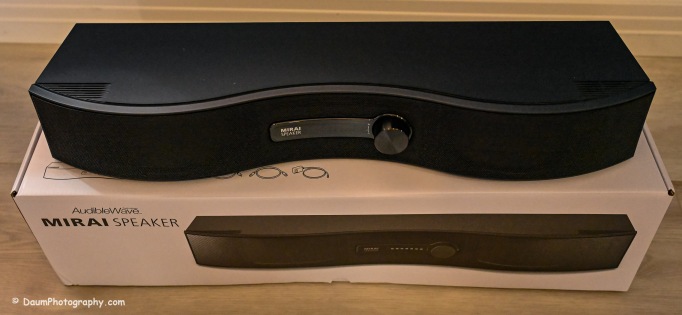
Here is what the Mirai Speaker looks like as unboxed:

The Mirai Speaker is very well made and finished.  The unit weighs 3 lbs. 10.6 oz/1.6625kg and is 21” W x 6” D (at its widest point) x 3.5”H/542mmW x 160mmD x 87mmH.  It was designed and developed in Japan and manufactured in Vietnam.  It retails for US$299.  The unit is well packaged and comes with everything you need to set it up and start using it including a remote with two AA batteries, two means of connecting it to the sound source: Optical cable or analog audio cable, AC power supply and instruction pamphlet.

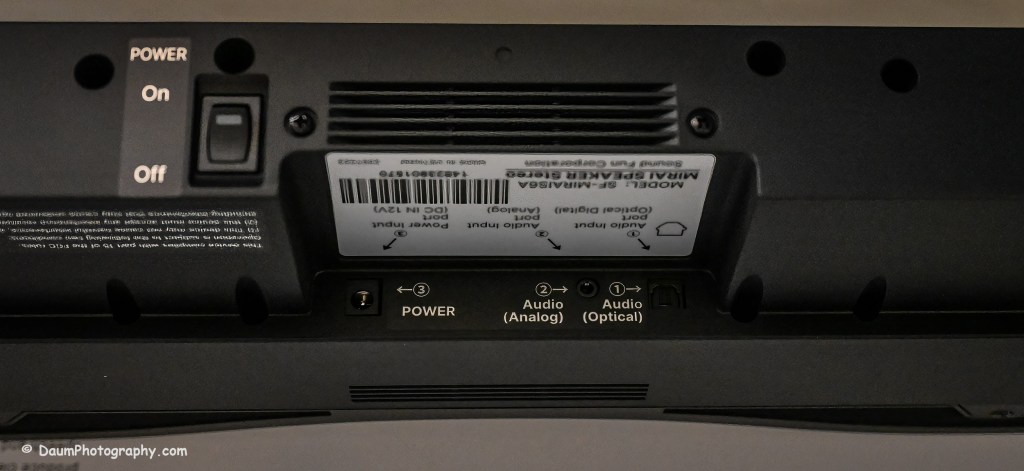
It is primarily intended to be connected to a television using either the optical output or analog output connection.  In addition, the unit needs to have its small power adapter plugged into an AC outlet.  If you use the optical outlet, you have two ways you can listen to the television.  You can use just the Mirai Speaker system or use a balance between the television and the Mirai Speaker. If you use the analog outlet, you cannot use both simultaneously.

Initial Impressions

The setup was straight forward and easy.  Even though the instruction pamphlet states it may take a few days to notice a real difference when using the Mirai Speaker, the effect of their AudibleWave™ Technology was immediately apparent in doing comparisons of just television speakers versus just the Mirai Speaker.  It wasn’t louder but was a cleaner, clearer sound with respect to any dialog.  It will take some time to refine the balance between the regular speakers and the Mirai Speaker for the best overall sound for example, in watching a movie. 

So, in a word does it work? Yes.  I believe this would be a nice reasonably priced addition, when you have one or more individuals in your home with some hearing loss normally associated with aging. I plan on doing more testing and also trying it incorporated into a full surround sound system set up.  Stay tuned!

BlackVue DR970X-2CH Plus and DR970X-2CH LTE Plus Dash Cameras Field Test

By Jeff Daum, Ph.D., PPA

The focus (yes, literally and figuratively 😊 ) of this review is a comparison of two new BlackVue dash cameras, DR970X-2CH Plus and DR970X-2CH LTE Plus, to my current benchmark, the BlackVue DR900S-2CH camera unit.  I reviewed the DR900S in 2020 and found it to be an excellent choice out of the already crowded field of dashcams.  You can see my review here https://insight.daumphotography.com/2020/07/11/product-review-blackvue-dr900s-2ch-field-test/ .  The new DR970X Plus units were provided to me by the Marketing Team of Pittasoft Company, who manufactures the BlackVue units in their own factory in Korea.

Technically speaking based on BlackVue press releases, the DR970X Plus appears to have several improvements over the DR900S including a faster processor chip, improved CMOS sensors, and in the case of the DR970X-2CH LTE Plus, built in SIM card capability.   Top of my interest in carrying out this comparison and review is the DR970X Plus noticeably better in actual day-to-day use?

Before jumping into the field results, here are some of the respective technical specifications.

Physical dimensions:

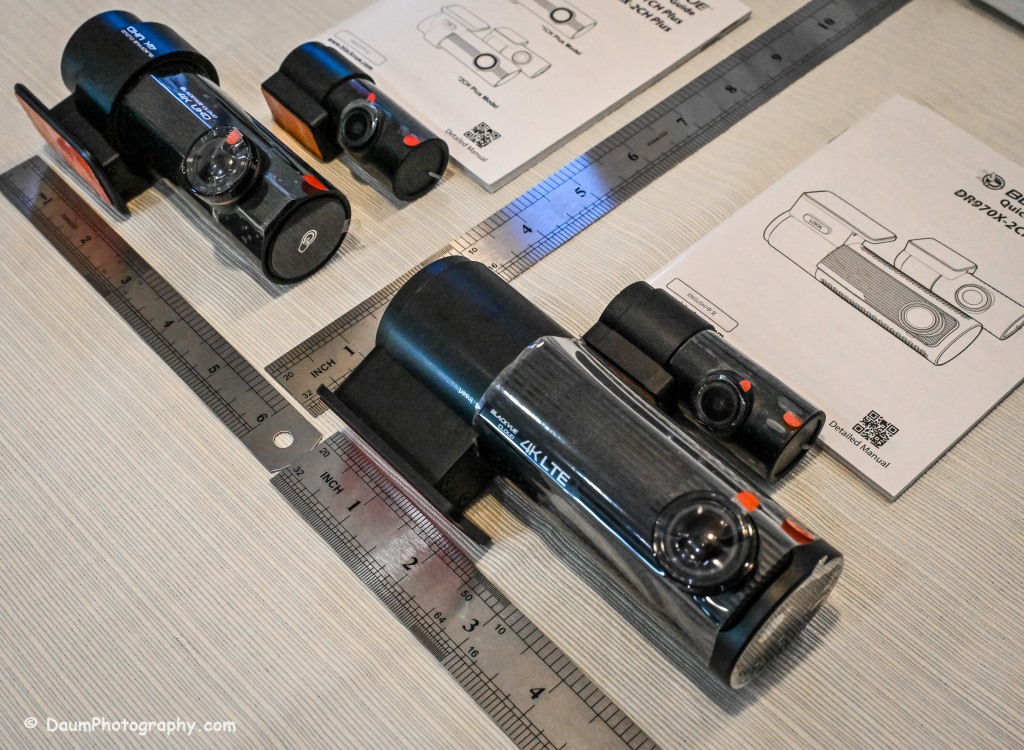
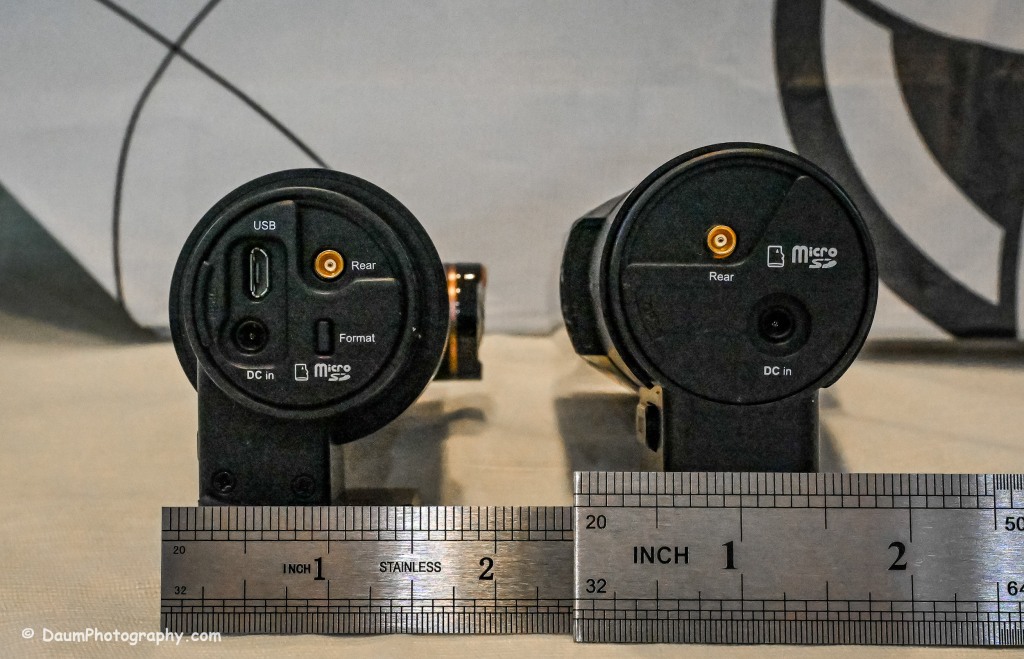
The DR970X-2CH Plus and DR970X-2CH LTE Plus have identical core components, that is, the lens, sensor, chips, etc., with the exception that the DR970X-2CH LTE Plus has a built-in LTE SIM micro card receiver and related circuitry.  This results in the DR970X-2CH LTE Plus being a little larger and slightly heavier than the sister unit.

DR970X-2CH LTE Plus vs DR970X-2CH Plus vs DR900S:

  -Weight with mount: 6.8 oz (192.7g) vs 5 oz (141.7g) vs 4 oz (113.39g)

  -Dimension: 5.42in (137.6mm) L x 2.67in (60.3mm) W x 1.69in (43mm) H vs 4.67in (118.6mm) L x 1.86in (47.7mm) W x 1.4 (36mm) H vs 4.66in (118.5mm) L x 1.4in (36mm) H

The rear camera is essentially physically the same on all three models: 2.6in (66mm) L x 1.1in (27.94mm) D and 1.0 oz (28.35g)

The DR970X Plus and the DR900S are almost the same physical size and weight, with the DR970X-2CH LTE being almost 2 ounces (56g) heavier as well as somewhat longer and rounder than the other two.

The lenses:

The DR970X-2CH Plus cameras (remember, both units are identical with respect to cameras and image capture) have a 125-degree horizontal and 68-degree vertical lens in the front unit, with a 107-degree horizontal and 55-degree vertical viewing angle in the back camera.  The DR900S-2CH camera has a slightly wider capture with a 136-degree horizontal and 77-degree vertical lens in the front unit, with a 116-degree horizontal and 61-degree vertical viewing angle in the back camera.

The resolutions and frame rates are identical for all three units at their highest settings: 3840×2160 @ 30 fps.

Image quality for the DR970X-2CH Plus units is 60+10 Mbps at the highest setting vs the DR900S is 25+10 Mbps, and all three have the same 8+6 Mbps with quality set to Normal.

Compression Codec is the same on all three units: H.265 (HEVC), H.264 (AVC)

Additional technology:

The DR970X-2CH Plus cameras use a STARVIS 2 CMOS Sensor of approximately 8.4 Megapixels on the front camera and a STARVIS CMOS Sensor or approximately 2.1 Megapixels on the rear camera, while the DR900S uses an 8-Megapixel CMOS Sensor on the front camera, and a Sony STARVIS CMOS Sensor of approximate 2 Megapixels on the rear camera.

All three cameras record in 4k UHD front and full HD rear.

All three camera units have built-in GPS but the DR970X Plus has dual band GPS, GLONASS.  They also have built-in WiFi with the DR900 supporting 802.11 2.4 GHz and 802.11 ac 5GHz dual band while the DR970X supports 802.11 a.b.g.n.ac.

All three record automatically when powered up and automatically over-write Normal recordings when the microSD card is full.  They also record and preserve impact detection events that occur while driving and while in parking mode (if powered).  Manual recording is also preserved.  They can take microSD cards from 16GB to 256GB (but strongly recommend only using BlackVue cards- more on this later).  Power is retained for a short period after shut down via built-in Super Capacitors.

All three cameras have a built-in microphone and speaker. One or both can be turned off via the BlackVue app.

All three camera units offer video recording saving to the cloud using optional paid plans, and the DR970X-2CH LTE Plus includes a free one-month trial SIM card and optional paid plans.  However, you don’t have to use the cloud and can either view your saved videos or live images by means of the free BlackVue phone app.  You can also download to your phone or remove the microSD card and transfer the files.  More on this shortly.

Power consumption per hour (really only important if you are using a dashcam in Parking Mode with the engine turned off) as expected, highest for the DR970X-2CH LTE being 590mA/12V in Normal Mode, 430mA/12V in Parking Mode vs the DR970X-2CH Plus at 480mA/12V Normal Mode, 370mA/12V Parking Mode vs the DR900S 380mA/12V in Normal Mode (Parking Mode was not part of the DR900S, so no equivalent power consumption available)

Recorded file size:  The typical DR970X Plus series front camera file size per recording (each is 1 minute in length) is 443 MB and for the rear camera 79.7 MB, while the DR900S file size per recording (1 minute in length) is 188 MB and for the rear camera 81.1 MB.  So, the DR970X Plus files for the front camera are more than 2.3 times larger than the DR900S, while the rear camera files are close in size.  This means that your microSD card is going to hold less than half the videos before it starts over writing as compared to the DR900S.

All come boxed with everything you need for either accessory plug powering or hard wire powering (both sets of power cords included), a starter BlackVue microSD card, connector line for linking and powering the rear camera, plastic trim pry tool, 3M adhesive for the cameras, small self-adhesive wire holders, Quick Start Guidebooks and a set of ‘nifty’ BlackVue stickers.  In my experience, the supplied power lines (hardwire or accessory, and rear camera) are more than adequate for proper setup in most vehicles.

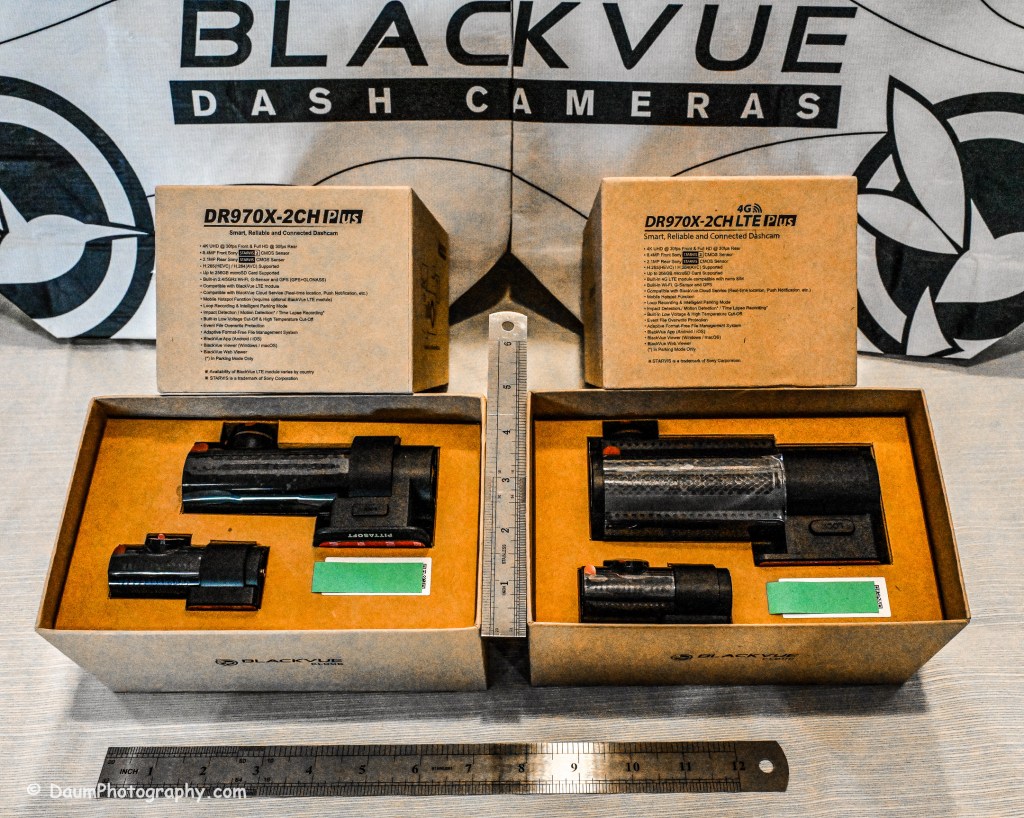
Here is what the unboxing and components look like:

Preliminary Field-Testing Results

Though I will not cover permanent mounting in this review, it is fairly straightforward.  Running and tucking (hiding) the wiring needs some patience and varies from the OEM and type of your vehicle.  For an example you can check out my install in a BMW X3 here https://insight.daumphotography.com/2020/02/19/blackvue-dr900s-2ch-dash-cameras-install/ .   I will be doing a hardwire installation within a few months in a couple of different vehicles- a BMW i4 and a Chevrolet Corvette.  A link will be provided to that when available.  While these cameras all (the DR900S needs the optional Parking accessory wiring component) support automatic switch over to ‘Parking’ recording when hardwired, many vehicles today have battery management software built-in that will either cut the power to the dashcam or cut other non-essential power draws when the vehicle is turned off and the draw exceeds a certain level, to ensure the main battery has sufficient power remaining to start the engine.  You can buy optional battery packs to power a dashcam for a specified amount of time, typically from a few hours to a few days by piggybacking them per manufacturer’s directions.  BlackVue sells them for their cameras as do other organizations.  Currently these battery packs add considerable cost especially if you are looking for several days of parking coverage.  Beyond that, long term parking will require the auxiliary battery packs get recharged either by removing them to charge them or by a solar panel placed in the windshield if feasible.

The videos (MP4) can be viewed and/or downloaded through the excellent (and free) BlackVue app, or you can remove the microSD card and load the files onto your computer.  Again, BlackVue has an excellent app for either PCs or Apple (I will discuss it shortly).  For this review I removed the respective microSD cards and transferred the videos to my PC.  All video captures and still images presented here are not retouched or corrected and appear as recorded.  In some examples I have enlarged or cropped images for easier evaluation.

As I stated in my earlier dash camera review, for most dashcam users, the primary purpose is to document traffic as you are driving.  Dashcams have become popular as a means of providing evidence in the event of road rage and/or an accident.  Ideally the dashcam will capture clear, time and gps marked images, both during daytime and nighttime driving to aid in this objective.  To begin evaluating how well these BlackVue cameras achieve this, let’s first look at a short comparison between the DR970X Plus and the DR900S.

A couple of observations- both BlackVues do well in documenting what is happening. To my eye, the DR900S images are slightly sharper during the day than the DR970X, while the opposite is true of the nighttime images.  This is probably a result of the new STARVIS 2 CMOS Sensor in the DR970X.  I should mention that Pittasoft has indicated a firmware update is planned for the DR970X series, while I don’t know what it will fix, perhaps focus refinement will be part of it.

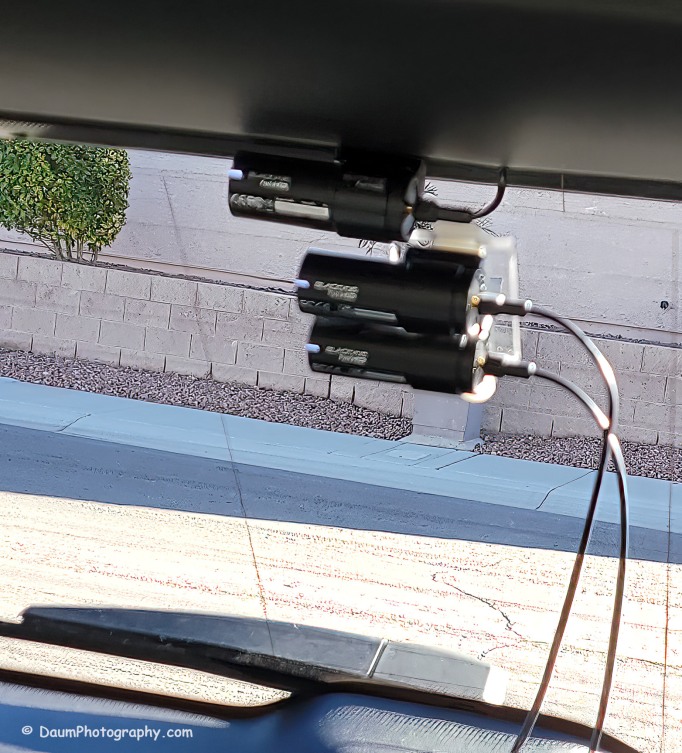
You might be wondering what is in the right side of the DR900S.  That is actually the bracket supporting the two DR970X cameras mounted below. Here is the set up I used:

Here are comparisons between the DR970X Plus and DR900S where you can see both the respective front and rear facing camera views, one day time and one nighttime set:

By the way, those simultaneous front and back views were generated using the free BlackVue PC app.  It is a very easy to use application that also can show each video along with a GPS location on a dynamic map, as well as a g sensor graph.  The g sensor shows any impact or bumps/rough road (which will also result in the video getting an “Impact” vs “Normal” label.  Here is what it looks like:

Here are some still images with the DR900S on the left and DR970X on the right:

Front camera

Rear camera

As with the videos, the greatest difference between the DR900S and DR970X is in the nighttime comparisons.  All images are viable straight from the respective cameras and could, if necessary, be sharpened with editing software.  One real advantage of the DR970X Plus series is that the WiFi is always on and that allows you to quickly view any saved or live images using the BlackVue app on your phone.  For the DR900S you have to turn on the WiFi at the front camera unit by pressing a button until it turns on (and it will automatically turn off in a few minutes).  Once turned on you can then link to the camera using the app.

Summary

As in prior comparisons, BlackVue continues to produce top line dashcams with the most important features built in.  Of course, quality does come at a price with the DR970X 2CH Plus including a 64GB microSD card retailing at US$474.99 and the DR970X LTE 2CH Plus including a 64GB microSD card, SIM card with a free trial of 1GB for one month retailing at US$544.99.  The BlackVue DR900S has been in my vehicle for four years now and has performed flawlessly in all temperatures from freezing to extreme desert heat. I have no reason to think the new DR970X Plus series won’t perform equally well. 

BlackVue states that you should use their microSD cards for optimal performance. I did experiment early on with several non-BlackVue microSD cards (all were name brand high-quality professional level cards, designed specifically for handling the frequent record events typical of security cameras designed for video recording), and while they would work for a period, inevitably they would stop working or have glitches.  Once I went back to BlackVue’s own card I never had it stop working or fail.

These cameras offer pricing plans for saving files to the cloud as well as in the case of the DR970X Plus LTE, a built-in SIM card to simplify the recording directly to the cloud.  As noted, it is easy to either download the video files or temporarily remove the microSD card and transfer the files to your computer.

The fit and finish of the new DR970X Plus is excellent (as was the DR900S) and all the included components are high quality.

If you are highly concerned about your vehicle when it is parked and unattended, you should consider purchasing optional battery packs to power the dashcam when the engine is off. One option is BlackVue’s Power Magic Battery Pack (US$159). It is designed for plugging into your accessory outlet and in turn your dashcam.  It provides about 12 hours of front camera recording or about 7.6 hours of front and rear camera recording.

A second option is to purchase Blackvue’s Power Magic Ultra Battery (US$389.99).  It is designed for either accessory plug or hardwire installation and then connection to your dashcam.  The Ultra unit is a high-capacity rechargeable unit that provides about 30 hours of record time for just the front camera, or about 19 hours record time with both front and back camera recording and can be piggy-backed to increase the total record time while parked.

Final thoughts:  Many of my readers have asked ‘Do you really need a dashcam, and if so which one?”  Hopefully this review is helpful in reaching a decision.  For me personally I always want to have documentation of what is going on around my vehicle when I am driving, so all my cars have dashcams and when I rent a car, I put in a portable dashcam before I leave the lot.  I also find it is nice to have videos of scenic drives and the ones from BlackVue are perfect for this.

Thanks for visiting and reading. If you have a question, please feel free to ask below! 

ZHIYUN Weebill 3S gimbal camera stabilizer: Steady As She Goes

By Jeff Daum, Ph.D., PPA

Simply put, a gimbal stabilizer is intended to help take videos minimizing movement created by the way you hold the camera while shooting.  If you have looked at adding a gimbal stabilizer to your equipment, you found an abundance of options out there.

This review is of the new Weebill 3S and how ZHIYUN designed it to stand out from the rest of gimbal stabilizers.  The unit was provided to me by ZHIYUN and GlobalPR.

What Is In The Box

When you order the Weebill 3S it is shipped directly from Hong Kong to you and the price includes free shipping and no additional custom’s duty and import taxes.  In my case it arrived quickly and in excellent shape.  All components are well packed.

There are two options when you place your order: the basic Weebill 3S at US$319 or the Weebill 3S Combo at US$439.  ZHIYUN is offering a 10% off discount code for my readers. Links are provided in footnote at the bottom for orders from their site or Amazon.1 I recommend the combo over the base since it includes the extension handle and wrist support which make the unit much more manageable.  Both come with the same warranty: free replacement or repair for quality defects within 15 days of receipt of product. Free repair from ZHIYUN for defective material or workmanship that results in product failure for 12 months from date of selling.

Included in the box is a heavy duty nicely designed case that can hold the Weebill 3S and all of its components as well as your camera and lens.  Though, if you are like me, you already have multiple camera cases and probably won’t end up using the ZHIYUN case.

The components (image above) include #1 the Weebill 3S, #2 the extendable Sling Grip and Trans Mount Wrist Rest, #3 assorted cables for direct connection to different OEM cameras, #4 the Quick Release plate, Camera Backing Base, M4 wrench and ¼” screws, #5 Tripod base and Quick Start Guide.

The first step was to download the user manual from ZHIYUN ( https://www.zhiyun-tech.com/en/download/instruction/617?type=website&page=download_software&source=instruction ) and charge up the Weebill 3S (NOTE: as with many electronics today, no USB charger was included with the Combo.  Any USB C phone charger 14 W PD or less will do).  It takes about two hours from empty to full charge, with the state of charge showing on the small built-in screen.  Based on how you use the unit, the charge can last up to 11 hours.

Putting the components together was fairly straightforward.  NOTE: When assembling the quick release plate to the camera, the provided ¼” screw will only fit into the end of the center slot on one side- the end which has ZHIYUN printed on the underside.  It takes a few tries to get the screw to perfectly match the threads in the plate.  The same is true when putting the screws into the camera backing base.  The screws will only thread into the end of the backing base which has ZHIYUN printed on the underside.  You’ll use the provided M4 wrench to tighten the screws.

The main unit weighs 2 lb. 4.2 oz (1.026 kilograms), adding on the extension handle, tripod and mounting plate brings it to 3 lb. 13.8 oz (1.752 kilograms).

For my testing, I used a Nikon Z7 mirrorless digital camera and a Nikkor 50 mm 1.8 S lens.  This camera and lens were listed on ZHIYUN’s compatibility chart.   The actual weight of the Nikon with lens came to 2 lbs. 7.6 oz (1.1226 kilograms).

Once you get the Weebill 3S fully assembled and your camera and lens mounted, connect your camera to the Weebill 3S using one of the supplied USB cables.  Later you can potentially use a Bluetooth connection.  In my case, the Bluetooth connection would not work.

Next you will need to go through the balancing steps for each of the gimbal’s three axes.  Especially If you are new to gimbals know this is a critical step that must be completed carefully to ensure that the gimbal will work properly. 

NOTE; If you are new to using gimbals, I encourage you to watch some ZHIYUN’s videos https://www.zhiyun-tech.com/en/service/support/617/3/show?type=website&page=second_nav&source=service2#/pages/index/support/videoPage   Here is another one that is particularly helpful: https://www.youtube.com/watch?v=BzmKhXDjf2k&ab_channel=MamoAir  

The above-mentioned videos will walk you through the process including how to update the Weebill 3S software.  If you haven’t balanced another gimble in the past, you may find it frustrating the first time, but it gets easier after just a few attempts.

NOTE: the Weebill 3S is very sensitive to the slightest change in camera/lens combinations, so be sure to remove your lens cover, and have your battery and memory card inserted before doing the balancing.

After getting your camera and lens balanced, you need to allow the Weebill motor software to make final adjustments (again as mentioned in the ZHIYUN videos above).  Now you are ready to go.

INITIAL FIELD TESTS

My first test was to shoot a static object while moving around it.  For comparison I shot the scene twice, once using the Nikon on the Weebill 3S and a second time hand holding the Nikon, trying to shoot the scene as close as possible to the first time.  This would attempt to partially answer “is a gimbal set up worth it for simple videos?”

In this and the following videos, the top frame video is always the one taken using the Weebill 3S and the bottom frame video is the handheld without the use of the gimbal.  Physically for this the camera and lens are sitting on top of the Weebill 3S in the three axes gimbal set up, and you are holding it with two hands by a combination of the Weebill 3S body and either the tripod or sling grip.

As can be seen there is movement generated by the camera in both versions, but the top frame one which used the Weebill 3S has noticeably less camera induced movement.

Next test was replicating shooting a video while both you and the target are moving.

Again, there is movement generated by my moving in both versions, but the top frame one which used the Weebill 3S has less movement caused by my walking while videoing.

This next test was of the Sling Mode, where the Sling Grip is moved so that the camera and Weebill 3S are under the Sling Grip.  This setup allows for capturing images/video from a perspective starting at or near the ground/floor.  The Weebill 3S and camera are actually more easily supported by just one hand lightly on the Sling Grip.

This Sling setup resulted in very little camera movement and a perspective that would have been difficult to duplicate without the Weebill 3S unless you were lying down on the floor holding the camera.

The Weebill 3S comes programmed with several cinematic features to enable creative shots.  It can be easily set to PF or pan follow, POV point of view, F follow, L gimbals locked, and V vortex mode.  Each mode locks or unlocks individually one, two or all three axis. You can also remotely control its movement via the ZYPlay app. Here is a brief example of Vortex mode:

A fun effect that would be very difficult to duplicate without the Weebill 3S!

PRELIMINARY CONCLUSIONS

Some thoughts/suggestions:

  • ZY Play app requires your scrolling through and agreeing to a User Agreement that ran on for about a dozen screens on Android and second agreement of about ten more screens.  This one appears to be written by a legal team that never had to read it on a phone screen. Why not have a simplified agreement?

Here is just one of the extensive sets of screens.

  • Earlier production units included a magnetic key that was attached to the underside of the camera mounting bracket and could be used for tightening the attachment screws.  That is no longer provided.  However, an Allen wrench is provided to serve the same purpose.  Either go back to the magnetic key or have an attachment place on the Weebill 3S body for the wrench so it is at the ready in the field.
  • A more significant change at this stage of production occurred with the Camera Backing Base.  This used to be a Quick Release Base.  Now the Camera Backing Base attaches to the camera body with one ¼” screw and the use of the M4 wrench.  In turn, the Camera Backing Base attaches to the larger Quick Release Base using two ¼” screws and the M4 wrench.  What this means is that you can’t just release the Camera Backing Base as with previous versions but must either unscrew the base from the Quick Release Base or release and slide out the Quick Release Base to remove the camera.  When you go to replace the camera, this ends up resulting in it being in a slightly different balance point and requires the rebalancing of the Weebill 3S before proceeding.  Fortunately, I found that it normally only required the rebalancing of one of the axes.
  • At least for use with the Nikon Z7, you have to remove the camera still attached to the quick release plate to change the battery and/or the memory card.  Consider a raised camera base plate that will allow changing the battery without having to remove the camera.
  • Suggest getting a spare M4 wrench if you don’t have one handy.

Positives:

  • The Weebill 3S appears to be very well constructed and feels solid.  I had no concerns about my camera suddenly dropping off or swinging wildly out of control.
  • The Weebill 3S has a built-in LED light that you can adjust in terms of intensity from 1000 lux down, and color temperature ranging from 2600k to 5500k.  It is a very handy fill light when needed.
  • It is ergonomically designed to allow easy access to the menu options (visible on its building screen), change operating modes, turning on and off the built-in LED light, starting and stopping your camera’s recording, etc.  The front rotary switch also can be user programmed.
  • Tripod extension is very useful as both an extension of the grip and to set the Weebill 3S and attached camera down on a flat surface without it tipping over.  It can also be used to perform super smooth panorama shots either manually or through the ZY Play app automatically.
  • The quick release allows for easy change from landscape to portrait orientation with minimal or no rebalancing needed.

In Summary

I think that ZHIYUN has done an admirable job of setting this Weebill 3S three axes gimbal apart from its competition.  It is very well made, compact and reasonably lightweight.  The Weebill 3S comes loaded with usable features that will enhance your videos along with reducing shake caused by how you hold your camera and move.  Just be sure that your intended camera and lens are on the ZHIYUN compatibility chart.  Based on how sensitive I found the Weebill 3S to the positioning of my Nikon and lens, I think even though it is on the compatibility chart it was near the top limit of the Weebill’s motors.

I hope you found this useful. Please let me know if you have any questions!

Cheers

1 To obtain the 10% discount use the code DaumWB3S.
And one of these purchase links:
ZHIYUN official store: https://geni.us/wb3s_str_dp

ZHIYUN Amazon: https://geni.us/AMZ-WB3S-PR-Daum

Too many electronic chargers to keep straight? Time to get a FLEDGING Spruce® all-in-one Charger

If you are like me, as you accumulated personal electronic devices like your phone, ear buds, laptop, smart watch, etc., you ended up with a gaggle of chargers.

In many cases the chargers were designed to work with a specific device and therefore have a different end (C, micro usb, Lightning) and item specific voltage output.   When you took a trip, you had to remember to bring each one.

This brings us to the FLEDGING Spruce® all-in-one Charger, supplied to me by their Head of Marketing for review.[1]  The Spruce is a compact charger unit capable of charging up to five devices simultaneously, quickly, and all at the proper voltage.


By my measurements the unit is 4.33”x3.15”x1.89” (110.2mm x 80.1mm x 48.1mm) and weighs 1lb 0.8 oz. (475g).  It comes standard with the country specific power cord (type A, C or G) you select when ordering, a C to C cable, soft carry case and instructions.

Designed in the USA, the unit is manufactured in China.  It lists for USD 124.99 on their website.[2]

The fit, finish and quality of build is excellent.

The compact unit has a phone or tablet wireless charging pad on top that can be used flat or raised up to 70 degrees, 3 USB C and 1 USB A ports on the side.


On the back of the unit is a schematic showing the relative outputs in wattage for each of the ports. 

The Spruce is powered by a GaN (Gallium Nitride) semi-conductor with software that provides the appropriate wattage for each plugged in device.

Included with my Spruce was FLEDGING new magnetic power cable.  This very clever cable has a male USB A connector on one end and a magnetic port on the other that accepts interchangeable connectors of either C, Lightning or micro USB.  Additionally, the cord has magnetic rings on it so that it coils and holds to itself when not stretched out.

I was informed that this FLEDGING new magnetic power cable will available later this year as an optional addon to the Spruce.

Field Test:

You will find the instruction manual is not necessary, since all you need to do is plug in the power cord and your respective cords to your electronic devices and/or place your phone or tablet on the charging pad and you are good to go.

I used it to simultaneously charge an iPhone, iPad, 2 sets of ear buds, and laptop.  The Spruce remained cool and charged each of the 5 electronic items to 100% as quickly as their individual rapid or quick chargers normally do.  Simple, highly efficient and eliminates all the respective chargers as well as having to find either 5 available outlets or the use of a multi-outlet power strip.

The compactness of the unit can’t be beat versus having five individual chargers.  Now you might be wondering about the fact it weighs in a about a pound or 475 grams.  Sure, that is more than a single phone charger weighs, but when you put all the respective five chargers (phone, laptop, tablet, ear bud, etc.) you would need together, you will find they will be close to a pound or 475 grams or even more, in total weight.

Conclusion The FLEDGING Spruce is a welcome solution to simultaneously charging multiple electronic units from one source. Very well designed and constructed with easy functionality. 

It earns 5 out of a possible 5

[2] https://fledging.tech/products/spruce-charger

[1][For my reviews of other FLEDGING products see

https://insight.daumphotography.com/2021/02/03/fledging-shell-slim-external-nvme-pcie-ssd-review-small-and-super-fast/

https://insight.daumphotography.com/2021/01/27/fledging-shell-thunder-thunderbolt-3-ssd-external-storage/ ]